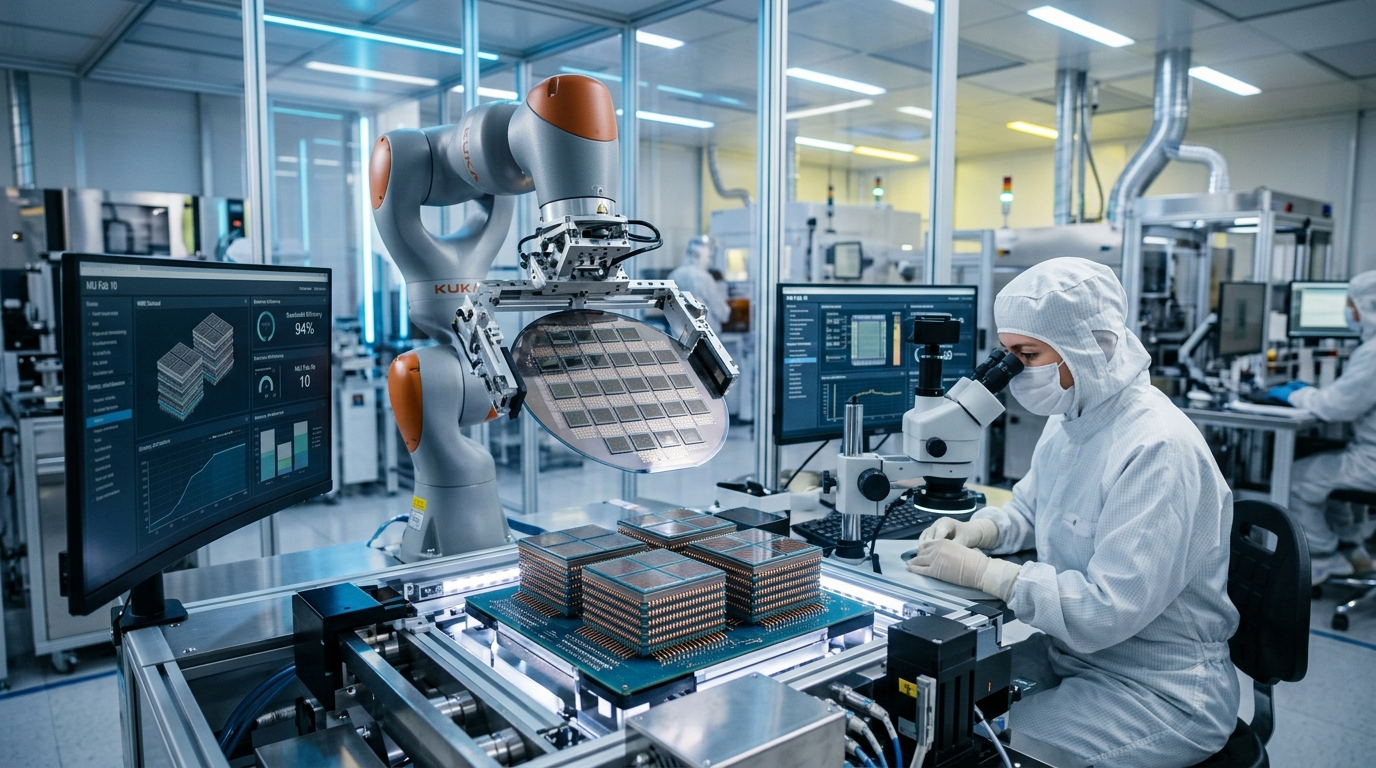
Something unusual is happening inside the memory chip market. A business that spent decades defined by brutal boom-bust cycles is suddenly behaving like a premium, contracted infrastructure play. That shift has a name: high-bandwidth memory. And Micron Technology (NASDAQ: MU) may be the most direct way to own it.
Wall Street woke up to this in a serious way just this week.
MU surged over 20% on May 26 alone — a move that took the stock from around $542 at the start of May to a close near $908 — as a cascade of analyst target hikes hit the tape simultaneously. Melius Research blasted its target from $700 to $1,100. CFRA nearly doubled its call from $500 to $900. Citigroup raised to $840. HSBC went to $1,100. That kind of coordinated repricing isn’t noise — it signals a structural re-rating of what Micron’s earnings power actually looks like in an AI world.
Here’s what’s driving it.
Micron’s fiscal Q2 2026 revenue surged 196% year-over-year to $23.86 billion, with a gross margin of 74.9% and non-GAAP EPS of $12.20 — blowing past the Street’s $8.79 estimate by nearly 39%. For Q3, the company guided revenue of $33.5 billion with non-GAAP gross margins of approximately 81%. Those are not memory company numbers. Those are software company numbers wrapped in silicon.
The core catalyst is HBM3E — Micron’s high-bandwidth memory product that sits at the center of every AI accelerator stack. The company’s entire 2026 HBM output is already committed under long-term contracts. Sold out. Fully booked. Melius Research framed MU and other “bottleneck” memory names as long-term winners positioned to absorb market cap from traditional software, which is a provocative but increasingly defensible thesis.
Management forecasts HBM’s total addressable market growing from roughly $35 billion in 2025 to approximately $100 billion by 2028 — a timeline that’s been pulled forward by two years from prior estimates. Micron is one of only three companies globally capable of producing this memory at scale, alongside SK Hynix and Samsung. That’s a moat the market is still pricing in.
The Numbers Worth Knowing
- Q2 FY2026 revenue: $23.86B, +196% YoY
- Gross margin: 74.9%
- Q3 FY2026 guidance: $33.5B revenue, ~81% gross margin
- Data Center revenue growth (Q2): +150% YoY
- HBM supply through 2026: Fully contracted under multi-year agreements
- Capital expenditure commitment: $25B+ in fiscal 2026 across fabs in Idaho, New York, Japan, Singapore, India, and Taiwan
There’s a slight tangent worth noting here: the capex number initially spooked some traders on earnings night. $25 billion is a lot to spend. But when Q3 guidance came in at $33.5 billion in revenue with 81% gross margins, the math became obvious quickly — and the stock recovered.
Risks exist. This is still memory, which means Samsung and SK Hynix are both investing aggressively. Supply expansions could eventually normalize margins post-2027. And the stock’s current valuation reflects significant optimism — consensus FY26 EPS is around $58, with the base case now sitting in the $900–$1,000 range. If AI capex moderates or hyperscalers pause infrastructure spending, MU would feel it fast.
But here’s the part people tend to skip: multi-year HBM contracts fundamentally change the risk profile of this cycle. When your customers are prepaying and locking in supply years in advance, the old commodity playbook doesn’t apply. This isn’t the boom-bust memory trade of 2019. AI workloads don’t have an off switch.
Whether MU reaches $1,100 or consolidates near current levels, the core argument — that AI permanently re-rated the memory market — appears to be playing out in real time. Worth a closer look before the Q3 print on June 24.