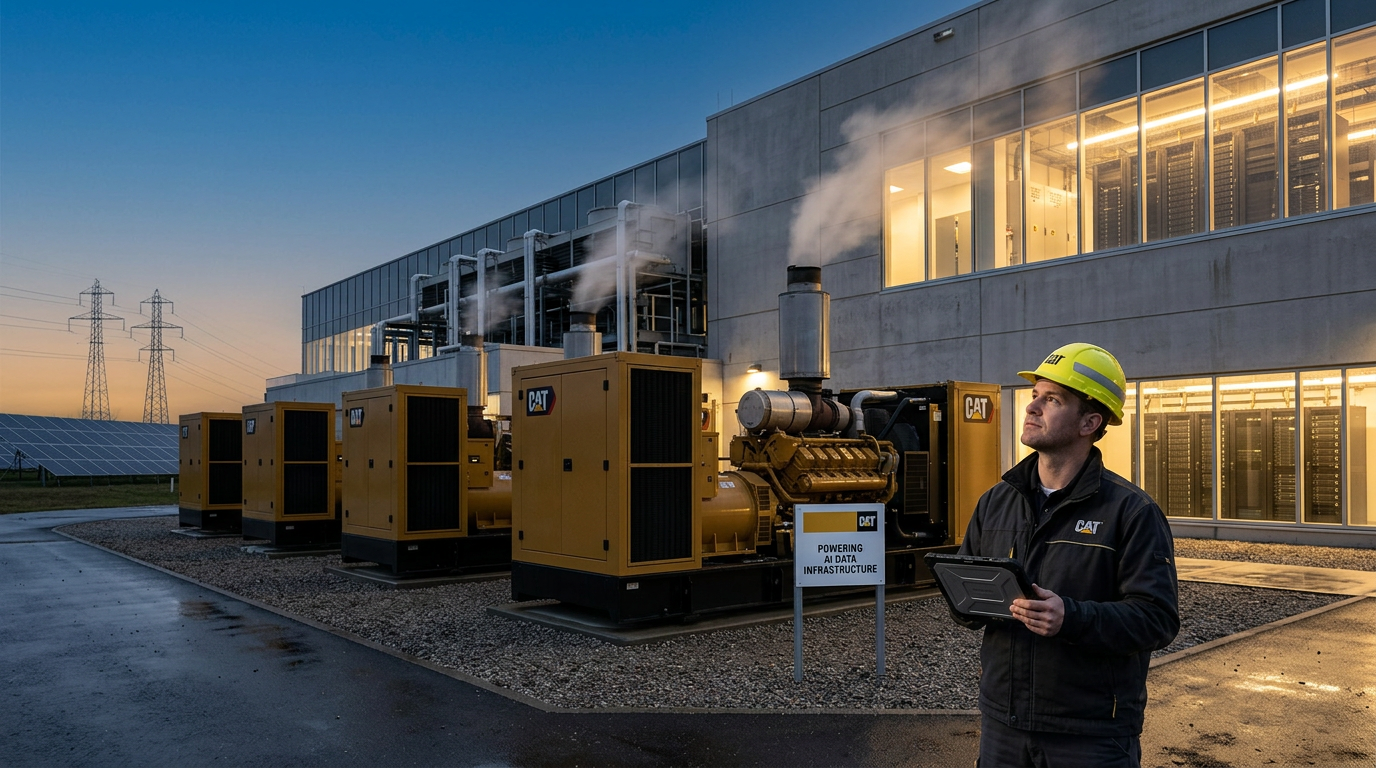
Here’s something the market took a while to figure out: the most consequential AI infrastructure company might not be a semiconductor firm. It might be the one making the giant gas turbines that keep data centers running.
Caterpillar (NYSE: CAT) has been on a tear in 2026 – up roughly 58% year-to-date and more than 160% over the past year. And while most people still picture yellow construction equipment when they hear the name, something much more significant is happening inside this company right now.
The Power & Energy division is quietly becoming the center of gravity for the entire business.
The Numbers Are Hard to Dismiss
In Q1 2026, Caterpillar reported revenues of $17.4 billion, up 22% year-over-year. Adjusted EPS came in at $5.54, a 19% beat versus Wall Street’s consensus of $4.64. Those aren’t small misses. That’s a company outrunning expectations on both the top and bottom line simultaneously.
But the number that really matters is the backlog. At Q1 earnings, CEO Joe Creed confirmed that total enterprise backlog hit a record $63 billion, up 79% year-over-year. The Power Generation portion of the Power & Energy segment has been a notable contributor, including demand tied to data center applications. Management also raised long-term growth targets, including a higher power generation sales target for 2030.
Slight tangent, but worth noting: CAT also hiked its quarterly dividend by 8% to $1.63 per share. That’s not a company managing a cyclical downturn. That’s a company signaling confidence in multi-year cash flow.
What’s Actually Driving This
Data centers need power – enormous amounts of it, and they need it fast. Grid connections can take years. Caterpillar’s large reciprocating engines and industrial gas turbines can provide on-site power generation at scale, right now.
A recent framework agreement with ProPetro’s PROPWR business involves a commitment to purchase at least 1.5 gigawatts of Caterpillar power generation assets, with an option to increase to approximately 2.1 gigawatts over five years.
And in November 2025, Caterpillar partnered with Vertiv to expand end-to-end power and cooling offerings for AI data centers, including the use of predesigned, modular reference architectures to speed deployments.
The company also plans to grow large reciprocating engine output to more than 3x 2024 levels by 2030, a capacity expansion that signals management sees this demand as structural, not cyclical.
The Part That Changes the Valuation Debate
CAT is no longer trading like a cheap industrial. The market is paying a premium for this business – and the debate now is whether that premium is justified by what the backlog implies about future earnings.
Oil and gas sales grew 13% in Q1 2026, driven in part by reciprocating engines used in gas compression applications. The Power & Energy segment delivered a 20.6% profit margin in the quarter – down from the prior year, with Caterpillar citing higher tariff costs within manufacturing costs, but still generating meaningful profitability at scale.
The Risks Are Real
- Valuation: After a 160%+ run in one year, CAT’s multiples are elevated relative to historical norms. Some analysts flag the stock as potentially overvalued at current levels.
- Tariff pressure: Trade policy continues to create cost uncertainty across manufacturing segments.
- Cyclical exposure: Construction and mining still make up a meaningful portion of revenue, and both are sensitive to a slowing economy.
- Execution risk: Scaling large engine capacity is an ambitious plan. Delays or cost overruns would weigh on margins.
The Bigger Picture
What’s interesting is how few people are framing this correctly. The story isn’t just that CAT benefits from AI infrastructure spending. The story is that Caterpillar may be one of the companies capable of delivering power generation at the scale and speed that hyperscalers actually need right now. Grid infrastructure isn’t keeping up. Caterpillar’s hardware fills that gap directly.
Whether you think the stock is fully valued or not, the business is clearly at an inflection point. The question isn’t whether AI is driving demand – it obviously is. The question is how long Caterpillar holds this position before the market finally, fully prices it in.
Worth watching closely.
This editorial is for informational purposes only and does not constitute investment advice. Past performance is not indicative of future results. All financial data referenced should be independently verified before making investment decisions. Investing involves risk, including possible loss of principal.