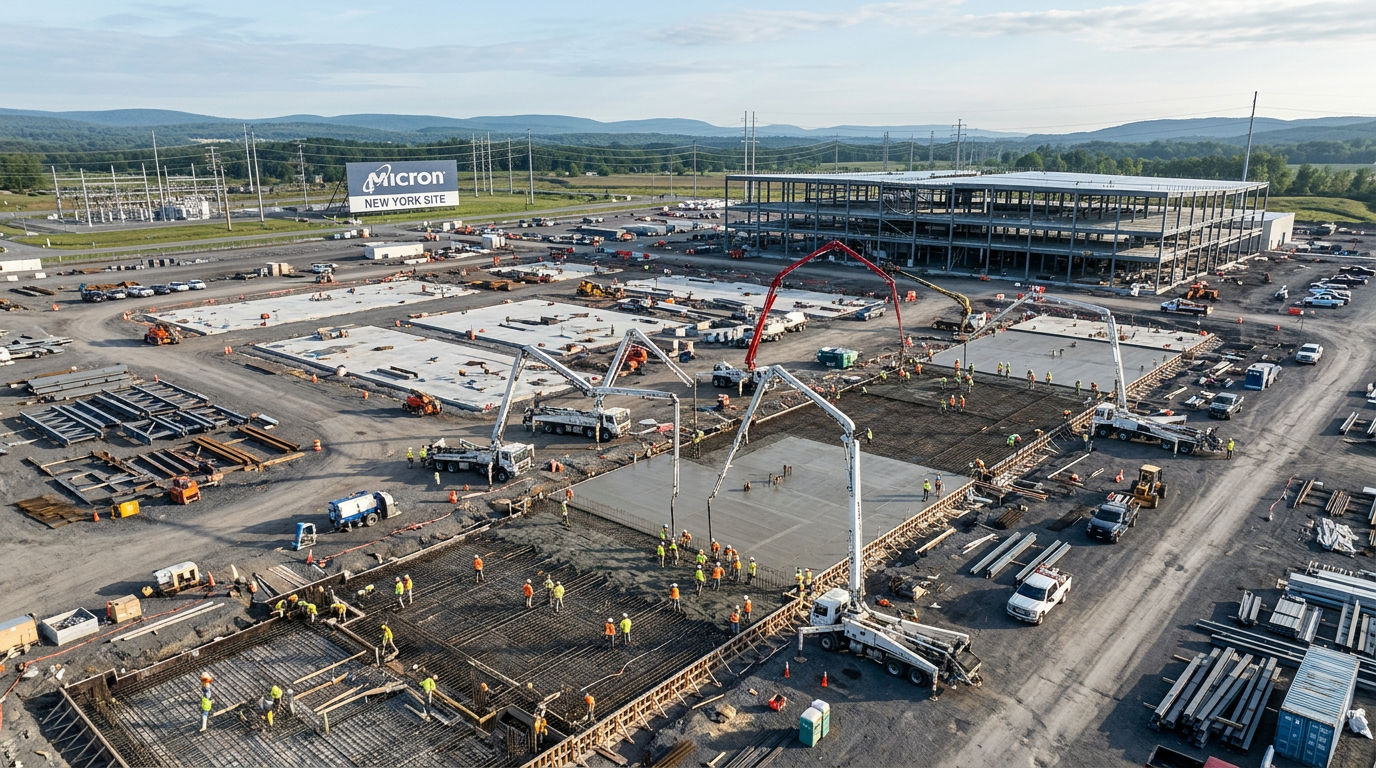
Here is the thing about Micron’s announcement this morning. The $250 billion number is the part everyone is going to talk about. It is the part that gets the presidential shoutout and the press conference and the Commerce Secretary quote. But the number that actually tells you something about where this company is headed is not $250 billion. It is the 10-year supply agreement with GlobalWafers, and the fact that concrete is already being poured in upstate New York — a full quarter ahead of the original schedule.
That is not a PR detail. That is an operational signal.
What happened today
Micron announced it is raising its planned U.S. investment to more than $250 billion through 2035, up from the $200 billion commitment it made last June, which was itself already a $30 billion increase from original plans. The new figure adds $50 billion to a buildout that spans facilities in New York, Idaho, and Virginia. Alongside the headline number, Micron separately committed up to $3 billion to strengthen the U.S. semiconductor supply chain, anchored by $500 million in strategic financing to GlobalWafers America’s 300mm raw silicon wafer facility in Sherman, Texas — plus a 10-year supply agreement securing long-term wafer access.
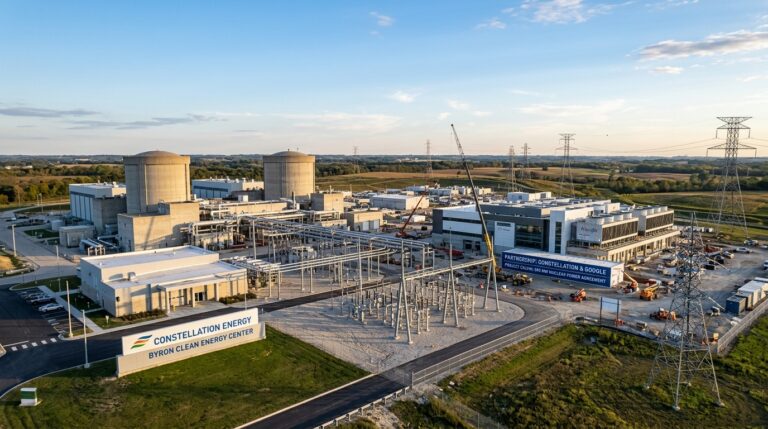
The New York campus is being built to become the largest semiconductor manufacturing site in U.S. history. The first concrete pour milestone at Clay, New York hit today, more than one quarter ahead of plan, transitioning from site preparation to vertical construction. Bechtel was selected as the construction partner. More than 80% of workers on site so far are New York residents.
Micron expects first wafer output in Idaho in mid-calendar 2027 for its first new fab, with the second Idaho fab coming late 2028.
Why the supply chain deal is the part worth reading
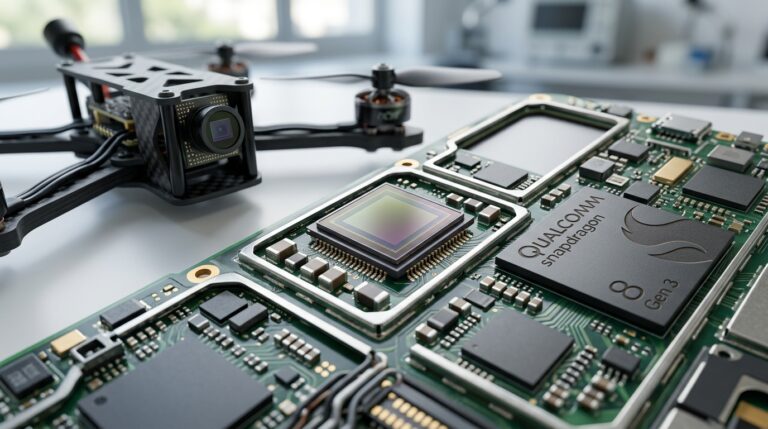
GlobalWafers is currently the only supplier participating in the CHIPS for America Program capable of producing advanced 300mm raw silicon wafers inside the United States. Micron’s $500 million financing commitment to their Texas facility, combined with a decade-long supply agreement, does something that the $250 billion headline does not: it tells you that Micron is locking in its input costs on American soil.
HBM — high-bandwidth memory — sits physically adjacent to every Nvidia AI chip. Only three companies on earth make it at scale. Micron is the only U.S.-headquartered producer. And right now, Micron’s HBM supply through 2026 is effectively sold out, backed by roughly $100 billion in binding multi-year AI memory contracts. The company has a long-term supply partnership with Anthropic, supply agreements with Ford and General Motors signed in recent weeks, and is a key memory supplier for Nvidia’s Blackwell and Vera Rubin GPU platforms.
Against that backdrop, the GlobalWafers deal is not defensive positioning. It is vertical integration for a company that has pricing power it has never had before in its history.
The financial picture
Micron’s revenue almost tripled in Q2 fiscal 2026, coming in at $23.86 billion against consensus estimates. Data center revenue more than doubled year-over-year. The company raised full-year fiscal 2026 guidance to a range of $31.5 billion to $33.5 billion. Gross margins reached 39% in the most recent reported quarter and management guided for approximately 42% in the following period.
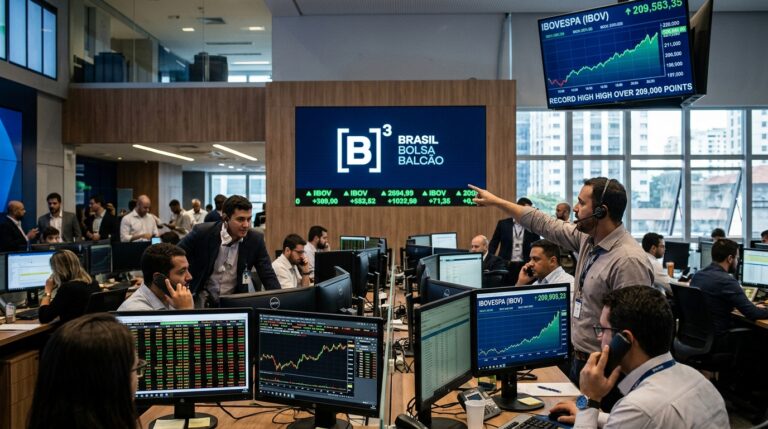
The stock has been one of the most dramatic re-ratings in recent memory, reflecting the market’s recognition that this is no longer a commodity memory cycle — it is a constrained-supply AI infrastructure play with multi-year pricing floors baked into binding contracts. Shares moved roughly 7% higher on today’s news in early trading.
Slight tangent, but it matters: the GlobalFoundries connection. GlobalFoundries shares rose today partly because GlobalWafers has an established long-term strategic partnership and multi-year supply agreement with GlobalFoundries. Investors read Micron’s commitment to GlobalWafers as an indirect tailwind for the foundry. Whether that read holds up in earnings is a different question — but the reflexive move shows how tightly interconnected the domestic semiconductor supply chain is becoming.
Three scenarios traders should hold in mind
Bull Case: Hyperscaler AI capex of more than $725 billion in 2026 continues to run through the memory stack. HBM pricing remains elevated through 2027 as Micron’s HBM4 volume production (already in early stages for Nvidia’s Vera Rubin platform) scales up. The New York fab and Idaho timelines hold, locking in a cost advantage over Korean competitors. Shares test the upper end of analyst targets north of $1,400.
Base Case: HBM demand stays robust but pricing moderates modestly as SK Hynix scales its own capacity. Micron holds its 20–25% targeted HBM market share. New fab construction proceeds on the accelerated timeline. Full-year fiscal 2026 revenue lands in or above the guided range. The stock consolidates near current levels as the market digests capex magnitude.
Bear Case: The $250 billion capital commitment — which runs through 2035 and well beyond any single AI cycle — is interpreted as the beginning of oversupply, not a signal of demand confidence. Cyclical memory bears point to the $25 billion-plus fiscal 2026 capex figure and warn of margin compression when the cycle eventually turns. Any softening in hyperscaler GPU orders flows almost immediately into HBM demand visibility, and the stock re-rates sharply lower.
What traders should watch
The capex magnitude is the central debate. Micron’s management has been explicit that the spending acceleration is demand-driven and supported by long-term contracts with pricing protections. Bears will argue that the history of memory cycles says otherwise — that every period of peak investment eventually resolves in oversupply. The question for disciplined traders is whether HBM is genuinely a different product category than commodity DRAM, with custom architecture and high switching costs that insulate pricing, or whether it is a cycle dressed up in AI vocabulary.
The GlobalWafers 10-year supply deal is a meaningful data point in that argument. Companies that expect a cyclical top in 12 to 18 months do not lock up raw material supply for a decade. Key technical levels to monitor: the 20-day and 50-day moving averages continue to frame near-term momentum structure. Any pullback toward the 200-day moving average would represent the kind of level where the demand thesis gets tested against actual order trends.
The next formal earnings catalyst is September. Between now and then, every hyperscaler earnings call — starting with the banks next week and moving through the major cloud providers in late July — carries data on whether AI infrastructure spending is holding its pace. That data will move Micron before Micron reports anything itself.
The $250 billion number is what gets shared. The 10-year wafer deal is what tells you how management actually sees the next decade playing out.
For informational and educational purposes only. Not investment advice. Trading involves risk, including loss of principal.