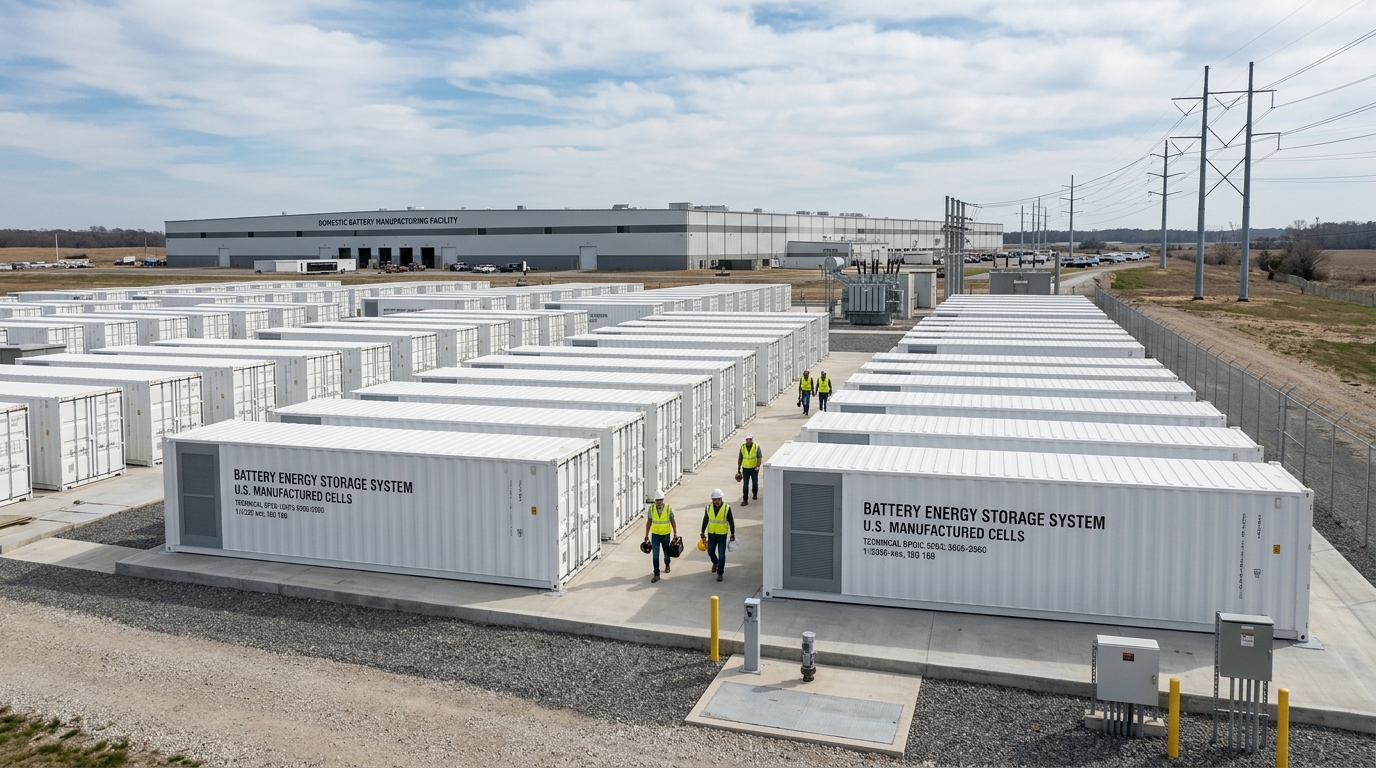
Start with a question that sounds boring on the surface: where does a grid-scale battery storage project get its cells?
Six months ago, the answer was easy. China. About 75% of U.S. lithium-ion battery imports came from Chinese-linked supply chains. Projects got built, tax credits got claimed, and nobody asked too many questions about the upstream paperwork.
That era ended on January 1, 2026.
What happened next is one of the most structurally significant supply disruptions in the energy sector right now. Almost no one outside the project finance world is talking about it.
The Compliance Wall Nobody Saw Coming
The One Big Beautiful Bill Act, enacted July 4, 2025, introduced new Foreign Entity of Concern (FEOC) restrictions on claiming investment tax credits and Section 45X advanced manufacturing production credits for battery storage. In plain terms: if your battery has meaningful Chinese-linked content, your project loses its federal tax credit. Entirely.
The minimum required share of non-FEOC costs starts at 55% for projects beginning construction in 2026, increases to 60% in 2027, 65% in 2028, and 70% in 2029. Projects that fall below these thresholds become entirely ineligible for the 48E credit.
This isn’t a headwind. It’s a wall. And most of the industry just ran into it at full speed.
Nearly all batteries used for power grids rely on China for at least one step of their supply chain. That dependency doesn’t disappear just because a regulation says it must. It creates a gap: surging demand on one side, and the suddenly very short list of batteries that actually qualify for federal incentives on the other.
The Scale of What’s Being Built
Here’s where the math gets interesting.
The U.S. is projected to install 146 GW/499 GWh of new storage capacity between 2026 and 2031, underscoring the scale of the build-out ahead as the grid modernizes to meet rising load. The grid is changing fast. AI data centers alone are pulling more electricity than entire cities. Renewable generation requires storage to be useful. Utilities are under mandate in more than a dozen states to procure significant capacity.
Battery energy storage system installations are projected to reach 200 GW/655 GWh of cumulative installed capacity by 2031, driven mainly by the utility sector, which will make up 85% of installations between 2026 and 2031.
That is an enormous amount of batteries that need to be FEOC-compliant. And right now, Wood Mackenzie identifies a fundamental supply chain constraint that will define market dynamics for the next two to four years, with FEOC-compliant equipment and safe-harbored capacity representing the key development bottlenecks threatening to limit near-term growth despite record-breaking deployment numbers.
Record demand. Constrained supply. And a regulatory framework that disqualifies most of what’s available.
That is not a minor policy footnote. That is a structural pricing event in the making.
The Part Wall Street Is Missing
The obvious trade on grid storage is lithium. LFP cells, South Korean manufacturers retooling EV lines for stationary storage, domestic content credits. All real. All being priced in.
But here’s the thing most investors are skipping over: battery cells represent the largest share of total system cost, often exceeding 50% of total project value, and because MACR is calculated based on cost, cell sourcing has the greatest influence on whether a project meets FEOC thresholds.
Lithium cells from Korean manufacturers are FEOC-compliant on paper. But production capacity and technical expertise for essential components such as active materials and their precursors remain heavily concentrated in China. Even a Korean-branded cell often has Chinese cathode material upstream. The auditable compliance framework, operationalized by IRS Notice 2026-15 in February, requires documentation six levels deep into the supply chain.
Slight tangent, but it matters: the grid storage boom is happening at the exact same moment that data centers are becoming the fastest-growing new electricity load in history. The data center industry’s global electricity consumption is set to surge by more than 300% by the end of this decade, and battery storage is no longer simply backup equipment. It is a primary tool for securing grid connections, managing the extreme power demands of AI workloads, and meeting clean energy commitments.
So the demand for FEOC-compliant storage just got a second engine. Utilities plus hyperscalers. Both need it. Both are running out of compliant options.
The Company Nobody Is Watching
Now zoom out from the lithium supply chain entirely.
What if the battery doesn’t use lithium at all?
Eos Energy Enterprises (NASDAQ: EOSE) builds zinc-based long-duration energy storage systems out of Turtle Creek, Pennsylvania. Its technology doesn’t touch lithium, cobalt, graphite, or any of the minerals that make FEOC compliance so difficult. About 80% of materials supply is sourced domestically, and Eos plans to source nearly 100% from the United States in the future, forgoing scarce critical minerals such as lithium that are largely imported and better insulating the product from market volatility and supply chain risk.
Unlike lithium-ion, which dominates short-duration storage, Eos’s zinc-based systems provide over 6,000 charge cycles, full depth of discharge without degradation, and U.S.-manufactured compliance with domestic content rules under the Inflation Reduction Act.
The FEOC compliance issue that is strangling lithium storage developers doesn’t exist for Eos. Its supply chain was already domestic before any of this regulation arrived.
What the Numbers Say Right Now
Eos Energy is rated a Buy by Needham with a 12-month price target of $9.71. Q1 revenue surged 445% year-over-year to $57 million, supported by a $645 million backlog and a $24 billion commercial pipeline.
Unit economics are improving rapidly, with labor and overhead costs per production unit down 47% and 43% year-over-year, respectively, as Battery Line 2 ramps production.
That revenue ramp isn’t accidental. Shares of Eos jumped roughly 13% after entering a Joint Development Agreement with Turbine-X Energy to power AI data centers with gas-plus-zinc battery systems targeting up to 2 GWh over three years, focused on private, on-site power for AI hyperscale data centers using its Indensity battery technology.
Z3 long-duration batteries from Eos were chosen for FPUSA’s 480 MWh ERCOT portfolio, the first deployment under a 2 GWh capacity reservation deal, with a broader framework through Stella Energy Solutions expected to channel more than 2 GWh of late-stage storage projects onto Eos Z3 batteries.
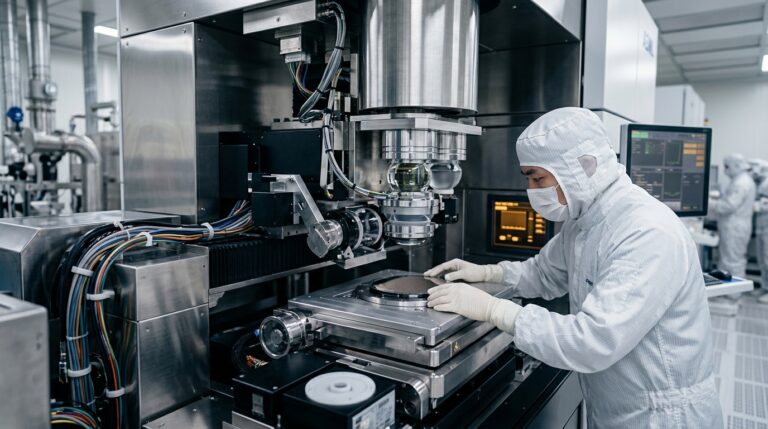
Eos has begun commercial production on its second battery manufacturing line at Thorn Hill in Pennsylvania, targeting 4 GWh of annual capacity by the end of 2026. Line 1 has already beaten its full-year 2025 output in the first 164 days of 2026.
Why This Isn’t On CNBC Yet
A few reasons. The stock is small-cap and volatile. It spent years as a commercialization-stage company with execution risk. Most analysts still slot it into the speculative clean energy bucket and move on.
But the investment case here is not about clean energy ideology. It is about regulatory arbitrage. The FEOC rules just created a moat around any battery manufacturer whose supply chain doesn’t touch China. Eos is one of the only ones at meaningful scale.
As one industry executive put it: “FEOC regulations and global mineral pressures have created both uncertainty and opportunity, pushing the U.S. to take domestic manufacturing seriously and driving renewed interest in non-lithium, FEOC-safe chemistries that strengthen our energy and geopolitical position.”
The risks are real. The company is still scaling, still burning cash to build manufacturing capacity, and dependent on a relatively small number of large customers near-term. Policy could shift. Execution could slip. These aren’t small caveats.
But the structural dynamic underneath Eos isn’t about a company doing something clever. It’s about a federal regulation that just permanently changed who gets to sell batteries to the American grid. And Eos built its entire supply chain to be on the right side of that line before the line was drawn.
That’s not a trade. That’s a structural position. And the market is only beginning to figure it out.
This editorial is for informational purposes only and does not constitute investment advice. All figures referenced are sourced from publicly available company filings, industry reports, and analyst research as of July 2026. Past performance is not indicative of future results. Investing involves risk, including the potential loss of principal. Please consult a qualified financial advisor before making any investment decisions.