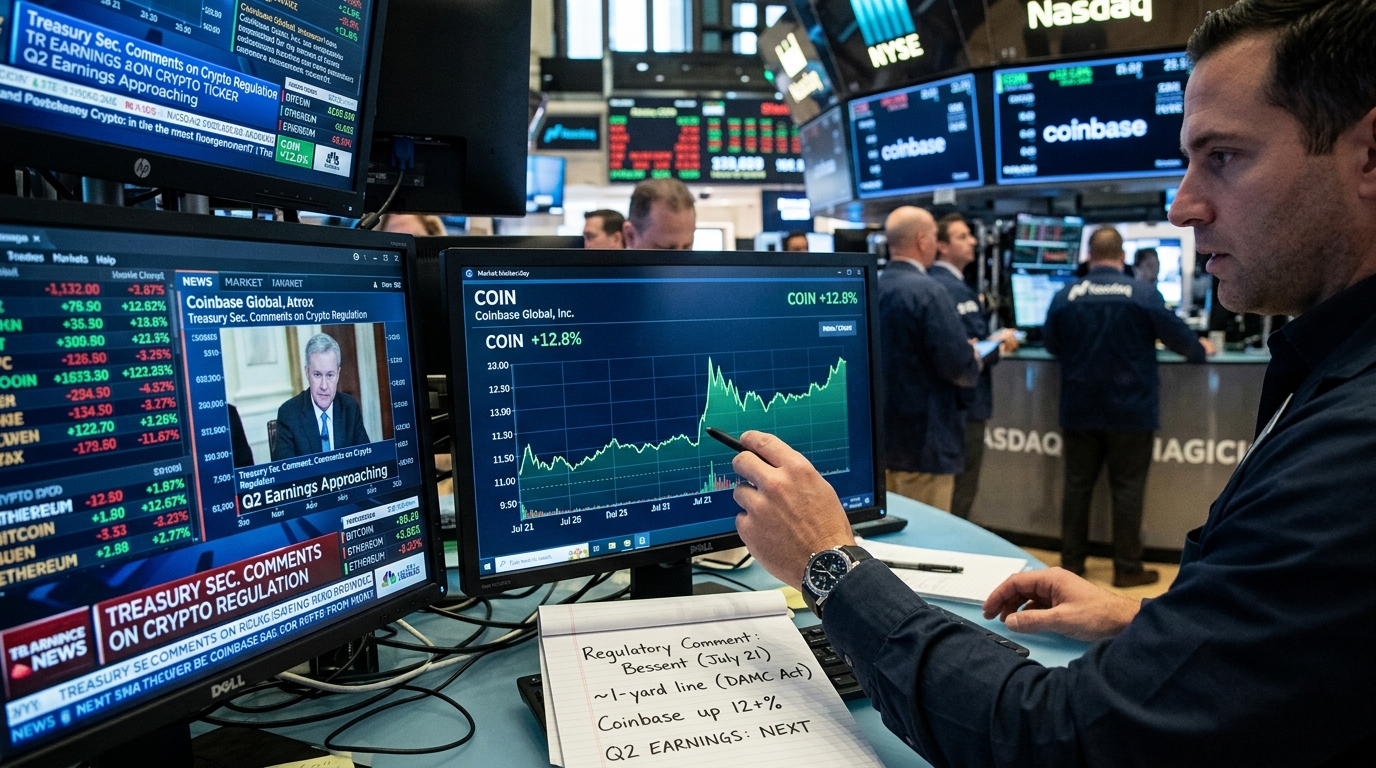
The stock spent most of 2026 trading like the market had given up on it. Then, on July 21, Treasury Secretary Scott Bessent said lawmakers were at the Digital Asset Market Clarity Act’s “1-yard line” — and Coinbase (COIN) jumped sharply in the session (reported as up as much as ~13% intraday).
That kind of move, on a regulatory comment rather than a product launch or earnings beat, tells you something.
It tells you the market isn’t pricing Coinbase on what the business does today. It’s pricing it on what the business becomes if Washington finally draws the rules.
The Overhang That’s Been Killing the Stock
Regulatory uncertainty has been one of the single biggest overhangs for crypto-adjacent equities for years. The CLARITY Act is designed to settle the fundamental question — who regulates digital assets, the SEC or the CFTC — and Coinbase is arguably the most direct public-market beneficiary if it passes.
The House passed the bill on July 17, 2025 by a 294-to-134 vote. The Senate Banking Committee advanced its version in May 2026 by a 15-to-9 margin. As of this week, Polymarket has shown odds in that neighborhood — a coin-flip-ish probability the bill gets signed into law in 2026 — not a done deal, but meaningfully better odds than the market has priced at times this summer.
Here’s the thing. Even if the bill stalls again, Coinbase is reporting Q2 2026 results on July 30 after market close. And the bar heading in is genuinely low.
Where the Business Actually Stands
Q1 2026 was rough. Revenue came in at $1.41 billion, down 31% year over year from Q1 2025. Coinbase posted a net loss of $394 million. Consumer transaction revenue was down 23% sequentially, reflecting softer trading conditions.
The company did maintain its 13th consecutive quarter of positive adjusted EBITDA at $303 million, and it said its crypto trading volume market share reached a new all-time high — having grown approximately fivefold since Q1 2023. It also highlighted “net native unit inflows” on platform.
That’s worth sitting with. Market share keeps growing even when the broader market shrinks.
For Q2, Coinbase previously guided Q2 subscription and services revenue to $565–$645 million. The early transaction run-rate coming out of Q1 was soft, but the macro backdrop has shifted since then.
The Business Coinbase Is Building
The strongest argument for Coinbase isn’t next quarter’s trading fee revenue. It’s the mix shift that’s been quietly happening underneath the headline numbers.
Subscription and services — stablecoin revenue, custody, staking — are growing as a share of total revenue. Coinbase said USDC average balances held in Coinbase products reached about $19 billion in Q1, representing more than 25% of total USDC in circulation. That’s a recurring, interest-rate-sensitive revenue stream that doesn’t vanish when Bitcoin drops 15%.
Then there’s Base, Coinbase’s Layer 2 network, where Base lead Jesse Pollak has indicated the launch of 1:1-backed tokenized equities is “imminent” — positioning Coinbase to compete more directly in a product category that barely existed 18 months ago.
The company exited Q1 with about $10.2 billion in cash and cash equivalents. That’s not a business running on fumes.
The Risks Are Real
COIN is still down roughly 62% from its 52-week high of $445. The stock traded around $158 in mid-July before the CLARITY headlines. The longer-term moving average structure remains mixed — the 200-day SMA sits well above current levels, and the broader technical recovery hasn’t been confirmed yet.
The CLARITY Act still faces a 60-vote Senate threshold. Passage is not guaranteed. And if the bill stalls, that kind of single-session gain can reverse just as fast.
Credit goes to the bear case too: Coinbase’s revenue model is still heavily correlated to crypto prices and trading volumes. If Bitcoin weakens from here, transaction revenue estimates fall with it.
What July 30 Actually Tests
The earnings date isn’t just about the headline number. Investors will be reading the subscription and services line against the $565–$645 million Q2 guidance range. They’ll be watching whether stablecoin economics held up. They’ll be listening to management’s tone on the CLARITY Act and whether tokenized equity plans are gaining real traction.
Analyst consensus currently sits at a mixed Hold — with published targets varying — versus a current price that’s well below where many targets have sat. Some analysts have cut their targets in recent weeks. Others see the regulatory catalyst as underpriced.
The Q1 miss set a low bar. A guidance beat heading into Q3 could be explosive to the upside. The risk, as always with Coinbase, is that the pattern of solid underlying business metrics and disappointing headline numbers repeats itself one more time.
Either way, July 30 is the date that matters now.