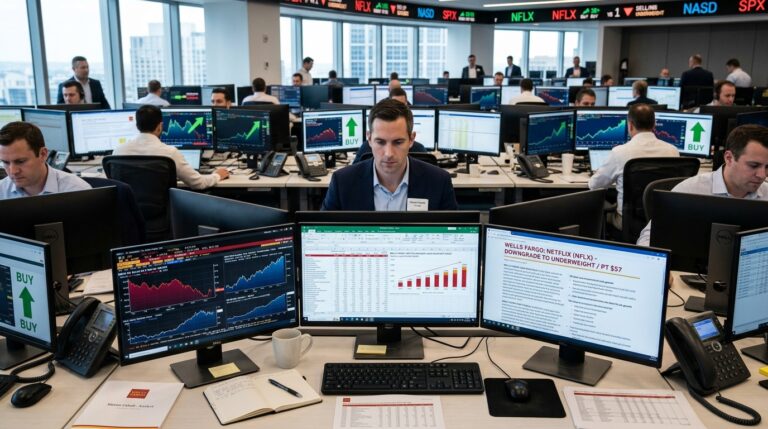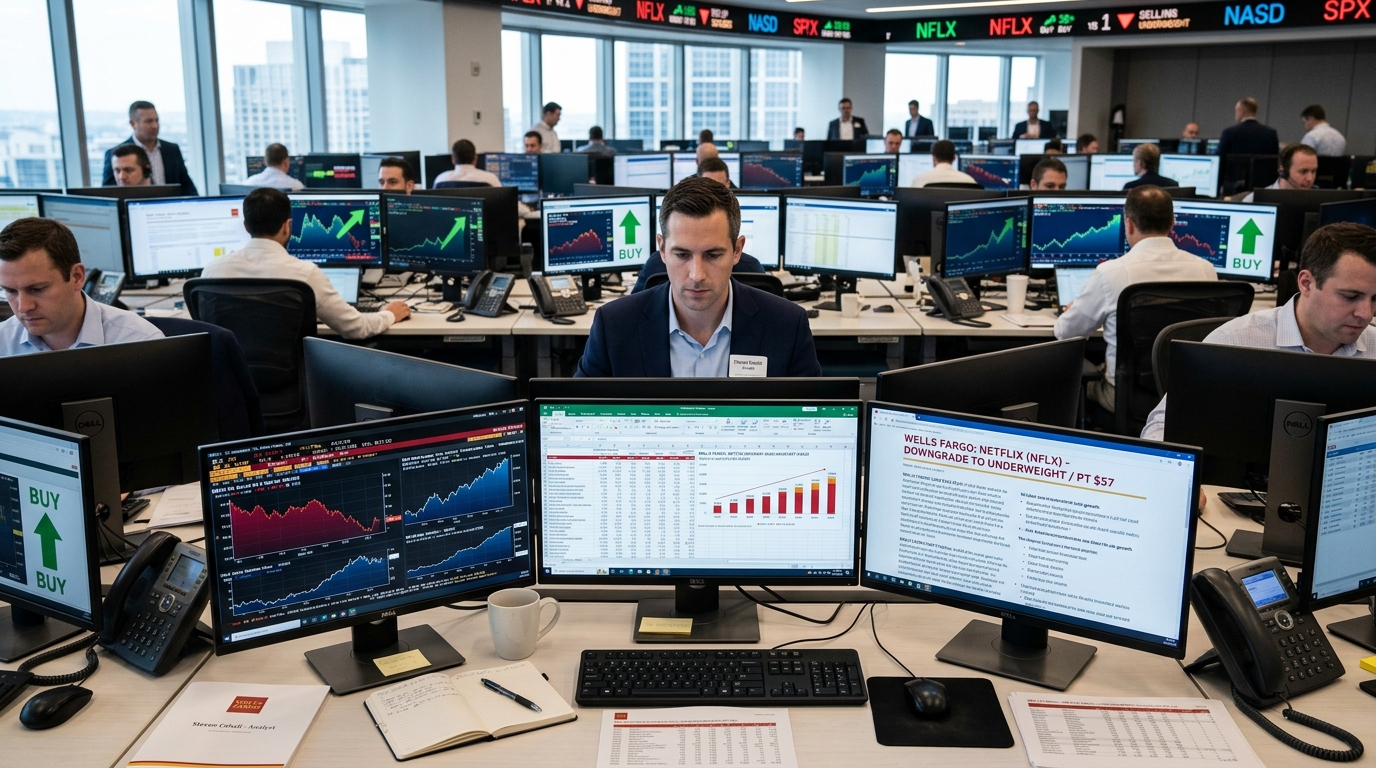
Fifty-two analysts cover Netflix. Thirty-eight of them rate it a buy or strong buy. As of Friday morning, exactly one rates it an Underweight. That analyst, Wells Fargo’s Steven Cahall, cut the stock to Underweight from Equal Weight, with a price target of $57 from $80, implying roughly 25% additional downside from Thursday’s close. The stock fell about 4% on the news, extending what is now a four-session losing streak.
The core of Cahall’s argument is not about the business model. He frames the downgrade as a debate over the second-half slate rather than a call against Netflix itself. His specific concern is hours: engagement at 1.6 hours per subscriber per day in the first half, which he estimates was down 8% from 2023 after adjusting for password-sharing and geographic mix. His base case is for second-half hours from top 100 originals to fall 21% year over year, with elevated churn risk into 2027.
The $57 target rests on a compressed multiple, roughly 15 times forward earnings versus 21 times previously. Cahall flagged Netflix’s next viewership report, expected alongside fourth-quarter results in January, as the negative catalyst, with churn risk building into 2027. In other words, this is not a call you can disprove today. The evidence arrives in January. That timing matters.
What the Bulls Are Watching Instead
Evercore ISI came to a different conclusion entirely just days before Cahall’s note. Netflix shares climbed about 3.8% on September 14 after Evercore raised its price target to $110 from $100, maintaining an Outperform rating. Analyst Kutgun Maral cited U.S. household penetration at a multi-year high of 63% and live event viewership reaching 60% of users. The $57-to-$110 spread between these two targets captures the whole dispute in two numbers.
Cahall argues that despite content spending nearing $20 billion this year, volume cannot substitute for the cultural impact required to drive multiple expansion. The bulls’ counter: Netflix is spreading its bets. The company has expanded its presence across platforms such as YouTube while investing in video games, documentaries, and live sports. Whether that diversification shores up engagement or dilutes it is the central empirical question.
Pershing Square Is Betting Engagement Recovers
Bill Ackman re-entered this debate in August, four years after a costly exit. Pershing Square has said it rebuilt a Netflix position after shares fell roughly 50% from their June 2025 high. Pershing Square’s stated view: “We expect Netflix to compound revenue at a double-digit growth rate, with content costs growing more slowly than revenue driving continued margin expansion.” That thesis directly contradicts Cahall’s framework, which treats engagement density as the binding constraint.
What Would Change the Thesis
Bears need Cahall’s engagement read to prove correct and Cahall himself acknowledges the downside to his own call. He acknowledged he could be wrong, noting Netflix’s record content spending, a hard-to-forecast international slate, and its history of delivering unexpected hits.
The clock is short. The next catalyst for Netflix stock is its earnings report on October 20, when management guidance may help determine which view is more accurate. Netflix stock is down about 22% year to date, so the downgrade lands on a chart that has already priced in a lot of sentiment damage. The stock recently fell toward $70, where it found support around the 200-week simple moving average, a level that also helped stabilize shares in July.
Investors inclined toward the bear case need Cahall’s engagement data to be confirmed by Netflix’s own January disclosure. Those inclined toward the bull case need a breakout hit in the second half, the kind Netflix has delivered before but has so far failed to deliver in 2026. “We see breakout hits as a must for the stock to work again,” Wells Fargo’s analysts wrote. That sentence is the whole argument. What October 20 will tell investors is whether the content pipeline is more like Cahall’s feared thinness or closer to the international upside Evercore still sees. One of these frameworks is going to look very wrong by year-end.