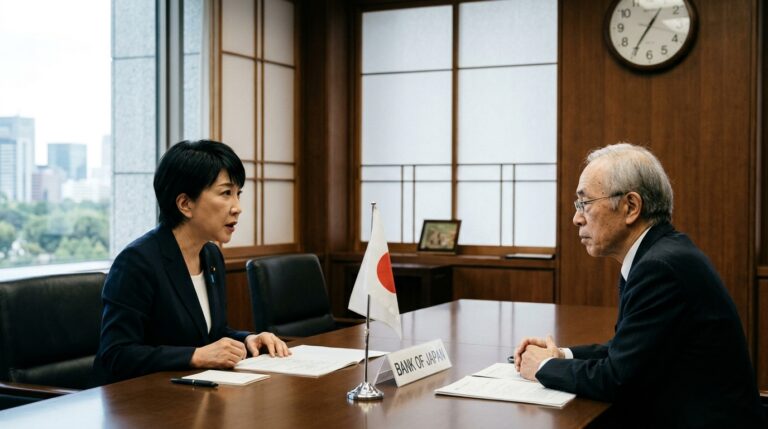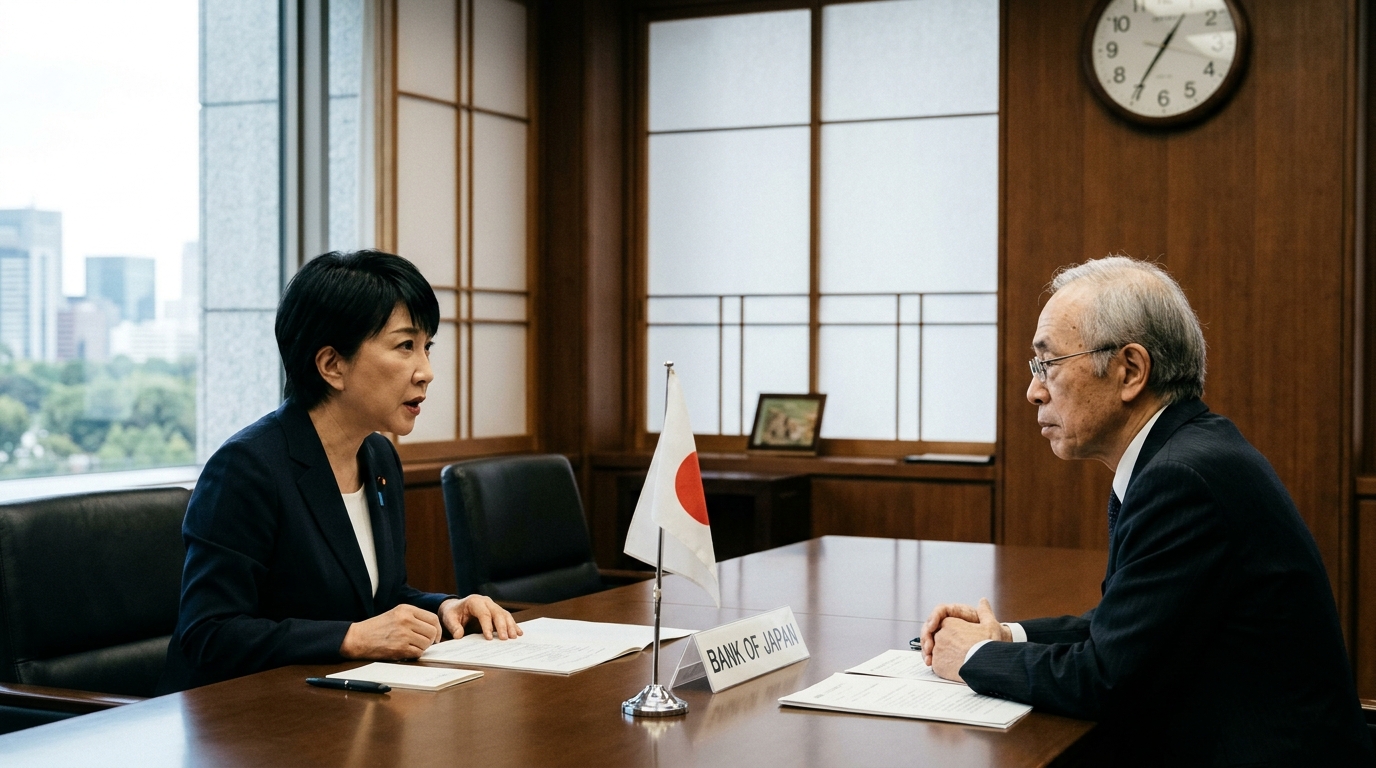
The yen is sitting at roughly 157 to the dollar this morning. The Bank of Japan decides Thursday and Friday, Oct. 29-30. And Prime Minister Sanae Takaichi has publicly leaned on Governor Kazuo Ueda to increase government bond purchases, a move that puts the two on a collision course just as yield and currency levels make the stakes unusually high.
Takaichi reportedly urged the BOJ to increase government bond purchases to contain long-term interest rates, exposing a widening policy divide between the prime minister and Governor Ueda. The BOJ has raised interest rates multiple times since Takaichi took office and has continued reducing its bond purchases. She wants the exact opposite: more buying, capped long yields, easier conditions for her fiscal agenda.
The fiscal pressure is real. Japan’s government has rebooted a DOGE-style spending review targeting 201 special-purpose funds holding around ¥7 trillion, with proceeds aimed at funding a food consumption tax cut from April 2027 alongside defence and industrial policy demands. Record budget requests of ¥143 trillion underline how wide the funding gap is. The spending review is partly a message to bond investors: concern over how Takaichi’s pledges will be funded has pushed 10-year JGB yields to multi-decade highs.
The 10-year JGB yield is sitting just under 3%. That is a world away from the near-zero rates Japan lived with for a generation. The 30-year JGB hit 4.235% on Oct. 6. These are not marginal moves. Japan’s 10-year yield has moved sharply higher during Takaichi’s first year in office.
Now consider what the BOJ actually does this week. The BOJ is widely expected to keep its policy rate at 1.25% at its Oct. 29-30 meeting, after hiking from 1% in a 7-2 vote in September. A hold is the base case. But a hawkish framing that keeps a December move in play would change the currency calculus fast.
That framing matters enormously for the yen. With a hold widely expected, yen and JGB moves are likely to hinge on the vote and Ueda’s guidance. Hawkish dissent from board members, or language pointing toward the next meeting, would probably bring December pricing forward and offer the yen some support. A unanimous hold paired with cautious messaging could see hike expectations drift later, keeping the yen soft.
This is the crux of the trade. Takaichi wants Ueda to buy bonds and hold yields down. Ueda is trying to convince markets policy is normalising, not sliding back into suppression. Those two positions cannot coexist without one side blinking. The front end is already pricing a BOJ that is not done tightening.
The Trade
The yen at 157 with a hawkish-leaning BOJ due in four days is a credible long yen opportunity, with the risk defined by Ueda’s post-meeting guidance. Front-end JGB yields remain the most sensitive gauge of shifts in timing, and the Tokyo CPI reading lands the same day as the decision, adding to the potential for volatility. Any signal pointing toward December tightening shortens the timeline for carry trade unwinds.
The risk to the long yen thesis is political override. If Takaichi extracts a public commitment from Ueda to slow bond purchase reductions, yields would fall and the yen would weaken further. Credible fiscal savings that cap new debt issuance near ¥40 trillion could ease some of the risk premium in long-dated JGBs, but markets are likely to wait for concrete numbers before giving the government credit.
Watch the vote count and the exact language on price risk in Thursday’s statement. A split board or any reference to overshoot risk is your confirmation. A clean unanimous hold with dovish language sends USD/JPY back toward 158-159. Four days is a short window. The signal arrives Friday morning Tokyo time.