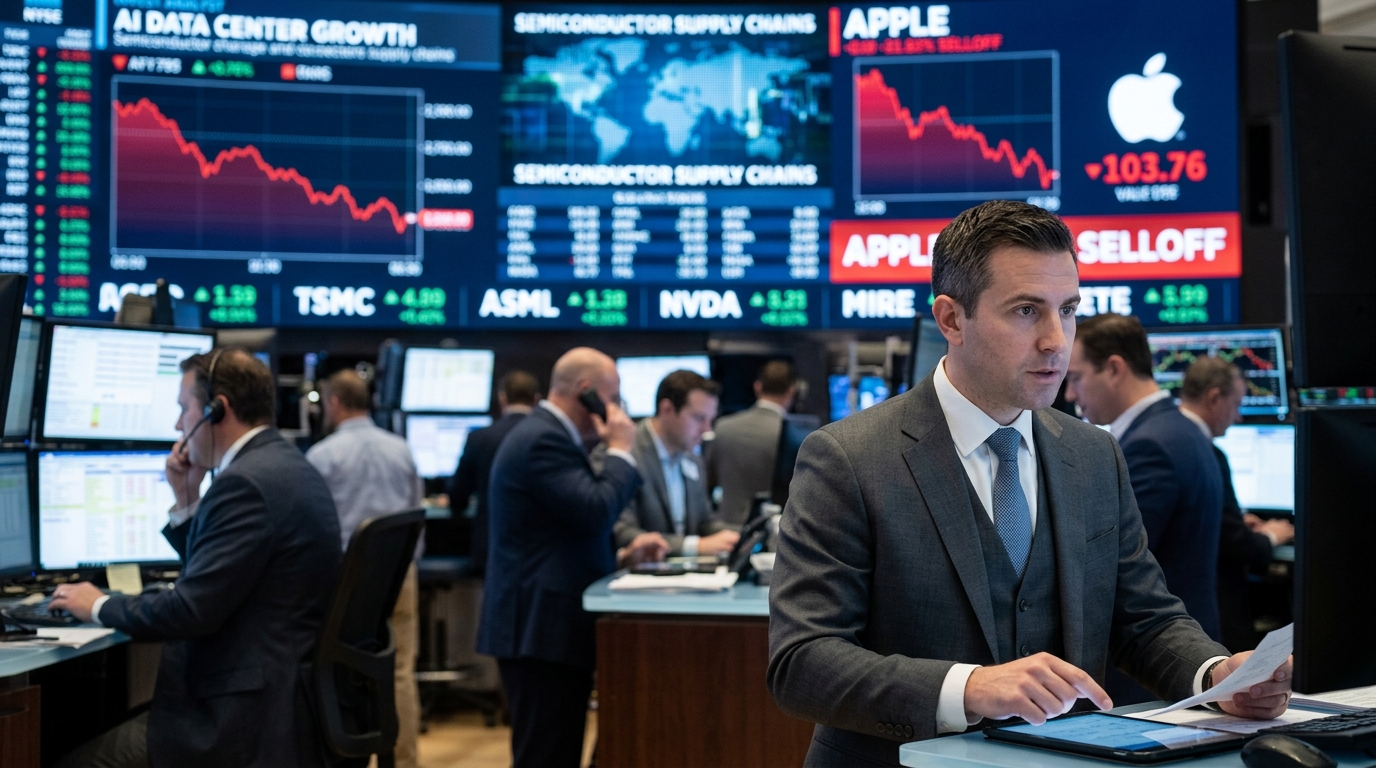
Apple reported its best June quarter in history on Thursday night. Revenue rose 16% to $109.4 billion. Diluted earnings per share climbed 29% to $2.02. iPhone revenue hit a record for the fiscal third quarter, up 22% year over year. And the stock fell nearly 10% on Friday.
The market’s reaction was not irrational. It was telling you something specific about where we are in the technology cycle, and most investors are reading it wrong.
The Market Context
The surface-level explanation for Apple’s selloff is familiar: services revenue came in at $30.74 billion against an expected $31.22 billion, and iPad revenue missed by roughly $730 million. Investors concluded the record quarter was partly a function of favorable comparisons and tariff timing, not a straight line to equally strong forward results. Greater China revenue was about $18.8 billion, below what some analysts had modeled.
But the deeper problem is structural, not cyclical. Apple expects September-quarter revenue growth of only 9% to 11%, and component constraints tied to the AI-driven supply squeeze will affect iPhone, Mac, and iPad availability. Memory prices are rising sharply, contributing to margin pressure and prompting reluctant price increases. This is not a quarterly variance. It is a capital allocation war, and Apple is on the losing side of it.
The broader market context compounds the pressure. The yield on the 30-year Treasury bond moved above 5% in July as investors continued to assess the latest FOMC decision and Chair Kevin Warsh’s press conference. The Fed left the federal funds rate unchanged, but three FOMC members voted in favor of a rate hike. Markets are currently pricing in a meaningful chance of a 25-basis-point rate hike in September. Rising long-duration yields tighten the discount rate on every premium-multiple technology stock, Apple included.
The Research
To understand what is actually happening to Apple, you have to understand what happened to the global memory market over the past 18 months.
Some analysts now estimate that data centers will consume the majority of high-end memory chips produced in 2026, a sharp reversal from the era when consumer devices accounted for the majority of such chips. This is not a supply disruption. It is a deliberate reallocation, driven by economics that consumer electronics companies cannot match.
“The high-bandwidth memory feeding AI data centers comes off the same DRAM wafers as the RAM in a laptop or phone,” according to analysts. “Capacity is finite, so a wafer committed to an HBM stack for an AI data center is one that never becomes memory for a mid-range handset.” As one senior cloud architect put it: “It is close to a zero-sum game.”
Apple’s CEO Tim Cook said on Thursday’s earnings call, “We’re seeing some very significant constraints currently, with limited flexibility in the supply chain to remedy it,” adding that Apple was “evaluating all options” for alternative suppliers. There are no easy alternatives. The structural causes are the reallocation of memory capacity toward AI data centers and a broader pinch in advanced semiconductor supply as leading-edge capacity is pulled toward AI-related demand. Some industry forecasts suggest the tightest period for certain parts of the supply chain could extend well into 2027.
This is the force behind everything. It is why customers accelerated purchases of Macs and iPads amid the global memory-chip shortage that pushed Apple to increase prices. The company has so far avoided raising prices on its flagship iPhone line, although analysts increasingly expect a price increase at Apple’s September launch event. The pressure is building toward the most important product cycle Apple will execute under new CEO John Ternus.
The Leadership Overhang
Thursday’s earnings call carried unusual weight. Tim Cook did not treat Thursday’s call as his last earnings call as CEO. Apple has said Cook will remain CEO through August 31, 2026, with John Ternus set to become Apple’s new CEO on September 1, 2026. Cook will transition to the role of executive chairman at that time.
Apple announced in April 2026 that Tim Cook will step down as CEO on August 31 and transition to Executive Chairman, with John Ternus, currently Senior Vice President of Hardware Engineering, taking over as CEO effective September 1, 2026. This marks the most significant leadership change at Apple in over 15 years. A hardware engineer taking the top seat in the middle of a global hardware supply crisis is either the best possible timing or a baptism by fire, depending on how September’s iPhone launch unfolds.
The CEO transition is unlikely to change the company’s direction overnight, but Ternus’ success will ultimately be judged on whether he can deliver AI-powered innovation without sacrificing Apple’s financial strengths. The handoff looks about as smooth as a leadership change at a multitrillion-dollar company can be. The real questions are about the future: Can Ternus close Apple’s AI gap and reignite hardware innovation, while protecting the margins and cash returns that investors prize?
That question does not get answered this quarter. It gets answered over the next four to six. Which means Apple, for all its records, enters a period of genuine uncertainty precisely when the constraints on its supply chain are about to worsen.
The Hidden Insight
Here is what the Apple selloff is actually telling you, and why the real trade is not in Apple at all.
The Financial Times’ running tally of hyperscaler capex, compiled from Q1 earnings, has Amazon, Microsoft, Alphabet, and Meta collectively planning around $725 billion of capital expenditure in 2026. That is up about 77% from last year’s record of roughly $410 billion, and the bulk of the money is going into AI infrastructure: GPU clusters, custom silicon, and data center construction.
That $725 billion has to go somewhere. It flows into chips, power, and floor space. The pricing power in that chain flows to whoever holds the constrained inputs, principally Nvidia and the custom-silicon partners, and increasingly the utilities and land close to substations. But the most underappreciated constrained input, the one that Apple’s earnings call just put on the front page, is memory.
The term “supercycle” has been used in the industry to describe the strong momentum in the memory sector since 2024. Some banks have described 2026 as a supercycle year for memory, with sharply higher DRAM and NAND revenue expectations driven by data center and HBM demand. SK Hynix is often cited as a primary beneficiary because of its leadership position in high-bandwidth memory.
The logic is straightforward. Every Nvidia Blackwell graphics processing unit requires high-bandwidth memory. Every hyperscaler building the next generation of AI training infrastructure requires it, and HBM consumes materially more wafer capacity than standard DRAM. That consumption ratio is the mechanism translating hyperscaler capex into memory scarcity for everyone else, including Apple.
The beneficiaries of Apple’s pain are, paradoxically, the companies supplying the chips that are crowding Apple out. In 2026, SK Hynix has posted record profitability, including record first-quarter revenue of about 52.6 trillion KRW, up 198% year over year, supported by surging demand for high-end AI memory. In the DRAM market that includes HBM, SK Hynix was ranked second globally based on revenue with a market share of 29.1% in Q1 2026. In the HBM market specifically, it was ranked first globally with a market share of 56.4%.
Micron tells a similar story. Micron has said its HBM output is sold out through 2026, and a large share of its future sales is being secured through longer-duration agreements. With sales of much of its memory supply locked in under multiyear contracts, AI data center demand still growing, and HBM supply structurally constrained, Micron stock looks less like the cyclical semiconductor bet that it used to be, and more like a long-term AI infrastructure asset.
This is the second-order implication that most market commentary is missing: Apple’s guidance miss is not primarily a consumer demand story. It is a supply allocation story. And the companies doing the allocating, who decide which wafers go to hyperscalers and which go to smartphone makers, are sitting on the most powerful pricing leverage in the technology sector right now.
Investment Opportunities
Micron Technology (MU) is the most accessible U.S.-listed direct exposure to the HBM supercycle. Its HBM production capacity through 2026 has been described by the company as sold out under contract. The concern the market carries, that Micron missed the supplier list for Nvidia’s next-generation Vera Rubin platform, is hard to verify in public data. But its existing volume locked into the current Blackwell generation provides a durable revenue floor into 2027. The stock has historically traded on cyclical fears; the current cycle is not behaving like a cyclical. Multiyear supply contracts change the earnings visibility profile materially.
SK Hynix is the structural leader, and it has been explicit about prioritizing HBM as the strategic center of its roadmap. Specific percentage allocations to Nvidia’s Vera Rubin platform are not something the company consistently discloses publicly, and estimates vary, so investors should treat such numbers with caution. U.S. investors have had limited access, but the company has moved toward improving access to its shares through U.S.-market instruments. The total semiconductor market is projected by industry groups to approach the $1 trillion mark over the coming years, with memory emerging as a key driver, and several forecasters expect above-trend growth in 2026 driven by AI and memory.
TSMC (TSM) operates as the foundry nexus behind this entire chain. Tight advanced-node capacity means every incremental dollar of hyperscaler capex that requires leading-edge silicon flows through TSMC’s fabs. Apple’s supply constraints are, in a real sense, an allocation decision within a constrained ecosystem. That capacity will remain constrained as long as hyperscaler capex continues to compound. Some strategists have argued that annual capital expenditures by the world’s largest hyperscalers could surpass $1 trillion as early as 2027. TSMC is the toll road on that trajectory.
Investors seeking diversified exposure without single-stock concentration risk can look at the VanEck Semiconductor ETF (SMH) or the iShares Semiconductor ETF (SOXX), both of which carry meaningful weights in the memory and foundry names most exposed to the HBM supercycle.
Risks and Counterarguments
The bear case on memory is not trivial. The 2017 to 2019 cycle demonstrated that HBM supply and conventional DRAM supply can normalize faster than consensus expects when manufacturers invest aggressively in new capacity. Some industry forecasts do project DRAM supply growth in 2026 that is below historical norms. But that below-trend supply growth itself reflects a deliberate choice: this is not just a cyclical shortage driven by a mismatch in supply and demand, but a potentially longer-lasting strategic reallocation of the world’s silicon wafer capacity. For decades, production of DRAM and NAND Flash for smartphones and PCs was the primary driver for production. Today, that dynamic has inverted.
The second risk is demand. If AI revenue does not compound fast enough, this cycle could start to look like prior capital cycles where enthusiasm outpaced reality. The hyperscalers have collectively committed $725 billion, but those are guidance numbers, not booked spend. If AI monetization disappoints, capex guidance gets cut, and memory demand softens faster than new supply is built. That would compress margins across the HBM producers significantly.
A third consideration is geopolitical. Samsung, SK Hynix, and Micron are all exposed to U.S.-China trade policy and Korean industrial policy in ways that create headline risk around any escalation. The ongoing U.S.-Iran conflict and its effect on energy costs for power-hungry fabs adds another variable that is difficult to model.
Research Conclusion
Apple’s Friday selloff is the most visible symptom of a structural realignment that has been underway since 2024. The $725 billion that four hyperscalers are pouring into AI infrastructure in 2026 is not circulating back to consumer electronics companies. It is flowing to the suppliers of constrained inputs: memory, advanced foundry capacity, and power. Apple, caught between a chip shortage it cannot fix and a CEO transition it cannot delay, faces a September quarter that will test the resilience of both its supply chain and its new leadership simultaneously.
The investment implication is not to sell Apple or to buy it. It is to recognize that the price-setting mechanism for the most critical inputs in the technology economy has shifted. Whoever holds the constrained wafer capacity holds the pricing power. That is Micron, SK Hynix, Samsung, and TSMC. Claims of a specific “nearly 700%” surge in DRAM spot prices are difficult to verify from primary, public price series, and the magnitude varies by product and contract structure. But directionally, memory pricing has tightened sharply as hyperscaler demand collides with limited high-end supply.
The indicators to monitor going forward: TSMC’s monthly revenue releases, which function as a real-time gauge of advanced-node demand; Micron’s quarterly earnings in September, which will update the HBM contract coverage picture for 2027; and Apple’s iPhone 18 launch in September, which will determine whether consumers will pay higher prices for memory-constrained devices or whether demand compresses at the new price points. Each of those data points will either confirm or challenge the thesis that this is a structural shift rather than a temporary dislocation.
The market read Apple’s earnings correctly. It just assigned the implications to the wrong companies.