Brent is sitting near $91. ULSD cracks are near $93–94 per barrel. That inversion, refined product commanding more than the raw crude, is the trade. Russia confirmed it Saturday morning, and the numbers have not moved in your favor yet.
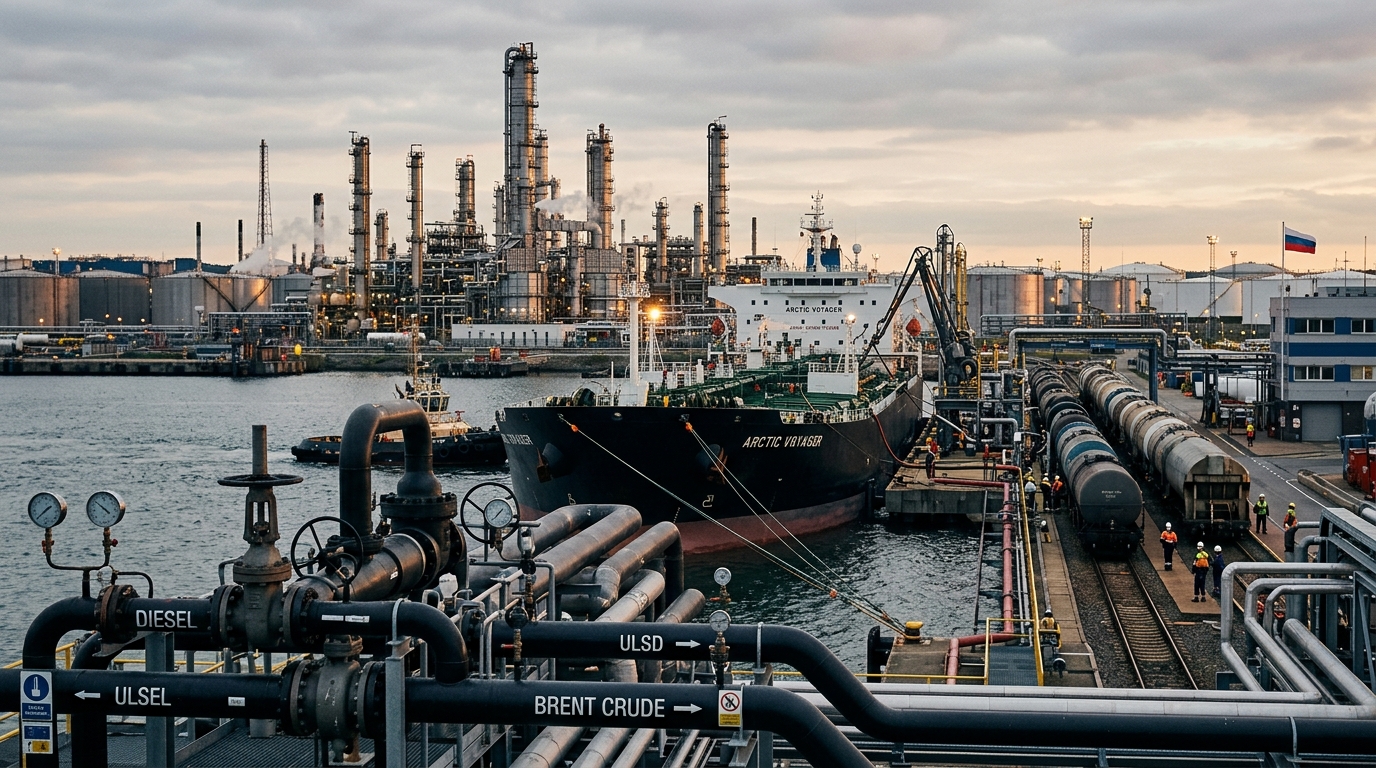
Russia formally extended its ban on diesel exports until September 30, citing the need to keep the domestic market supplied amid intensified Ukrainian attacks on its refineries. This is no longer a rumor or a policy option under discussion. It is signed policy, and the domestic damage driving it continues to worsen. Over the past week, drone strikes halted operations at refineries in Perm, Nizhny Novgorod, and Yaroslavl.
The ban itself has structural weight. Russia is typically the world’s second-largest diesel exporter after the United States. Every day the ban holds is another day that volume stays out of the Atlantic Basin. Traders should treat September 30 as a floor, not a ceiling.
As of late August 2026, the US Gulf Coast ULSD crack versus WTI stood near $93–94 per barrel, after briefly topping a record $102 on August 17. These levels are far above what traders would call normal in balanced markets, and reflect acute supply tightness rather than soaring crude prices alone. The correct framing here is not to ask whether cracks are high. They are. The question is whether you want flat crude exposure or pure refining margin exposure. The answer is the latter.
Brent and WTI have moderated from wartime peaks, yet product prices have held firmer due to lost refining output and export restrictions. That divergence is the structural argument for owning complex refiners against a flat or short crude position rather than just buying energy broadly. The long crude trade has already happened. The spread trade has more runway.
Among the names, Marathon Petroleum, Valero, and Phillips 66 are the clearest expressions. Valero’s refining margin per barrel of throughput rose sharply year over year, while Marathon’s refining and marketing margin climbed from $17.58 to $36.33 per barrel in Q2. Valero’s net debt-to-capitalization ratio, net of cash and cash equivalents, was 11% at quarter-end; Marathon returned more than $2.8 billion through buybacks and dividends and finished the quarter with $7.8 billion in cash. These are not leveraged bets on a thesis. They are companies already converting the bottleneck into free cash flow.
Phillips 66 is the laggard in price performance but not in fundamentals. PSX’s forward price-to-earnings multiple is low versus many peers, suggesting the market may be underestimating its earnings potential for the coming year. That discount looks like opportunity if cracks stay elevated through the fall maintenance season, which seems probable given that total US distillate stocks stood at approximately 105.6 million barrels as of the week ending August 14.
Reuters estimates that Ukrainian attacks have disrupted at least 17% of Russia’s oil refining capacity. That figure keeps rising. Each new strike makes the September 30 extension look less like a deadline and more like a waypoint. The fuel queues forming at Moscow filling stations are the market’s real-time signal on how long the ban holds. As long as that pressure persists domestically, Moscow has no political room to lift the restriction.
The risk is straightforward: any ceasefire development in either Ukraine or the Persian Gulf that reopens product flows would compress cracks quickly and take the refiners with them. Position sizing matters here precisely because the catalyst is geopolitical and therefore binary. Keep position sizes disciplined, watch distillate inventory draws each Wednesday from the EIA, and treat any weekly build in US distillate stocks as a reason to reduce exposure.
The spread is the trade. The ban confirmation is the timing tell. The refiners are the vehicle.