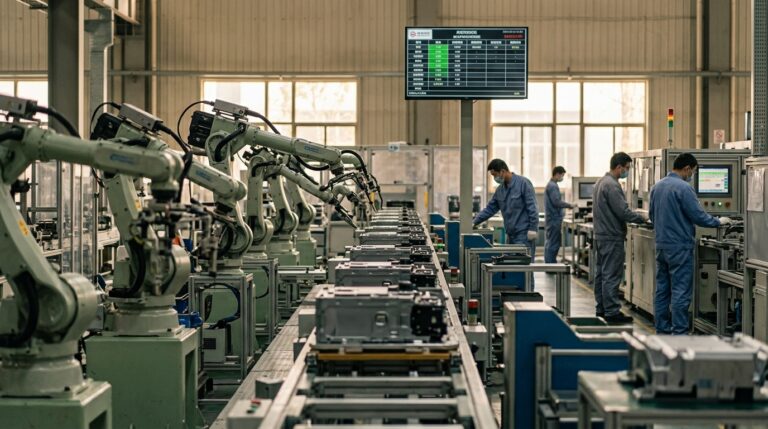
This morning the National Bureau of Statistics in Beijing delivered a number worth paying attention to if you own emerging-market funds: Chinese industrial profits grew just 4.2% in August from a year earlier, the weakest pace this year, as manufacturers grapple with persistent weakness in consumer demand and a sustained rise in energy costs.
The August reading marked the fourth straight month of deceleration, following a 24.7% expansion back in April, and the weakest performance since November 2025 when profits posted a double-digit decline. The drop from July’s 11.2% was sharp, and it came in below an 8% growth forecast cited by Reuters.
For the first eight months of 2026, profits at large industrial firms climbed 15.7%, losing momentum from a 17.6% rise in the January-July period. The cumulative figure still looks healthy. The monthly one does not. That gap is exactly what should focus your attention.
What This Means Beyond the Headline
The figures highlight a growing imbalance in China’s industrial economy, where manufacturers are producing at a strong pace but weak consumer demand is making it difficult for companies to raise prices and protect margins. High-technology manufacturers thrived, with profits in computer, communication and other electronic equipment manufacturing up about 1.1 times year on year, while automobile industry profits fell 16%.
That split matters for how you read it as a portfolio signal. The AI-driven chip and computing boom inside China is real, but it is narrow. Sectors like wine and beverages, more tied to local shoppers, are still under pressure. The domestic consumer is not participating, and that is the structural vulnerability that most emerging-market funds carry when they buy broad China exposure through vehicles like FXI or MCHI.
Year to date, FXI has returned roughly -4.83% while MCHI has returned approximately -5.20%. Both have lagged their emerging-market peers considerably. The August profit data reinforces why: broad exposure to Chinese industrials has meant exposure to the margin squeeze, not to the AI subsector that has actually performed.
Wednesday’s PMI and the Golden Week Complication
The official purchasing managers’ index indicated that manufacturing activity contracted for two consecutive months in July and August. China’s National Bureau of Statistics is set to report the September manufacturing PMI on September 30, 2026, two days from now. Expectations are for the September manufacturing reading to improve, supported by the Emerging Industries PMI, which rose 4.5 points month-on-month to 52.3, returning to expansion after a July-August correction.
Here is the timing problem. Mainland markets will be closed for National Day from October 1 through October 7, 2026, while Hong Kong will reopen, though Stock Connect trading with mainland exchanges will remain suspended. That means Wednesday’s PMI lands just before a week in which you cannot act through mainland-connected channels. Any reaction to a disappointing number will be compressed into a single session.
Economists expect Beijing to lean harder on stimulus as consolidation accelerates in sectors facing weak demand and price wars. Potential stimulus is the bull case for patient holders. But waiting on that catalyst while sitting through a week-long liquidity gap requires deliberate conviction, not inertia.
The Commodity Linkage: BHP and Rio Tinto
The August profit data also has implications beyond pure equity funds. China accounts for roughly 70% of global seaborne iron ore demand, making the demand outlook for that commodity almost entirely concentrated in a single buyer. China’s property-led steel demand boom, which shaped global iron ore markets for more than two decades, is structurally cooling as the property sector deleverages and urbanisation matures. BHP and Rio Tinto are managing this reality: BHP has moved to diversify toward copper and potash, while Rio Tinto is increasingly pointing to India as a long-term demand alternative.
Where Does This Leave You?
For investors already holding FXI, MCHI, or commodity-linked positions in BHP and Rio Tinto, this week is about gathering information rather than reacting to it. Wednesday’s PMI is the next genuine data point. If it comes in above 50, signaling an end to the two-month contraction streak, the argument for holding or adding gets measurably stronger. If it misses again, the deceleration story deepens and the Golden Week closure simply defers the market’s response.
Adding to broad China exposure ahead of that reading, with a week-long shutdown immediately behind it, compounds uncertainty without adding information. The better path is to let the PMI speak first.
The Wealth Builder Takeaway
A single month of weak factory profits does not break a bull case. Four consecutive months of deceleration, paired with contracting PMIs and a domestic consumer under pressure, is a trend asking to be acknowledged. China’s industrial earnings are still up 15.7% for the year, which tells you 2026 is not 2025. But August tells you the pace of this recovery has real limits. Know which half of China’s economy your fund actually owns before deciding whether this morning’s data changes anything for you.