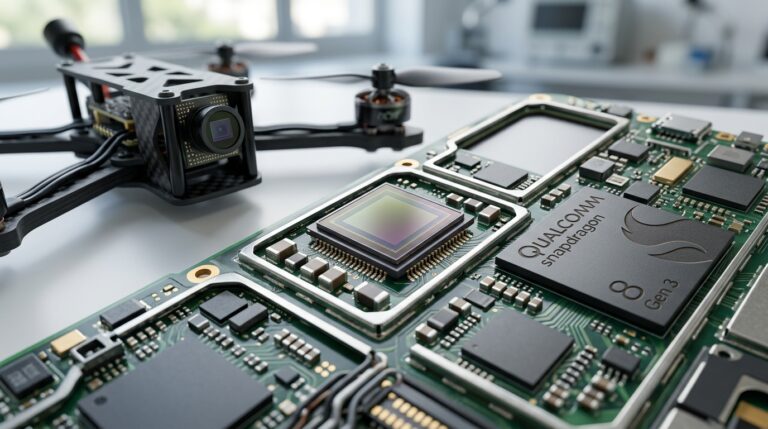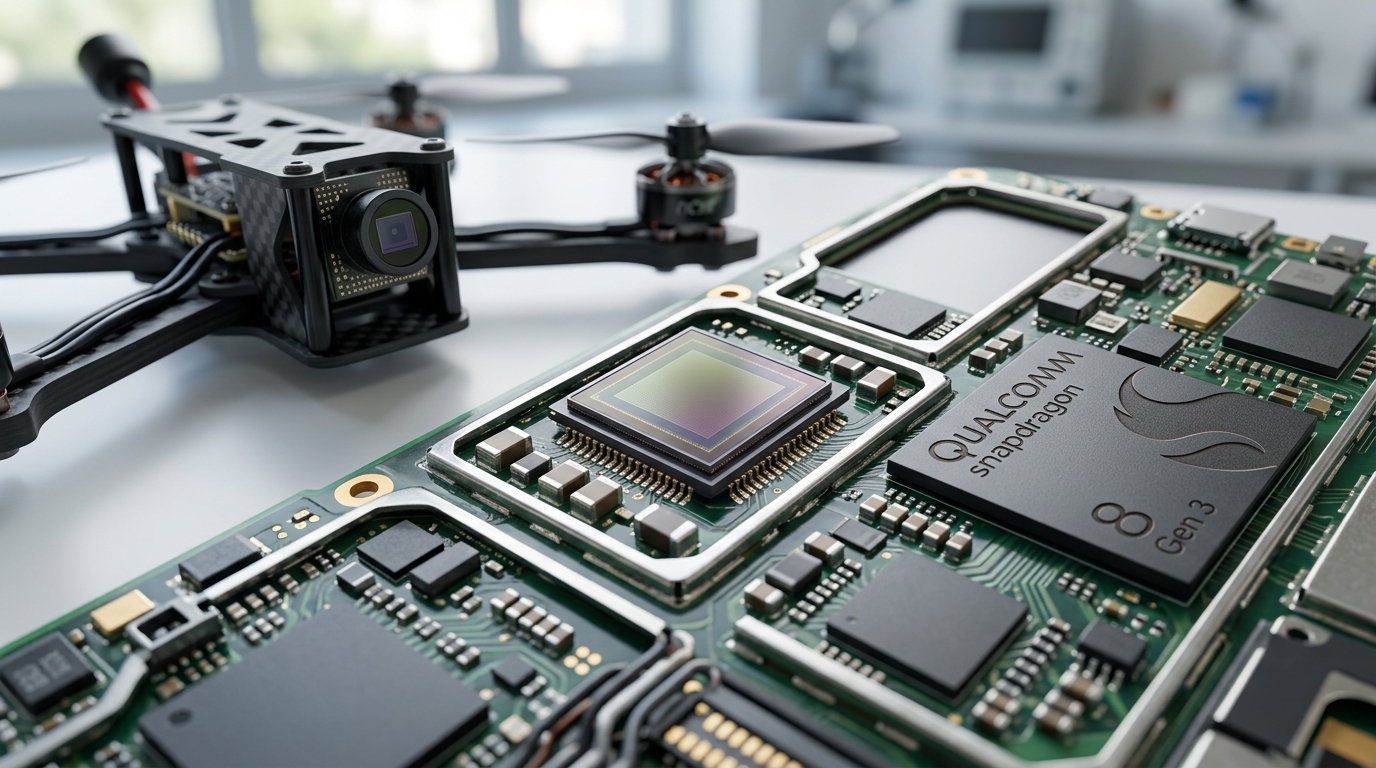
The contract flow has quietly started. Paris-based Prophesee co-developed the IMX636 sensor with Sony, and it has publicly described smartphone work that is production-ready on Qualcomm’s Snapdragon 8 Gen 3 platform. That is the clearest signal that event-based vision is moving from a research curiosity to a component-level specification. The angle most coverage misses is not the imaging quality story. It is the power budget story, and that is where the contract leverage actually lives.
Conventional camera chips process every pixel in every frame, whether or not anything in that frame moved. Event-based sensors only capture what changes in a scene, enabling them to skip processing and data capture for unchanged pixels. This vision category can reduce power, latency, and data processing requirements by orders of magnitude versus conventional imaging in change-driven workloads. That gap is not incremental. It is the kind of performance delta that rewrites component spec sheets.
Drones make the argument even sharper. GSI Technology has shown Gemini-II edge benchmarks running a 12-billion-parameter multimodal model at about 30 watts on a drone platform, with the company comparing that to substantially higher power for comparable edge-GPU-class platforms. Intel and ETH Zurich have also demonstrated very high-rate control workloads on Intel’s Loihi neuromorphic platform, including drone horizon tracking at 20kHz with 200 microsecond latency. Speed and efficiency arriving simultaneously is the combination that procurement teams for autonomous systems have been waiting for.
On the defense side, contracts are already signed. BrainChip was awarded a roughly $1.8 million Air Force Research Laboratory SBIR Phase II contract for neuromorphic radar work, including mapping complex sensor signal processing algorithms onto neuromorphic chips. BrainChip has also disclosed a subcontractor agreement with RTX’s Raytheon to support completion of that AFRL contract.
The market itself is still small but growing fast enough to matter to early movers. Mordor Intelligence puts the neuromorphic chip market at $0.51 billion in 2026, expanding to $4.08 billion by 2031 at a 51.57% CAGR. Separately, Persistence Market Research says image recognition and vision processing is the largest application segment in 2026, at over 34% of the neuromorphic computing market and valued at more than $2.8 billion. Vision is where the first wave of commercial volume concentrates, and that is not an accident.
The edge, covering sensors, wearables, drones, and always-on devices, is where neuromorphic wins first and cleanly, because the enemy there is the battery rather than Nvidia. That framing matters for traders. The data center debate about neuromorphic versus GPU is a multi-year argument. The edge sensor contract cycle is already underway. Qualcomm, Sony, BrainChip, GSI Technology, and SynSense are the names showing up in actual commercial partnerships and deployments. Watch which of them convert pilots and early deployments into volume commitments over the next two quarters. That is the signal the market has not yet priced.