Hey there, bargain hunter.
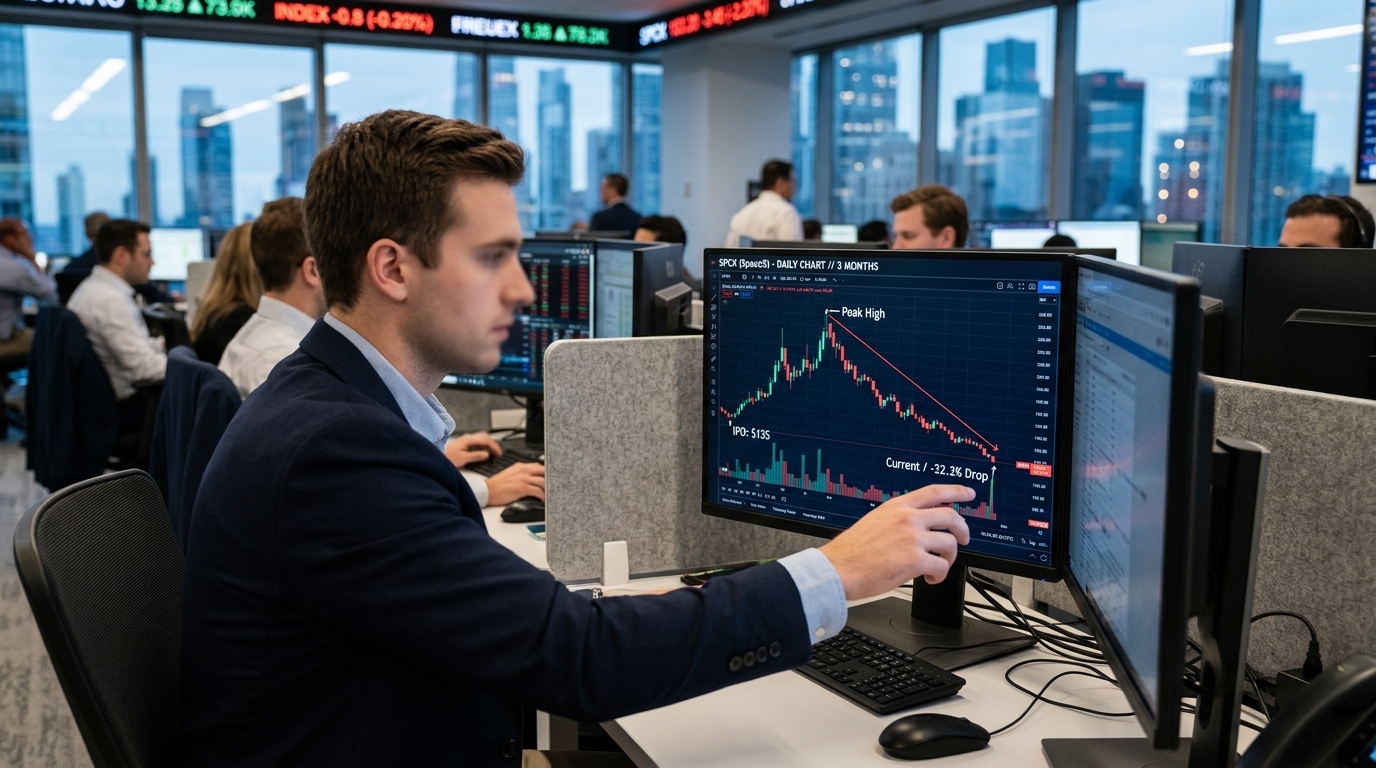
Two weeks ago, SpaceX completed what may be the most watched public market debut in a generation. The stock priced at $135, surged 67% to a peak above $225 within days, and now trades around $153. In two weeks, it has already done a full cycle of euphoria and hangover.
So. Is this a buying opportunity, a warning, or just the noise that follows every mega-IPO?
Let’s start with what actually happened.
What the Numbers Say
The IPO itself was historic by any measure. SpaceX priced at $135 per share ahead of its June 12, 2026 trading debut, raising about $75 billion — the largest IPO ever. The company entered public markets at a valuation around $1.75–$1.8 trillion. Within days it briefly hit a market cap north of $2.6 trillion, briefly surpassing Amazon and Meta by market value.
Then it came back down.
As of June 25, SPCX trades near $153 — roughly 13% above its IPO price, but 32% off the peak. The part most people are skipping over is why it went that high so fast, and why it came back down almost as quickly.
Here is where it gets interesting. Only about 4% of SpaceX’s total shares were made available for public trading at launch. That is not a typo. The remaining shares were locked up by insiders, early venture backers, and Elon Musk himself. With almost no float and widespread anticipation around potential Nasdaq-100 “fast entry” eligibility, the early price action was structurally distorted. Then options began trading. Bears got access to the stock for the first time. And the pullback started.
The Business Underneath the Price
Strip away the post-IPO noise and you have three very different businesses inside one ticker.
Starlink is the one that matters most right now. In 2025, Starlink generated $11.4 billion in revenue — up roughly 50% from about $7.7 billion in 2024 — and carried an adjusted EBITDA margin of about 63%. As of March 31, 2026, it had about 10.3 million subscribers across roughly 160 countries and territories. Recurring subscription revenue, global scale, and a margin profile most software companies would envy. That is what the bulls are actually paying for.
Then there is the launch business. Profitable, strategically critical, and increasingly commoditized on its own terms. SpaceX dominates launch economics with Falcon 9 reusability, but this segment does not move the valuation needle the way Starlink does.
Then there is xAI. This is where the losses live. SpaceX’s IPO materials and contemporaneous coverage described the AI segment (which includes xAI and X) as loss-making and capital-intensive, but specific figures like “R&D costs up 300%” and “76% of group capex in Q1 2026” are not consistently verifiable from primary filings in public circulation. You are buying a cash-burning AI moonshot wrapped inside a cash-generating satellite business.
The Lockup Problem Every Buyer Needs to Understand
This is the part that will matter more than anything else between now and year-end. The lockup structure on SPCX is not a standard 180-day single event. It is tiered, rolling, and more complex than most retail investors have mapped out.
- A first tranche can unlock after Q2 2026 earnings (timing depends on the company’s actual reporting date)
- A conditional performance-based tranche can unlock early if SPCX trades at least 30% above its IPO price for a specified test period before that earnings date — meaning above $175.50
- Additional tranches may release periodically into the fall
- The main time-based 180-day lockup expiration is December 8, 2026
One analyst calculated that insiders could potentially sell a large fraction of shares by early September, dramatically increasing the current float.
That is the supply shock hiding in plain sight.
Elon Musk’s shares — he controls 85.1% of voting power through Class B stock — are subject to extended restrictions beyond the standard lockup, but the exact release date for that block should be verified against the final prospectus language. But early venture backers and thousands of employee holders will have real decisions to make as the staggered unlocks begin.
Valuation — Where It Gets Uncomfortable
At $153, SPCX carries a market cap around $2 trillion. Starlink’s $11.4 billion in 2025 revenue, growing at roughly 50% annually, is the anchor. A 30x revenue multiple on Starlink — aggressive but not absurd for a global satellite monopoly with 63% EBITDA margins — gets you to roughly $340 billion for that segment alone.
The rest of the company is almost pure optionality: Starship’s commercial potential, xAI’s upside, and the orbital data center ambitions. SpaceX also disclosed a bitcoin treasury in its S-1 (valued around $1.3 billion as of March 31, 2026), though it is not the centerpiece of the thesis. The bull case is that you are buying the most vertically integrated technology-infrastructure-defense-AI company ever assembled, at a discount to where it was two weeks ago.
The bear case is simpler. S&P Dow Jones Indices declined to adopt a fast-track rule for the S&P 500, meaning the largest pool of passive capital — SPY, VOO, IVV — will not be forced buyers for at least a 12-month seasoning period. A company burning heavily in its AI segment, with a swelling float schedule, priced at more than 175 times trailing Starlink revenue, needs the fundamentals to keep compounding to justify staying here.
What to Watch
- Starlink subscriber and revenue growth in Q2 2026 — the first reported quarter since the IPO. The market will measure actual subscriber acceleration against the roughly 50% pace seen in 2025.
- The $175.50 threshold — whether SPCX can hold above that level may determine whether the performance-based tranche triggers around earnings, adding more near-term supply pressure.
- xAI capex trajectory — if AI-related losses widen further, sentiment on the company’s profitability timeline deteriorates fast.
- Starship test cadence — progress toward NASA’s Artemis lunar mission timeline is a visible milestone for institutional holders.
- December 8, 2026 — the main 180-day lockup expiration. This is the date most patient buyers are circling.
The Cheap Investor Take
Slight tangent, but it matters: the history of mega-IPOs is not kind to buyers who step in during the first 90 days. Facebook fell more than 40% before recovering. Most large IPOs do their most attractive work between the first lockup wave and the six-month anniversary.
The business case for SpaceX is genuinely compelling — Starlink is one of the highest-quality recurring revenue businesses to ever enter public markets. The price, at $153, is already lower than where most retail buyers could access shares at IPO. But the supply calendar is real, and the first post-IPO earnings report is a hard fundamental test of whether this valuation holds.
If the Starlink growth rate stays above 40% and AI-related losses begin to narrow, the pullback toward the $135 to $155 range looks like a patient entry window. If growth decelerates or the lockup waves create sustained selling, December 2026 will offer a cleaner setup than today.
The question worth sitting with: is this a discount, or just the first of several discounts to come?
This is not investment advice. All data sourced from SpaceX’s prospectus and publicly available coverage as of June 26, 2026. All investments involve risk, including the possible loss of principal.