There are quarters that beat estimates. And then there are quarters that rewrite the story entirely.
Micron Technology just had the second kind.
On June 24, the company reported fiscal Q3 2026 results that stopped a lot of people mid-scroll. Revenue came in at $41.456 billion — up about 346% from the same quarter a year ago, and well past the roughly $35–$36 billion Wall Street had penciled in. Earnings per share hit $25.11, beating consensus by roughly $4.6 per share. Gross margins expanded to 84.9%. And then the guidance dropped: Q4 revenue of approximately $50 billion (plus or minus $1 billion).
That’s not a beat. That’s a different conversation.
What’s interesting is how Micron got here — because it wasn’t luck, and it wasn’t a one-time surge. The company is the largest U.S.-headquartered memory manufacturer and one of only three companies with the capability to produce high-bandwidth memory (HBM), the specialized architecture that sits directly on AI accelerators. Without it, those chips can’t process data fast enough to run large language models at scale. Every time a hyperscaler orders another wave of GPUs, it also needs the HBM that goes with them.
And right now, there simply isn’t enough of it.
Micron has said its 2026 HBM supply is fully committed under agreements. Some reports also claim Micron’s next-generation HBM4 is ramping faster than its prior HBM3E generation and that HBM4 revenue has already surpassed $1 billion, but those specific HBM4 ramp-rate and revenue figures are not confirmed in Micron’s Q3 FY2026 earnings release.
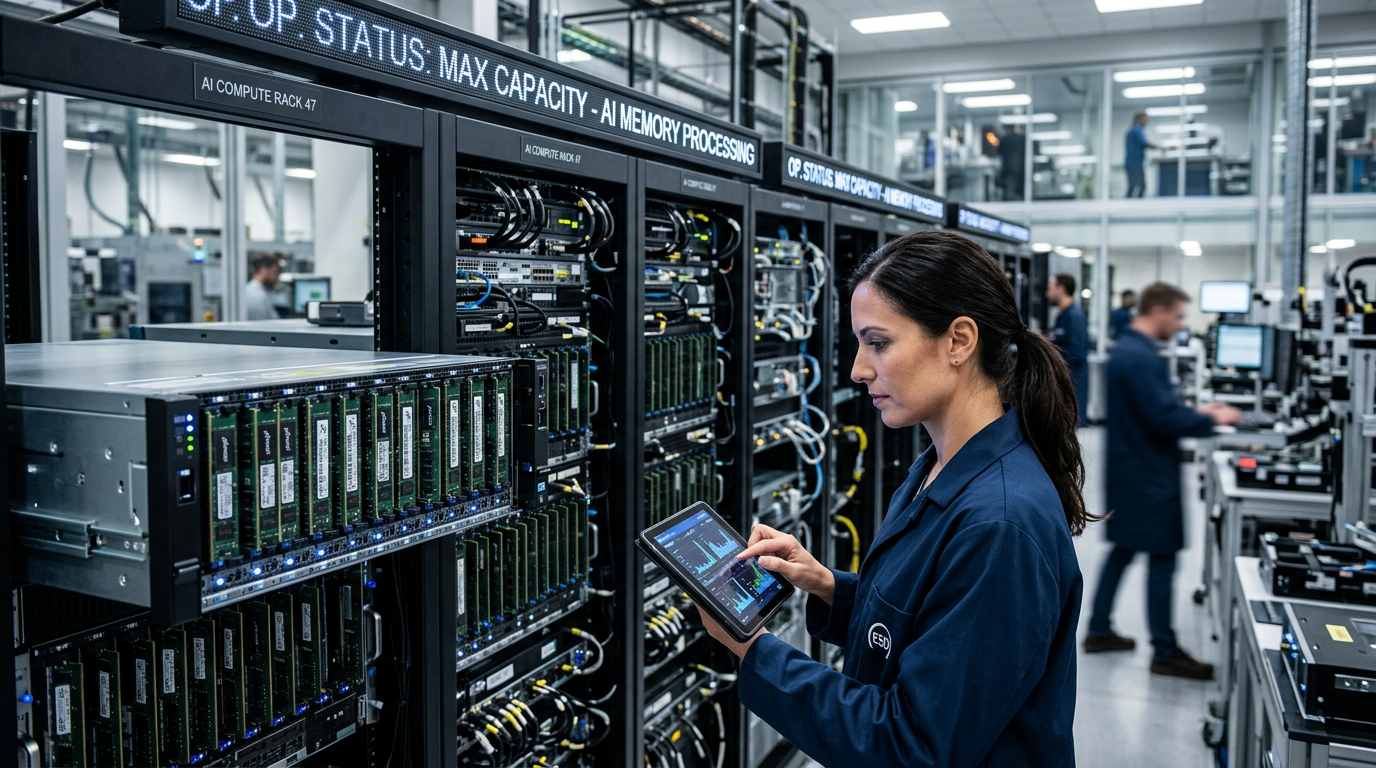
Slight tangent, but it matters: the hyperscalers have collectively guided to around $725 billion of capital expenditures in 2026, largely tied to AI infrastructure. That money eventually runs through memory chips. Every server, every GPU cluster, every inference rack needs memory to function. Micron doesn’t just benefit from that spending — it’s one of three companies in the world that can supply HBM at scale.
The other two are Samsung and SK hynix. And all three have signaled they intend to manage supply carefully rather than chase volume at any cost. That pricing discipline is showing up in the margins. Micron’s gross margin was about 38% in fiscal Q3 2025. It’s 84.9% now.
To cement that revenue visibility further, Micron signed 16 long-term “take-or-pay” Strategic Customer Agreements — binding commitments that provide contracted supply assurance. Micron has disclosed that 14 of those 16 agreements represent approximately $100 billion of cumulative revenue at the minimum contract price over the remaining agreement term (based on the minimum commitments in the contracts).
The stock has moved accordingly. Shares are up several-fold over the past year, and the company crossed $1 trillion in market cap in late May.
Here’s where it gets interesting though.
Despite that run, the stock’s forward earnings multiple has been widely discussed as remaining well below many other marquee AI names (though the exact forward P/E depends on which earnings basis and estimate set you use). UBS did sharply raise its price target earlier this year, arguing that structurally durable HBM demand should change how Micron is valued. Meanwhile, Micron has projected the total addressable market for HBM to grow from about $35 billion in 2025 to roughly $100 billion by 2028 (about a 40% CAGR).
The risks are real and worth naming. Samsung and SK hynix are both expanding capacity aggressively. If demand growth slows or supply floods the market faster than expected, margins compress. Micron is also guiding to approximately $27 billion of capex for fiscal 2026 (net of anticipated government incentives), which carries its own execution risk at scale.
But here’s what the bears may be underweighting: memory is no longer a commodity in the way it used to be. HBM is more complex to manufacture than conventional DRAM, and the industry has been shifting mix toward HBM to serve AI accelerators. New capacity takes years and billions to build. That’s not a setup that unwinds quickly.
The old playbook — sell the cycle peak — may not apply here. When HBM’s share of total DRAM revenue becomes large enough, analysts argue Micron’s earnings could become structurally less volatile. The exact timing and threshold for that transition varies by model and isn’t something the company’s Q3 FY2026 release itself pins down.
Which leaves the question: does a company with ~346% revenue growth, 84.9% gross margins, ~$50 billion in Q4 guidance, and 16 multi-year binding supply agreements deserve to trade at a deeply discounted multiple?
The market hasn’t made up its mind yet. That’s the part worth watching.
This editorial is for informational purposes only and does not constitute investment advice. All data sourced from company filings and publicly available analyst reports. Past performance is not indicative of future results. Investing involves risk, including the possible loss of principal.