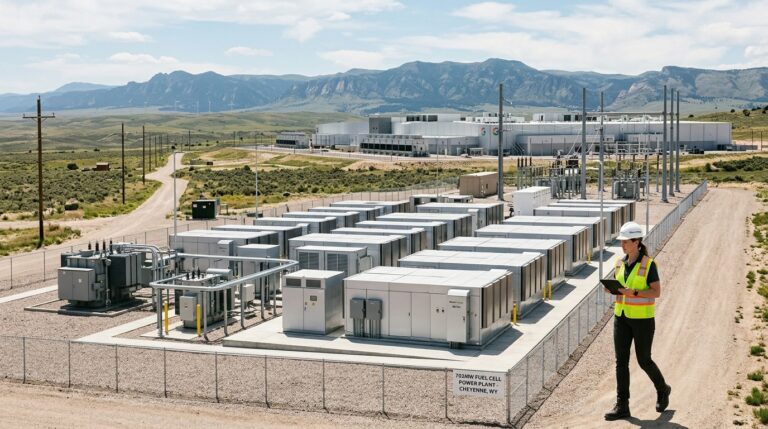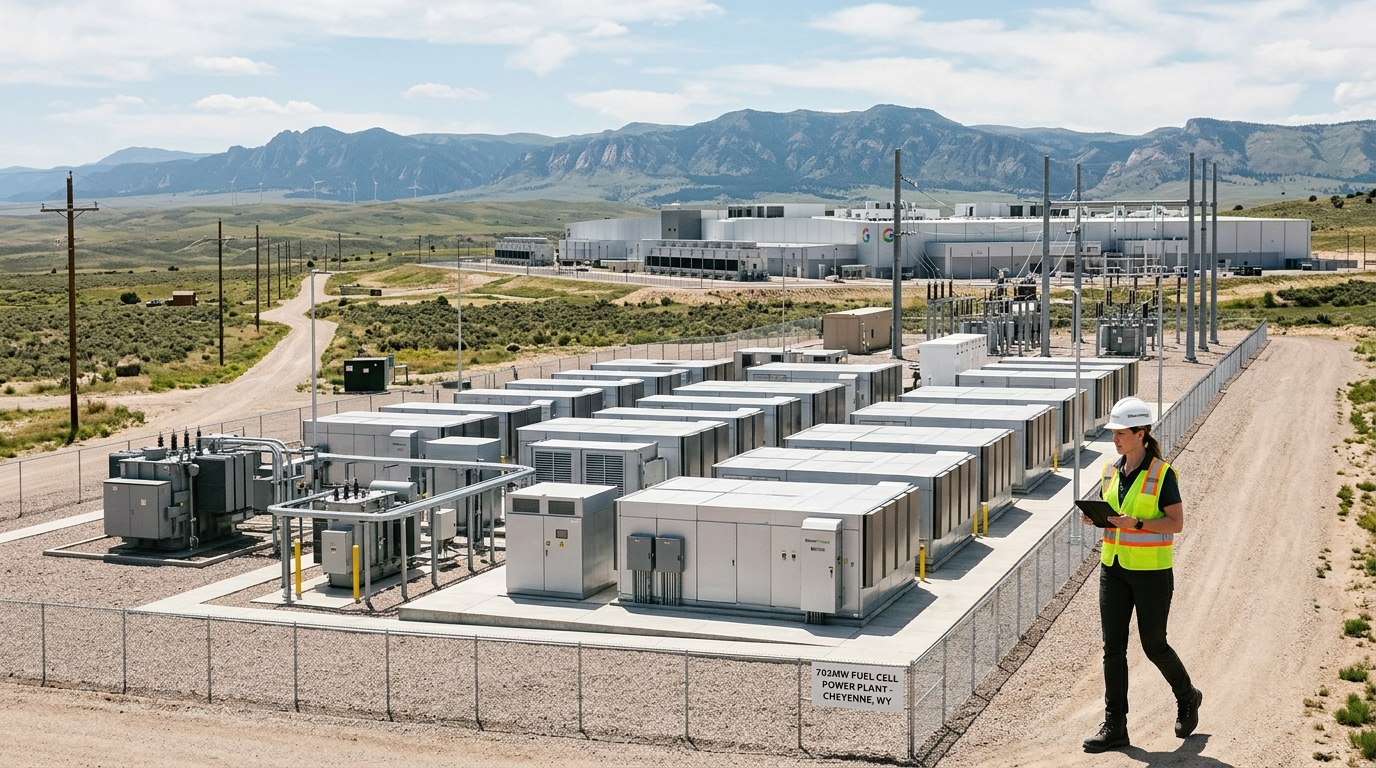
Most utility contracts are measured in cost recovery and regulatory approval. AEP’s deal announced October 14, 2026 is something different: a 20-year power purchase agreement with Google to offtake 100% of a new 702MW fuel cell facility near Cheyenne, Wyoming. Twenty years of guaranteed revenue from one of the most creditworthy buyers on earth. That is the kind of contracted growth rate-regulated utilities almost never get to count.
The Business
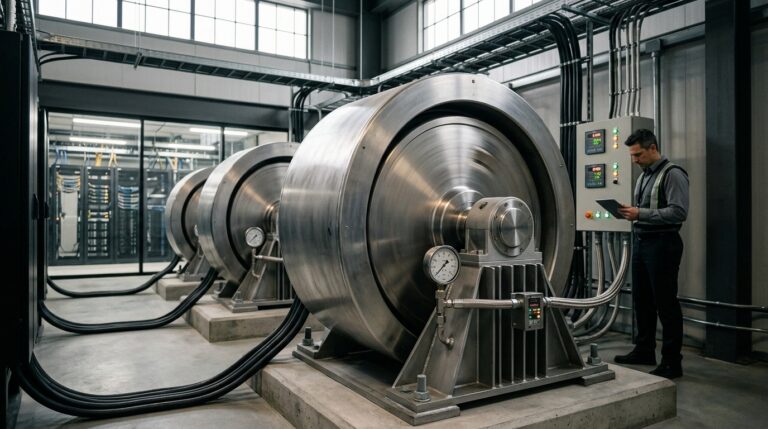
AEP plans to invest approximately $4 billion to develop the plant, which will use Bloom Energy fuel cell technology. The technology generates electricity from natural gas without combustion, and the project includes plans to integrate carbon capture technology to deliver reliable, near-zero-emissions power. Construction starts in 2026, with full operation targeted for the end of 2028.
The structure is deliberate. Google will purchase power from Cheyenne Fuel Cell, LLC, of which AEP holds an approximately 92% stake, with nearly 8% held by funds advised by Basalt Infrastructure Partners. That separation keeps the project off the rate base that serves AEP’s 5.6 million regulated customers. No ratepayers stand behind this plant, so AEP’s return rests entirely on one customer’s signature.
Why Wall Street Is Paying Attention
This is not a standalone deal. Black Hills Corp. separately announced it is investing $1.8 billion in new natural gas generation and managing 2.1 gigawatts of third-party contracted resources through a private microgrid, all under agreements with Google effective September 30, 2026 and running through 2048. Google is currently developing a 2.7GW data center near Cheyenne, and it is assembling the power supply piece by piece from regional utilities willing to act as contracted builders rather than grid operators.
On October 13, 2026, KeyBanc upgraded AEP to Overweight from Sector Weight and set a price target of $133. AEP closed at $127.14 on October 16, 2026, up 2.29% on the day. The stock has recovered most of its summer drawdown but sits roughly 10% below its 52-week high of $140.58.
What’s Driving the Opportunity
The AEP deal is compelling for what it proves about the utility’s expansion ambitions. This is a regulated utility building dedicated generation for one customer outside its traditional service territory. Utilities are learning to act like power developers for hyperscalers. AEP’s $78 billion five-year capital plan gives it room to repeat it.
But investors focused purely on the Cheyenne fuel cell project may be looking at the wrong ticker. The fuel cells will be supplied by Bloom Energy under a previously announced agreement for up to 1 gigawatt. Bloom gets the hardware revenue regardless of how AEP’s regulated earnings develop. Bloom Energy’s revenue over the trailing twelve months reached $3.11 billion, up about 91% year over year. The deal flow is real; whether the stock already prices it in is the honest question.
What Could Go Wrong
For AEP, the risks are structural and timing-dependent. The schedule depends on tax credit timing: AEP has said the facility is expected to be fully operational by the end of 2028. Any construction delay does not just push revenue, it can also complicate eligibility and timing for credits. A December 2026 milestone condition noted in AEP’s second-quarter filing remains outstanding, and the October release naming Google does not confirm those conditions are met.
For Bloom, the problem is valuation. Bloom trades at a price-to-sales ratio above 20. Insiders have sold about $165.2 million worth of shares over the past 12 months, with no buying reported. The deal flow is real; whether the stock already prices it in is the honest question.
The Bottom Line
AEP is doing something genuinely new for a regulated utility: building a contracted power plant for a single hyperscaler customer outside its own grid, funded by project-level debt rather than ratepayer guarantees. AEP will report third-quarter results on October 28, 2026, which will be the first real window into how management intends to scale this model. That is the event to watch.
The stock at $127 trades at a premium to peers on most valuation metrics. Investors who want direct exposure to the fuel cell buildout, with higher risk and a wider range of outcomes, are really looking at Bloom Energy. AEP offers the steadier, regulated-adjacent version of that story, backed by 20 years of Google’s credit. Neither is cheap. Both deserve a place on the list.