Bloom Energy (BE) reported Q3 results Wednesday that checked every box a stock screener could ask for: record quarterly revenue of $1,235.8 million, a 138.1% year-over-year increase, and full-year revenue guidance raised to $4.4 billion to $4.6 billion, representing 122% growth at the midpoint. Management raised its full-year guidance for revenue for the third time this year, citing increased visibility into the fourth-quarter delivery pipeline and a growing customer backlog. The stock sold off nearly 9% on the day anyway, leaving a gap between the numbers and the price that deserves a close look.
The Business
Bloom makes solid oxide fuel cell systems that generate electricity on-site without combustion, converting natural gas or hydrogen through an electrochemical process. Revenue growth is being driven by the adoption of distributed on-site power solutions by hyperscalers and commercial enterprises. The pitch to data center operators is simple: the grid cannot be built fast enough, and Bloom can deliver reliable power in weeks rather than years.
Product revenue of $1,073.6 million increased 179.4%, crossing $1 billion in a single quarter for the first time. Non-GAAP operating margin reached 23.1%, up from 8.9% a year ago. Non-GAAP operating income of $285.7 million grew more than 500% year over year, and in this quarter alone exceeded operating income for all of last year. That is the kind of operating leverage that rerated industrial companies in prior cycles.
Why Wall Street Is Paying Attention
Bloom joined the S&P 500 on September 21, 2026, following record Q2 revenue and raised full-year guidance. Every index fund benchmarked to the 500 had to buy it, whether or not the price made sense. That mechanical buying layer landed on top of an already strong momentum story.
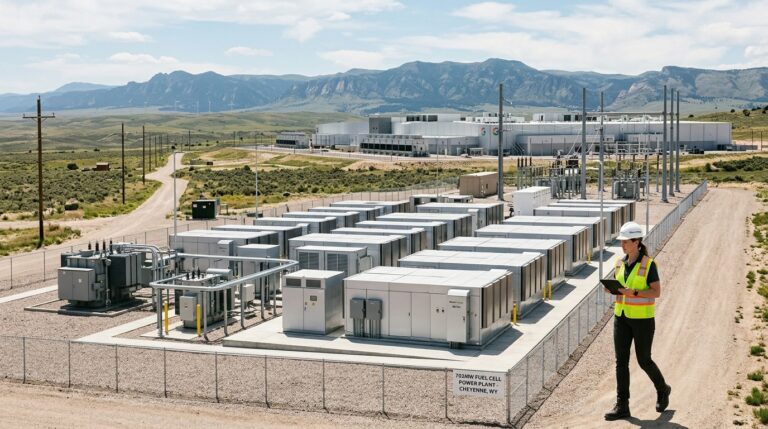
The catalyst pipeline thickened further during the quarter. AEP plans to invest about $4 billion in a 702-megawatt Bloom Energy fuel cell project near Cheyenne, Wyoming, to supply Google under a 20-year power purchase agreement, with plans to integrate carbon capture technology. Unlike turbines and engines, Bloom’s technology can support carbon capture plans, and management calls CCS a potential trillion-dollar market opportunity. The company says its backlog is expanding faster than revenue, with increasing diversity in customers, verticals, and geographies.
What Could Go Wrong
Here is the number that matters most and gets the least attention: during the three months ended September 30, 2026, revenue from two customers accounted for approximately 43% and 26% of total revenue. Together, 69 cents of every dollar Bloom collected last quarter came from a pair of buyers. Pull one large delivery, delay one site acceptance, and a quarter that looked like $1.2 billion becomes something much smaller.
This is not a new problem, but it is scaling with the revenue. Large campus deliveries are lumpy, and one or two customers could lead revenue in any given quarter as different projects reach their delivery windows, meaning revenue can look concentrated in any single quarter. Management frames the concentration as an artifact of timing. That may be true. It is also the same explanation given in Q1 and Q2, each of which showed similarly narrow customer bases driving the headline numbers.
Free cash flow was negative $181 million in the quarter, though positive $42 million year to date. Cash on hand stood at $2.5 billion at quarter end, which provides meaningful runway, but the working capital build from rapid scaling means cash generation is lagging reported income.
The Bottom Line
Bloom Energy is combining things that rarely appear together: triple-digit revenue growth, meaningful margin expansion, a raised forecast, and mandatory index-fund buying. Revenue grew 138% while operating expenses rose only 26%, which is the definition of operating leverage asserting itself. The AEP-Google carbon capture project is the kind of reference deal that pulls other hyperscalers into active conversations.
The stock trading down 9% on a blowout quarter, during a week when AI-adjacent names faced financing-related selling pressure, opens a window that rarely lasts. The risk is real and specific: a $4.5 billion annual revenue forecast flowing predominantly through two contractual relationships means a single delayed delivery can move the stock dramatically in either direction. Investors who can hold through that volatility, and who believe the backlog is real, are looking at a company that has earned the right to be taken seriously.