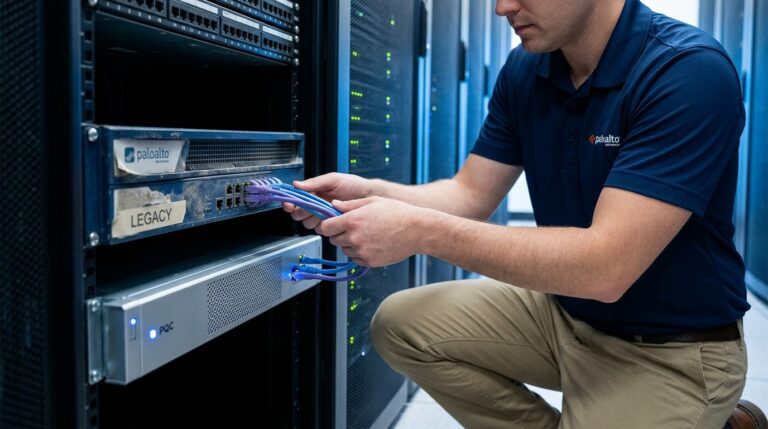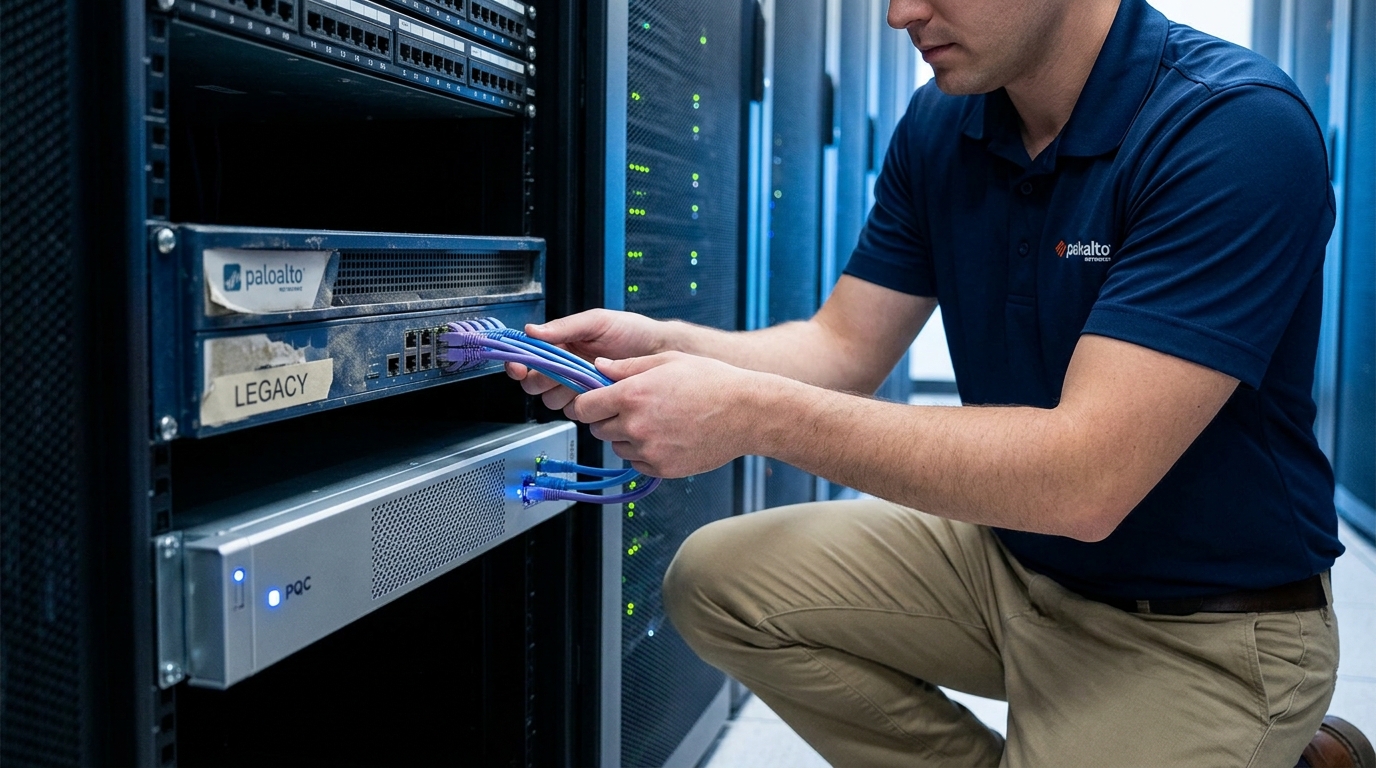
Palo Alto Networks has spent the better part of the past year repositioning its firewall franchise as the enterprise answer to post-quantum risk. The product logic is credible. The commercial question is more complicated.
In July 2026, AT&T folded Palo Alto’s post-quantum cryptography-enhanced Prisma SASE fabric into its Dynamic Defense offering, calling the integration “an operational mandate.” The architecture applies PQC protection uniformly across wireless 5G, fiber, and legacy circuits, eliminating what the companies describe as weak links in hybrid environments where data moves between private and public circuits. That is a meaningful distribution event for PANW: AT&T’s enterprise reach turns a product announcement into real deployment scale.
The underlying threat is not theoretical. PANW introduced quantum-safe VPN tunnels and SSL/TLS sessions specifically to defend against harvest-now, decrypt-later attacks, where adversaries collect encrypted data today intending to break it once quantum computing matures. Palo Alto Networks executives have also argued that the window to prepare is tightening, and have pointed to a shorter time horizon than many older estimates. That compressed timeline is now a sales argument.
The architecture PANW built around this threat is genuinely clever. Through Cipher Translation, its infrastructure acts as a proxy, re-encrypting vulnerable traffic into quantum-safe standards such as ML-KEM in real time at the network edge, moving legacy assets to a quantum-safe posture without a single line of code change. For enterprises sitting on large portfolios of aging internal applications, this matters: a software-defined wrapper beats a hardware replacement cycle.
But here is the part the financials do not yet reveal cleanly. While the public edge is rapidly securing data in transit, organizations have barely begun to address the cryptographic threats lurking in their internal networks, authentication protocols, and administrative structures. PANW’s cipher translation proxy handles the perimeter. Everything behind it, the internal app estate, the certificate infrastructure, the identity layer, remains the customer’s problem.
Full fiscal year 2026 revenue reached $11.5 billion, up 24%, with remaining performance obligations closing at $21.2 billion, up 34%. Next-Generation Security ARR hit $9.1 billion, up 63%. These are the numbers of a platform business, not a product cycle. The quantum overlay accelerates platformization because it gives CISOs a compliance reason to consolidate onto a single vendor rather than managing five point solutions.
The risk worth watching: adoption remains uneven due to performance overheads, legacy integration complexity, skills shortages, and uncertainty around quantum timelines. If enterprise budget cycles slow or Q-Day estimates drift further out, the urgency case softens. PANW’s $21 billion RPO book cushions near-term revenue, but the quantum argument needs regulatory mandate, not just fear, to drive the next leg of hardware refresh spending. That mandate is forming. How fast it hardens determines whether this is a two-year cycle or a five-year one.