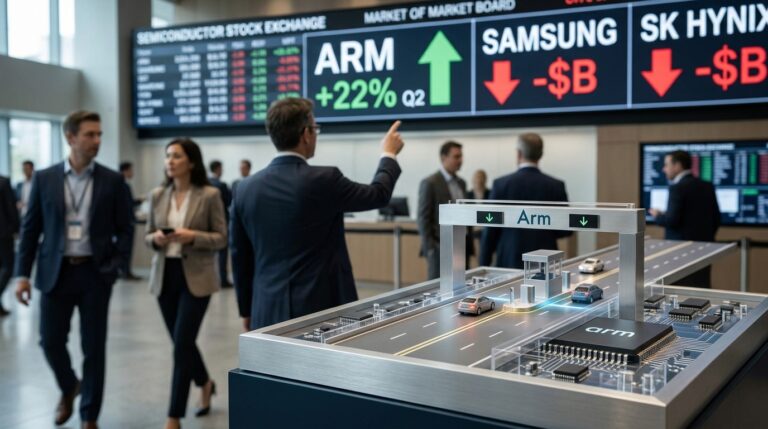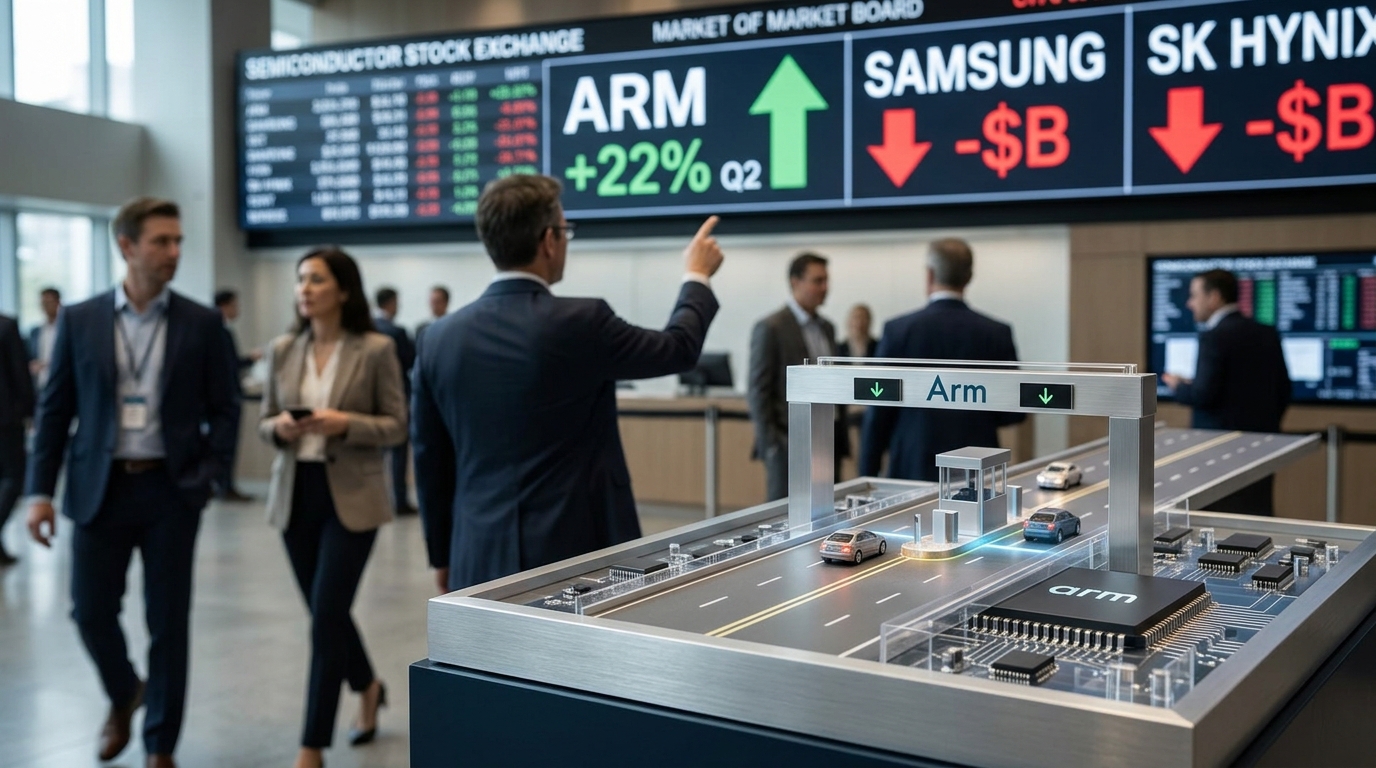
The same week Samsung and SK hynix shares slid sharply in Seoul, Arm Holdings posted a record quarter. That contrast is not a coincidence. It is a business model lesson playing out in real time.
Arm’s second quarter of fiscal 2027 marked its fifth consecutive quarter of total revenue growth exceeding 20% year over year. Licensing revenue reached $773 million, royalty revenue $670 million, and non-GAAP operating income $638 million. Non-GAAP earnings per share came in at $0.52, beating the $0.48 consensus estimate. The memory complex was bleeding. The toll booth kept collecting.
What a Toll Booth Actually Looks Like
Arm is not a chipmaker. It is a royalty and licensing business that earns more revenue per chip every time its partners upgrade to a newer architecture. It licenses processor architectures and designs to companies that build silicon, earning licensing fees when a customer adopts a design and royalties afterwards on every unit shipped. Those royalties accrue for years across smartphones, servers, cars, and industrial equipment, which makes the model closer to a toll than a product sale.
The structural advantage is in the gross margin. When you are licensing blueprints rather than making physical products, your cost of goods sold can be extremely low. In Arm’s fiscal Q2 2027, its GAAP gross margin was 97.1% and its non-GAAP gross margin was 97.9%. Qualcomm competes. Nvidia competes. Amazon and Google compete. All of them pay Arm first.
Two Revenue Lines, Two Different Clocks
Two revenue lines run on two different rhythms: licensing revenue lands when a customer signs up for a design, and royalty revenue accrues afterwards, for years, as products ship. This quarter, licensing surged 50% to $773 million. Data center royalties doubled from a year earlier.
The royalty line is where the structural compounding lives. Arm earns different rates depending on which architecture generation a chip uses. The Armv9 architecture carries higher royalty rates per chip than the prior v8 generation. Arm has said that the typical royalty fee for Armv9 has been around double the fee for Armv8. As the installed base migrates from older designs, Arm’s blended rate per chip rises without any volume increase at all.
The Data Center Changes the Ceiling
Smartphones built the business. The data center is rewriting the opportunity. Data center royalties doubled year over year, and Arm-based server market share at the top hyperscalers more than tripled from 15% in calendar 2024 to more than 50% in calendar 2025. Based on current ramps across Google Axion, AWS Graviton, Microsoft Cobalt, and Nvidia platforms, Arm expects that share to exceed 60% by the end of calendar 2026.
Arm said Amazon disclosed that Graviton revenue commitments had increased more than twentyfold year over year. Microsoft highlighted strong adoption of its Arm-based Cobalt CPU. Arm said Google regards Axion as a critical component of its AI infrastructure. Every one of those chips carries a royalty back to Cambridge.
What Could Go Wrong
The bear case deserves an honest hearing. The quarter itself beat Arm’s own guidance, but what pressured the stock after hours was forward guidance, not current results.
The licensing line, which rescued Q2, is lumpy by nature. A strong quarter of upfront fees tells you customers are committing to Arm’s future roadmap, which is genuinely bullish. But it also means the royalty ramp, the durable recurring engine, is still building. Investors who confuse one-quarter licensing strength with the steady compounding of royalties are reading two different stories as one.
Then there is Arm’s move into its own silicon with the AGI CPU. Arm said confidence increased for the AGI CPU achieving up to $2 billion in revenue across fiscal 2027 and 2028. The upside is real. The risk is that building chips alongside customers who license your architecture tests the neutrality that makes the toll booth trusted in the first place.
The Mogul’s Read
What Warren Buffett identified in Visa, what Charlie Munger admired in See’s Candies, is the same thing Arm demonstrates every quarter: a business positioned at a choke point that cannot easily be routed around. The instruction set architecture is the toll booth, and there is no alternative route.
The question for long-term investors is not whether this quarter was good. It was. The question is whether the per-chip economics, still early in their Armv9 migration, compound into a materially larger royalty stream over five to ten years. The data center evidence says yes. The licensing backlog says customers agree. The valuation, still rich, says the market already suspects it too.
Owning the road has always beaten owning the fastest car on it.