FILE PHOTO: Battery cell production in a Volkswagen pilot line in Salzgitter
By David Shepardson and David Lawder
WASHINGTON (Reuters) – The U.S. Treasury Department on Friday gave automakers additional flexibility on battery mineral requirements for electric vehicle tax credits on some crucial trace minerals from China, such as graphite.
The department said it would give automakers until 2027 to remove some hard-to-trace minerals like graphite contained in anode materials and critical minerals contained in electrolyte salts, binders, and additives.
New rules took effect on Jan. 1 restricting Chinese content in batteries eligible for EV tax credits of up to $7,500, which sharply cut the number of eligible vehicles. Automakers have since made changes to supply chains and won restored eligibility for many vehicles.
Treasury has temporarily exempted graphite and other trace critical minerals from new strict rules barring materials from China and other countries deemed a Foreign Entity of Concern (FEOC), including North Korea, Russia and Iran.
John Bozzella, who heads the Alliance for Automotive Innovation, a group representing major automakers, said the new Treasury rules “appear to recognize the realities of the global supply chain by providing some temporary flexibility in terms of where the critical minerals in EV batteries can be sourced.”
Senate Energy Committee Chair Joe Manchin on Friday harshly criticized the decision, saying the administration has made clear it “will break the law in pursuit of their goal to flood the market with electric vehicles as quickly as possible.” He said the Treasury has “provided a long-term pathway for these (FEOC) countries to remain in our supply chains.”
The new rules, required under an August 2022 law, are designed to wean the U.S. EV battery chain away from China.
Abigail Hunter, executive director of SAFE’s Center for Critical Minerals Strategy, said Treasury’s decision to create a two-year exemption for graphite sourcing should be temporary.
“We need a clear exit strategy, lest we continue our dependencies on adversaries and further undermine the competitiveness of U.S. and allied critical minerals projects,” Hunter said.
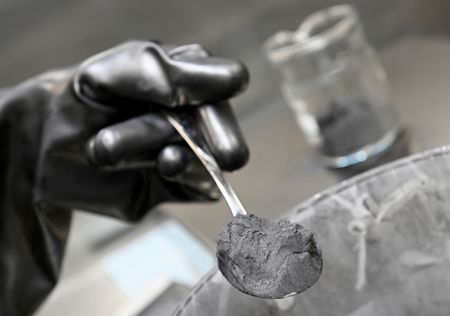
China currently accounts for 70% of global output of graphite, which is used to make electric battery anodes, the negatively charged portion of the battery.
The FEOC rules came into effect on Jan. 1 for battery components and will do so in 2025 for critical minerals used to produce them.
Treasury said in December that the materials being exempted each accounted for less than 2% of the value of battery-critical minerals.
Manufacturers may temporarily exclude certain impracticable-to-trace battery materials from FEOC compliance until 2027 as long as they demonstrate how they plan to comply by then, Treasury said.
“Imagine an EV that complied with all IRA eligibility requirements but is kicked out of the program because of a trace amount of a critical mineral from a FEOC?” Bozzella said. “That makes no sense.”
The 2022 law allowed qualifying EV buyers to use tax credits as a point of sale rebate from the start of this year.
So far in 2024, more than 100,000 credits have been used at the point of sale, representing more than $700 million in upfront savings, the Treasury said.
(Reporting by David Shepardson and David Lawder; Editing by Jamie Freed and Jonathan Oatis)
About the Author