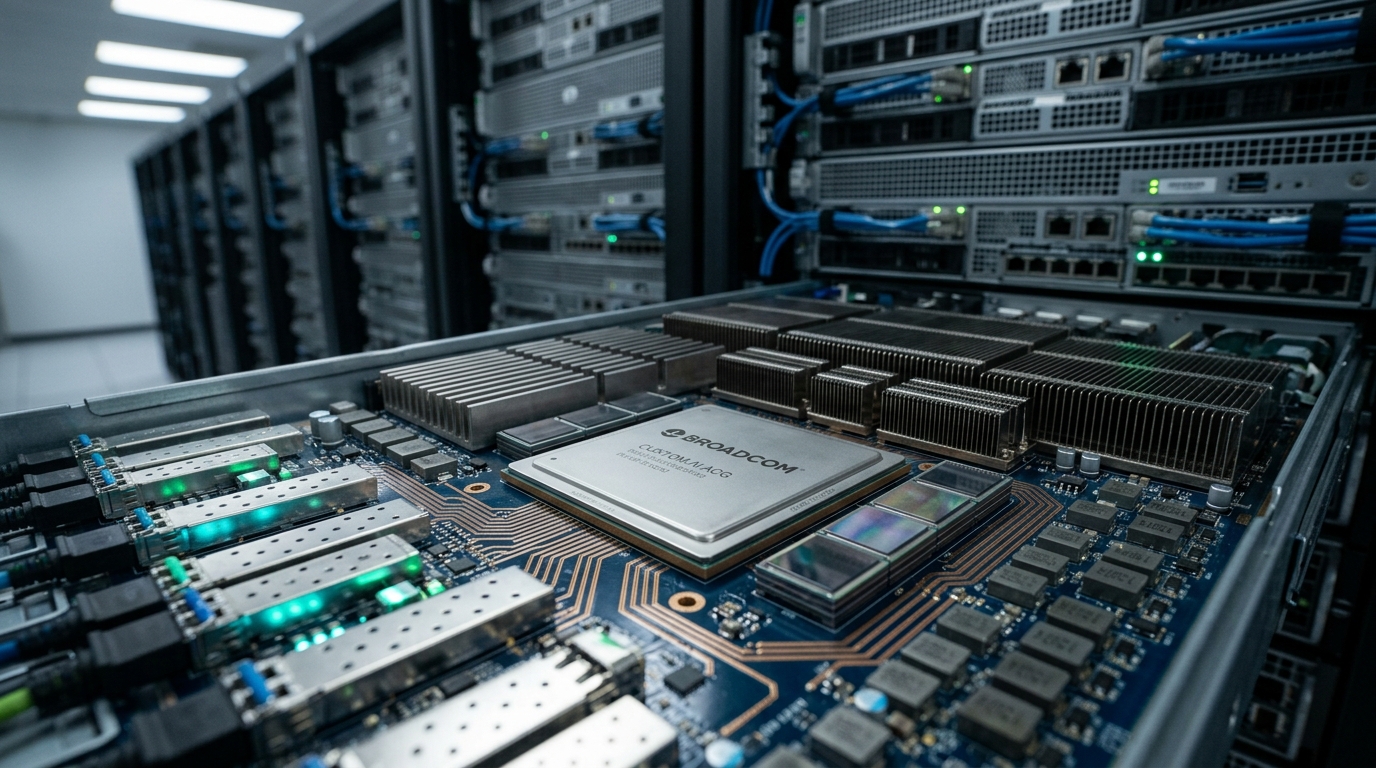
Everyone talks about Nvidia. Fair enough. But while the narrative stays locked on one name, Broadcom has been quietly posting numbers that deserve a second look — maybe a longer one.
Here’s where I’m at on this. The AI infrastructure buildout is no longer a theme in its early innings. It’s a capital spending story at a scale that’s hard to fully comprehend. Morgan Stanley recently revised combined hyperscaler capex estimates to roughly $800 billion in 2026 — up from a prior projection of $450 billion. That money has to go somewhere. A meaningful chunk of it flows directly through Broadcom’s custom silicon division.
In Q1 fiscal 2026, Broadcom reported record revenue of $19.3 billion — a 29% year-over-year jump. But the number that actually matters: AI semiconductor revenue hit $8.4 billion, up 106% year-over-year, ahead of internal forecasts. Management guided Q2 AI chip revenue to $10.7 billion, with total quarterly revenue expected to reach $22 billion — a 47% year-over-year increase. These are not rounding errors.
What’s interesting is the nature of Broadcom’s moat here. General-purpose GPUs dominate headlines, but custom AI accelerators — designed specifically for individual hyperscaler workloads — are gaining ground fast. Alphabet has already deployed Broadcom-designed Tensor Processing Units at scale. Several additional hyperscalers are expected to bring their own custom designs into production through 2026 and 2027, which would materially expand Broadcom’s revenue base. CEO Hock Tan has projected the custom AI chip business alone could generate over $100 billion in annual revenue by end of 2027.
Slight tangent, but it matters: Broadcom also debuted its Taurus™ 400G/lane optical DSP at OFC 2026 — the industry’s first — signaling that the company isn’t just riding the AI wave, it’s actively building the pipes the wave runs through. Analysts have revised the 2026 revenue forecast upward to $94.7 billion, with net income forecast to grow 53% next year.
On valuation — yes, AVGO trades at elevated multiples. 86x trailing earnings isn’t cheap on its face. But forward earnings at 39x start to look more reasonable when the growth trajectory is accelerating, not decelerating. The stock has recovered from a rough start to 2026 and is now trading up roughly 30% year-to-date.
The Risks Worth Watching
- Semiconductor cycles are notoriously unforgiving — demand could soften faster than current guidance implies
- Trade tensions and export controls remain a genuine overhang on the chip sector broadly
- Infrastructure software, which grew just 1% last quarter, remains a drag relative to the headline AI numbers
The part people skip when analyzing Broadcom: this isn’t a single-product, single-customer story. The networking business, the custom silicon partnerships, and the software layer all compound on each other. That’s a different kind of durability.
Whether AVGO is the right fit for your portfolio is your call to make — but the data suggests this one is worth a closer look before the next earnings print.