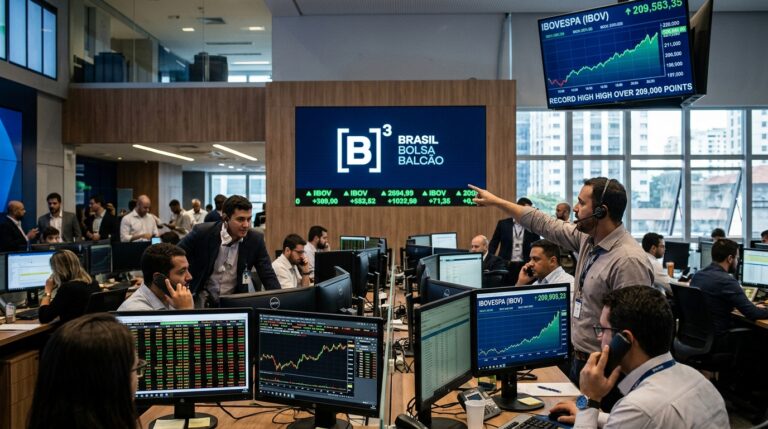
For roughly 15 years, betting on emerging markets over U.S. equities was a reliable way to underperform. That pattern may be breaking in a meaningful way, and the flows say so more clearly than any analyst note.
Year-to-date in 2026, investors have added $35 billion to U.S.-listed broad emerging market equity ETFs – up 21% from the same period last year. Single-country ETF flows have already exceeded the total inflows for all of 2025. According to Bank of America research, four times more money is currently flowing into international stocks than U.S. stocks. That is not a rounding error. That is a regime change in how institutional capital is being allocated.
The numbers behind the shift are not complicated. EM equities currently trade at approximately 14x forward earnings – a 32% discount to developed markets, wider than the long-term average discount of around 27%. At the same time, EM earnings revisions have turned positive relative to developed markets after roughly 14% earnings growth last year. In 2026, EM earnings are expected to grow 29%, more than double the current U.S. consensus estimate of 14%.
What’s interesting is that most of the institutional rotation quietly began months ago, while U.S. investors were still debating whether the Fed would cut or hike. The MSCI Emerging Markets Index posted a 30.6% return in 2025, outperforming all three major U.S. averages. Through early 2026, it was off to its best start versus the S&P 500 in three decades, outpacing domestic stocks by 14.4% through February before the Iran conflict introduced a temporary headwind.
The leadership within EM is specific and worth understanding.
Korea and Taiwan are the East Asian tech angle – semiconductor exports, AI hardware, and corporate governance reforms. Taiwan Semiconductor sits at the center of every conversation about where AI chips actually come from. South Korea has been one of the standout country performers, with its MSCI index returning over 45% in 2025 alone. India has compounded at roughly 13% annually over the past 15 years in USD terms, driven by domestic consumption, infrastructure spending, and a burgeoning IPO market. Brazil is the emerging contrarian call – cheap on a CAPE basis, with presidential elections approaching and a political environment that analysts at Alvine Capital are describing as part of a broader Latin American realignment.
The dollar is the other piece of this. EM assets historically suffer when the U.S. dollar strengthens, because most commodity contracts and EM debt are dollar-denominated. But EM currency volatility, measured by the MSCI EM Currency Index, reached multi-decade lows in 2025. The macro backdrop – a weaker dollar trend, moderating U.S. rate expectations, and improving EM sovereign balance sheets – is materially different from the environment that crushed EM in the 2013 taper tantrum or the 2018 dollar surge.
Here is the part the headlines miss. Despite improving flows, EM remains structurally under-owned relative to global benchmarks. Institutional positioning is only now beginning to catch up to the opportunity the fundamentals have been pointing to for over a year. The reallocation that creates durable performance is not a week or a quarter – it is a multi-year rotation of the type that defined EM outperformance from 2003 to 2007.
The accessible vehicles are straightforward. The iShares Core MSCI Emerging Markets ETF carries $144 billion in assets, tight spreads, and broad exposure across China, India, Taiwan, and South Korea. The SPDR Portfolio Emerging Markets ETF tracks over 3,000 holdings. Single-country ETFs for Korea and Brazil have seen exceptional demand in 2026. For investors willing to go more specific, Taiwan Semiconductor and Samsung Electronics represent direct plays on the AI semiconductor cycle with a fraction of the U.S.-comparable valuation.
The risk is not theoretical. Geopolitical friction – particularly around Taiwan – remains a live variable. China’s 24% weighting in the MSCI EM index means sentiment around Beijing’s economy and regulatory posture matters significantly. And any meaningful reversal in the dollar’s current direction would put pressure on EM currency returns.
But here is where I land on this: the consensus in 2026 is still U.S. equities first, everything else second. The data is starting to argue the opposite. When a rotation this large is happening and most retail portfolios still have near-zero non-U.S. exposure, that asymmetry tends to close in one direction.