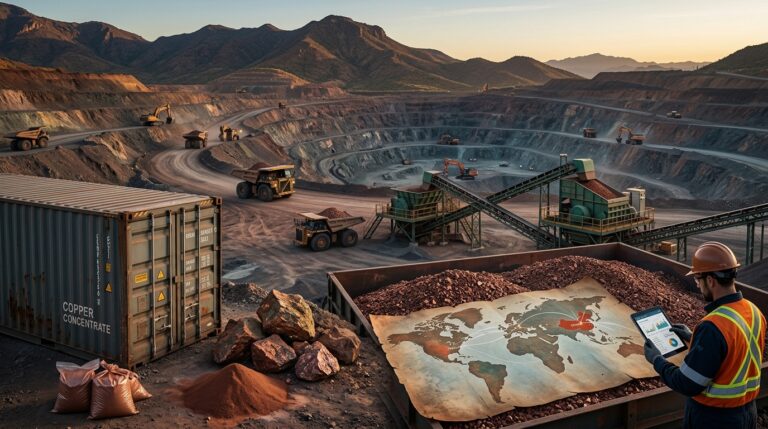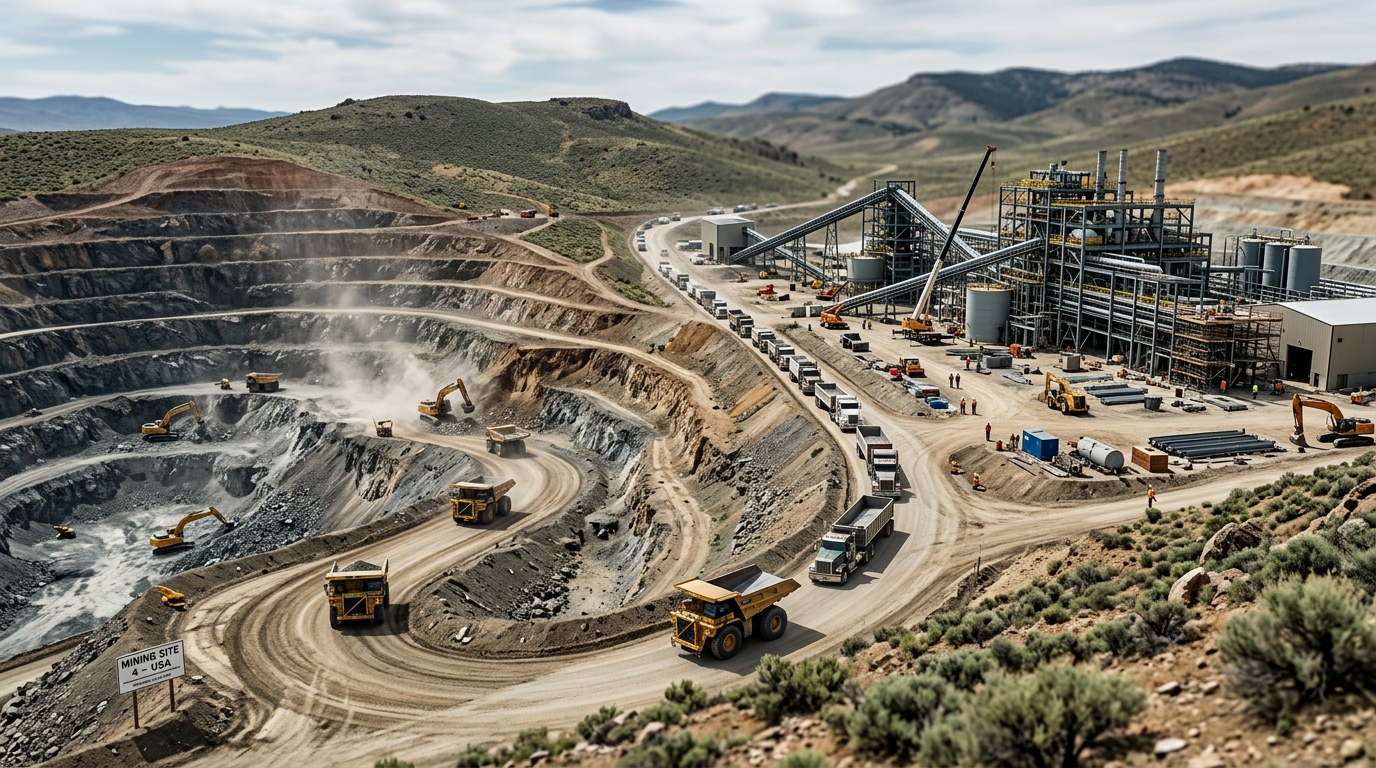
Friday’s State Department roundtable produced a clean headline: President Trump touted $3 billion in US investments in critical minerals mining at a meeting with top industry executives aimed at weaning the US off supply chains dominated by China. The stock market responded accordingly. MP Materials (MP) jumped and USA Rare Earth (USAR) also surged on the day. The reaction was rational, the framing was incomplete.
The piece that didn’t make the headline is the one professional investors are quietly debating. Mining more ore does not equal supply chain independence. Not even close.
Why Wall Street Cares
The US government is investing $3 billion in critical minerals and battery projects to increase domestic production and boost national security. The White House needs these materials to replenish weapons stockpiles depleted during the Iran conflict and reduce dependence on Chinese supply chains. That second sentence is the driver. US forces burned through large numbers of precision-guided missiles and air-defense interceptors during the five-month Iran conflict. Defense officials have warned that replenishing some inventories could take years given existing production constraints. Supplies of rare earths, tungsten, germanium, and scandium are essential for manufacturing precision-guided missiles, fighter aircraft, armored vehicles, and infrared sensors.
Against that backdrop, the administration’s urgency is understandable. But institutional investors watching this space are focused on a structural constraint the $3 billion mostly does not address.
The Bull Case
The commitment of capital is real and it is accelerating. The investments included a $1.4 billion loan to help Sila Nanotechnologies build a new lithium battery plant, as well as $180 million in planned investments in mining schools and training programs. The Office of Strategic Capital also announced a $400 million conditional loan commitment to Sunrise Energy Metals and a $725 million conditional loan commitment to Energy Fuels in June.
Friday’s announcement sits inside a much larger policy architecture. The federal government has pledged more than $10 billion of investments in a bid to jump-start nascent US markets for rare earths and permanent magnets. Since returning to office, Trump has launched a $12 billion strategic minerals stockpile, backed investments in companies developing US mines and processing facilities, and introduced measures aimed at reducing the reliance of American defense contractors on Chinese supplies. Add Friday’s $3 billion and the total policy commitment is substantial by any historical comparison.
For the miners themselves, demand signals have never been clearer. The United States is 100 percent import reliant for 12 critical minerals and 50 percent or greater net import reliant for a further 29 critical minerals, a dependence profile that makes the case for every new domestic mine almost self-evidently.
The Bear Case
Here is the problem serious investors are chewing on: one of the most consequential misunderstandings in public debate about rare earth independence is the assumption that building more mines solves the problem. It does not. Mining is only the first of five interdependent stages in a mine-to-magnet value chain, and it is arguably not the most critical bottleneck.
The numbers at the processing stage are stark. China mines roughly 60% of global rare earth elements, processes and separates about 90%, and manufactures approximately 94% of REE-based magnets. A new American mine ships ore that still has to travel through Chinese refining facilities before it can enter a weapons system or an electric vehicle. Countries that succeed in opening new mines but lack processing infrastructure will find themselves shipping ore to China for refining, recreating precisely the dependency they sought to escape.
The timeline problem compounds this. Realistic timelines for meaningful alternative processing capacity range from five to fifteen years depending on the element, the jurisdiction, and the regulatory environment. The administration has framed its goal as a complete mine-to-magnet supply chain by 2027. Those two numbers do not reconcile.
China is also not standing still. Some of China’s October 2025 export-control measures were suspended until November 10, 2026, a diplomatic timeline that creates its own risk. For tungsten and antimony, the situation is more restrictive: 15 companies are qualified for tungsten export and 11 for antimony under the 2026-2027 state trading list.
The Evidence
The processing gap is not a theoretical concern. In 2025, China produced roughly 70% of global rare earth mining output, while the United States produced about 13%, almost all from the Mountain Pass mine in California. In 2024, China accounted for approximately 91% of global separation and refining capacity. Even though the US is the world’s second-largest rare earths producer, it historically shipped most of its output to China for separation and refining due to a lack of domestic processing infrastructure.
China has an even greater monopoly in heavy rare earth processing: as of 2025, China controlled roughly 99% of the world’s capacity. Heavy rare earths are not peripheral. They are the inputs for the most demanding defense applications, including the magnets in missile guidance systems and fighter aircraft motors.
The administration also announced funding for mining schools and workforce programs. That spend acknowledges the deeper problem: the human capital to run advanced separation chemistry at scale does not yet exist in the United States at anything like the required volume.
The Mavens’ View
The Council on Foreign Relations, in a February 2026 assessment, reached a conclusion that cuts against the current policy emphasis: the United States cannot out-mine and out-process China. Instead, it should leapfrog China’s dominance by scaling disruptive innovation, recovery, and recycling. Current executive actions focus largely on expanding traditional mining and processing capacity. That is a necessary approach, but one that takes years, often decades, and is insufficient to address potential escalation of tensions with China in the present.
The institutional investors who have been building positions in this space are split roughly along those lines. One camp is long the miners on the thesis that government support, price floors, and demand guarantees create durable economics even before the processing gap closes. The case for rare-earth stocks like MP Materials and USA Rare Earth rests on the argument that demand for domestically produced rare-earth magnets will be strong enough to create favorable pricing conditions, and that both companies will effectively implement their mine-to-magnet strategy.
The other camp is more cautious. China’s position is unusually hard to replicate: it rests not only on ore access, but also on processing know-how, environmental tolerance for refining, economies of scale, and an integrated magnet-manufacturing ecosystem that competitors have not yet matched. Switching costs for manufacturers are real, and academic work on supplier switching costs in critical minerals markets suggests the adjustment burden can be large for firms.
What Investors Are Missing
The debate in most coverage is framed as US investment versus Chinese dominance. The more useful frame for investors is midstream versus upstream. The companies receiving the largest government checks are mostly miners. The companies that would actually close the processing gap are the ones that do separation, refining, alloying, and magnet sintering. That is where China’s advantage is most durable and where American capacity is most absent.
Only four of the 27 publicly listed rare-earth companies actually make permanent magnets, and just one, MP Materials, spans the full chain from mine to magnet. Ten companies operate separation or refining capacity, the midstream bottleneck where China’s grip is strongest. Most of Friday’s capital went to miners and upstream developers. The midstream is where the structural gap lives, and it is largely unfunded relative to the scale of the problem.
The November deadline adds pressure the market is not fully pricing. Some of China’s October 2025 export-control measures, including those with extraterritorial reach, were suspended until November 10, 2026. If that diplomatic track disappoints, the controls can snap back.
Stocks to Watch
MP Materials (MP): The only company among 27 publicly listed rare-earth names that spans the full chain from mine to magnet. The Pentagon’s equity stake and supply agreements with Apple and General Motors make it the clearest government-backed play. The processing capability it has built is genuinely difficult to replicate. The valuation increasingly reflects that consensus, so the question is execution risk on the magnet production ramp.
USA Rare Earth (USAR): USAR represents an alternative thesis focused on building processing capacity and magnet manufacturing. Friday’s move brought new attention to a name that had been consolidating for months. The Stillwater facility is a tangible asset in the right part of the value chain.
Energy Fuels (UUUU): Energy Fuels must maintain a steady supply of monazite sands from third-party sources, and geopolitical shifts in source countries could disrupt this midstream model. The $725 million Office of Strategic Capital conditional loan commitment announced in June is the largest single publicly disclosed commitment tied to scaling a US rare earth processor’s buildout. The feedstock dependency is the risk worth monitoring.
NioCorp Developments (NB): NioCorp is building a scandium project and has described defense-related end markets as part of its commercial ambition. Scandium is used in specialized alloys and other applications relevant to aerospace and defense supply chains. The Pentagon’s strategic interest makes this a procurement story as much as a mining one, with a different risk profile than pure-play rare earth names. It is smaller and less liquid, which matters when assessing position sizing.
Lithium Americas (LAC): Lithium Americas is advancing Thacker Pass in Nevada. Its presence in Washington’s critical-minerals orbit signals administration priority. Lithium sits outside the rare earth processing debate, but import reliance remains material and the battery dependency runs through this company specifically. Thacker Pass is the asset the administration needs most urgently in this part of the supply chain.