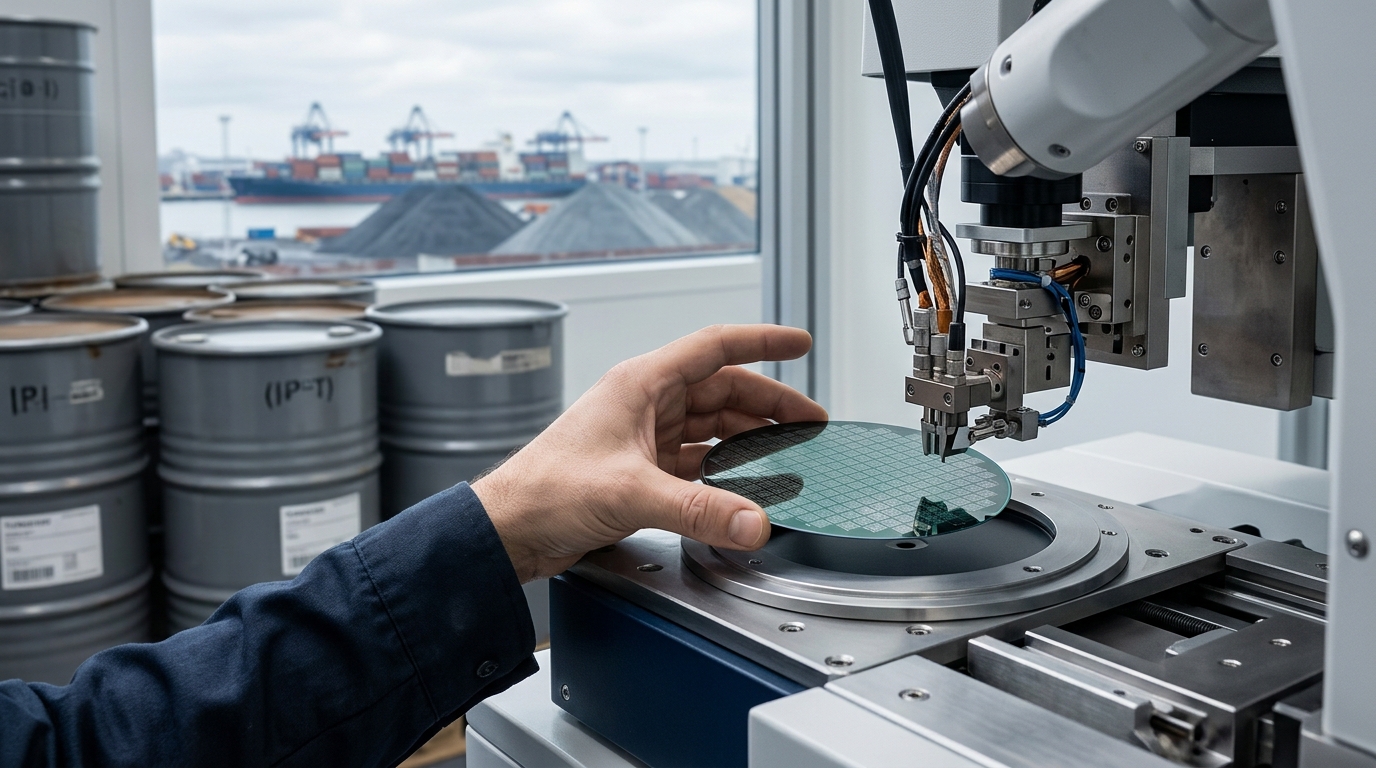
Here is the question nobody in the semiconductor industry wants to answer out loud: What happens to AI chip production when the metal inside every advanced interconnect becomes a geopolitical weapon?
Tungsten is that metal. Its exceptionally high melting point and density make it an essential input for chipmaking. It appears both in chips themselves and in several types of equipment and processes used to manufacture them, particularly at advanced nodes.
At scale, there is no practical substitute that can replace tungsten everywhere it is used in semiconductor manufacturing.
China controls the supply. And China just turned the tap.
Why This Stock Matters Now
In early February 2025, China’s Ministry of Commerce and the General Administration of Customs announced export controls covering tungsten-related items, including ammonium paratungstate (APT) and other products and technologies. That policy tightened supply conditions for parts of the market outside China.
The price response has been dramatic. APT prices have climbed sharply since early 2026, and were trading above $3,000 per MTU in mid-2026. The exact percentage move depends on the benchmark and geography, but the direction is clear: a historic squeeze.
The downstream damage is already hitting the chip sector specifically. By mid-2026, the chip industry is in a tight spot. Not because of a lack of factories, but because of a gas that hardly anyone knows about: tungsten hexafluoride, or WF6. Industry reports said some Japanese WF6 suppliers warned Korean semiconductor companies about potential supply disruptions, with inventories expected to last only until mid-2026.
Separately reported pricing announcements from Korean WF6 suppliers described increases in the 70% to 90% range for 2026. HBM and high-layer NAND are already supply-constrained because of AI demand. WF6 shortages make that worse.
This is not an abstract risk. The 2026 Strait of Hormuz disruption and the broader Iran conflict have strained multiple supply chains at once. In that environment, strategic-material shocks like tungsten can hit chip production through both direct inputs and higher costs across the industrial base.
The Investment Thesis
There is one publicly listed company positioned to supply meaningful non-China tungsten at scale. It listed on the Nasdaq Capital Market on July 14, 2025, and it has been ramping its flagship project in South Korea. It also just expanded its flagship offtake deal to US$490 million in contracted annual revenue at current APT pricing.
That company is Almonty Industries (NASDAQ: ALM).
Almonty has traded with extreme volatility since the market began treating tungsten like a strategic chokepoint. The stock has given back a large portion of its peak, even as the supply shock it was built to solve has intensified. That gap is the investment question.
The Business Behind the Stock
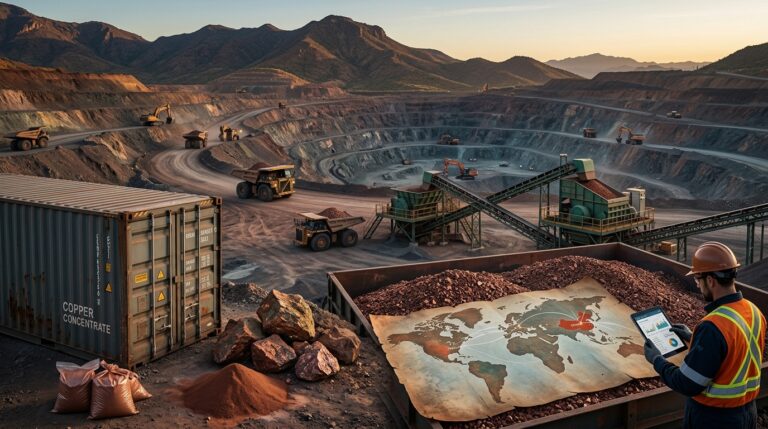
Almonty’s flagship Sangdong Tungsten Mine in South Korea, historically one of the world’s largest and highest-grade tungsten deposits, is expected to be a major contributor to the global non-China tungsten supply chain upon reaching full capacity, directly addressing critical supply vulnerabilities highlighted by U.S. defense procurement restrictions and China’s export controls.
The company completed Phase I commissioning in March 2026. Management framed that milestone as the culmination of more than a decade of work to return Sangdong to production.
In June 2026, Almonty closed an oversubscribed US$800 million convertible senior notes offering (US$700 million base deal plus a US$100 million over-allotment). The company disclosed net proceeds of about US$772.7 million. The article’s claim of “$1.2 billion in cash” could not be verified and has been removed.
On July 14, 2026, Almonty amended its offtake agreement with Global Tungsten & Powders. The revised terms, covering about 90% of Phase I output, improved pricing by roughly 6.3%, boosting expected annual contracted revenue at current APT pricing to US$490 million. The contract term was extended from 15 to 21 years, extending contracted deliveries into the late 2040s.
A planned Phase 2 expansion, expected to come online in 2027, is designed to increase processing capacity to approximately 1.2 million tonnes of ore annually, doubling tungsten output to roughly 4,600 tonnes per year. At full capacity, Sangdong is expected to supply roughly 40% of global tungsten demand outside China.
On June 29, 2026, Almonty’s inclusion in the Russell 1000 and Russell 3000 indexes became effective at the market open, following the 2026 reconstitution process. That can increase ownership from index-tracking funds, but it does not mechanically “force” every passive fund to buy immediately or in a fixed quantity.
What’s Changing
The policy catalyst is crystallizing. The U.S. has designated tungsten as a critical mineral, and federal defense procurement rules are tightening. Effective January 1, 2027, Department of Defense procurement restrictions expand to cover the supply chain from tungsten ore or feedstock through production of tungsten metal powders for certain covered tungsten products, with restrictions tied to covered countries including China, Russia, Iran, and North Korea.
The demand side is simultaneously tightening from the semiconductor direction. Modern semiconductor manufacturing relies heavily on tungsten thin films and interconnects because tungsten can withstand extreme thermal and process conditions required by advanced chips. Market forecasts vary by source, but multiple industry analyses point to steady demand growth over the next decade as compute intensity rises.
The second beneficiary in this disruption is Linde (NASDAQ: LIN), which has faced the 2026 helium shock tied to the Middle East conflict and disrupted Gulf logistics. Reuters reported in March 2026 that Qatar produces nearly one third of the world’s helium supply, and the Strait of Hormuz disruption added further strain to an already concentrated market.
Linde delivered record Q2 2026 sales of $9.3 billion, up 9% year-over-year, and adjusted EPS of $4.50, up 10%, driven by growth in electronics, manufacturing, and chemicals and energy end markets. The company also described strong customer proposal activity, particularly in electronics, alongside a record project backlog.
The Risks
Almonty’s valuation reflects the momentum, not the execution. The gap between contracted revenue and actual cash flow depends entirely on the Phase I ramp proceeding on schedule.
The Sangdong project targets higher volumes over time, but a key open question for semiconductor exposure is whether tungsten concentrate and downstream processing can consistently meet ultra-high purity requirements for electronic-grade chemicals. Defense procurement and industrial tooling tolerate lower purity. Semiconductor WF6 does not. If the supply chain cannot consistently support semiconductor-grade material, the addressable market shrinks materially.
The broader tungsten supply picture offers no easy relief for buyers, but also no guarantee of sustained pricing for producers. With restricted exports and limited near-term new supply, price volatility could persist. A diplomatic thaw that materially eases the current premium, however unlikely in the near term, would reduce the upside that high-cost projects depend on.
For Linde, the risk is simpler: helium-related sales can be positive on a dollar basis but pressure margins when logistics and sourcing costs spike. A faster-than-expected normalization of Gulf shipping routes would remove the pricing tailwind without immediately restoring cost efficiency.
What Investors Should Watch Next
Four developments will determine whether the thesis holds through year-end. First, the January 1, 2027 Pentagon procurement deadline: any signal that the rule will be enforced strictly is the single most important near-term catalyst for Almonty. Second, Phase I throughput data: the company needs to demonstrate consistent commercial-scale output to build credibility for the Phase II ramp. Third, WF6 pricing and allocation signals: if Korean semiconductor companies confirm further increases or tighter allocation, it validates the severity of the chip-level squeeze. Fourth, Linde’s Q3 earnings in October: management has reiterated its full-year adjusted EPS guidance and highlighted a robust electronics pipeline and record backlog. If helium-related margin recovery accelerates ahead of expectations, consensus estimates move higher.
Bottom Line
The semiconductor supply chain’s tungsten problem is not a future risk. It is arriving now, in the form of sharply higher APT prices, WF6 allocation warnings to Korean chipmakers, and a hard Pentagon deadline that lands in less than five months. Almonty Industries, which listed on Nasdaq in July 2025 and commissioned Phase I at Sangdong in March 2026, is positioned as a meaningful non-China supply option as that deadline approaches.
The stock is down substantially from its 2026 peak. The supply crisis that created the stock’s original bull case has intensified. That divergence is the investment question worth sitting with.