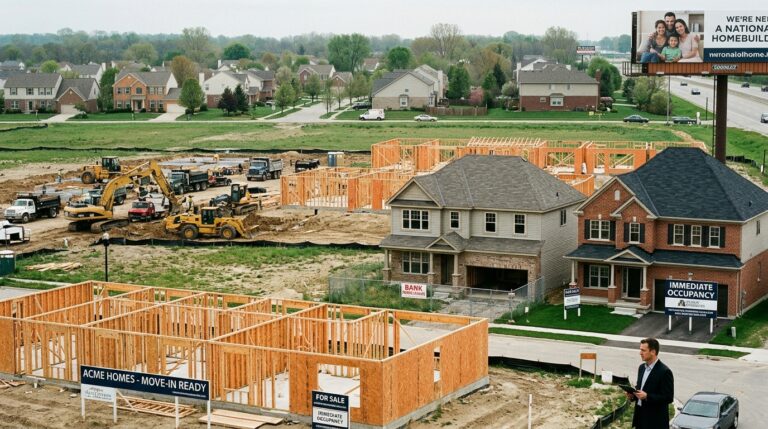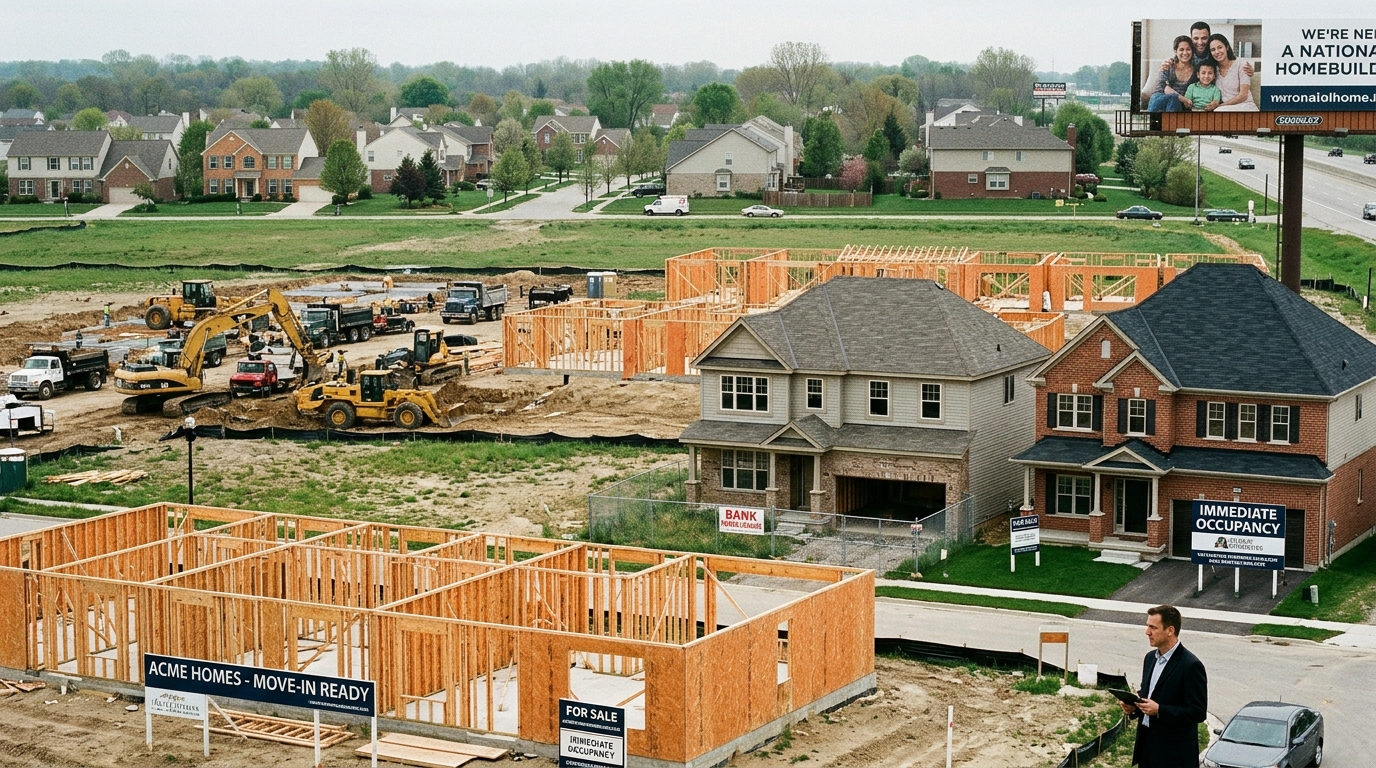
The housing market just handed investors a number that demands a decision. Existing-home sales fell 5.5% in October to an annualized rate of 3.75 million, the weakest pace in 16 years. The median price held at $416,700, still up 0.4% from a year earlier, the 40th consecutive month of year-over-year price gains. Volume at a generational low, prices still rising. That combination does not resolve itself cleanly, and it is forcing a real debate inside every portfolio committee that holds homebuilder exposure.
Why the Number Is Worse Than It Looks
The National Association of REALTORS, citing Freddie Mac’s Primary Mortgage Market Survey, pegged the average 30-year fixed mortgage rate at 7.33% in October versus 6.86% in September. That move happened fast enough to catch builders off guard. Zonda’s October builder sentiment survey was one of the most negative in years: 86% of builders said demand was slower than expected, and just 14% said it was on track or stronger. Eighty-seven percent of builders anticipated starts will be flat or down in 2027.
Housing economist Bill McBride said November sales are likely to fall to another low for this cycle and that sales for all of 2026 will very probably finish at the lowest level since 1995. That is not a trough call. That is a warning that the floor has not yet been found.
The Bull Case for Public Builders
The argument for owning DHI, LEN, and PHM through this cycle starts with their balance sheets. Private builders are being squeezed out of a market they cannot finance. Credit conditions on loans for residential land acquisition, development, and construction tightened again in Q3 2026, with NAHB’s net easing index posting a reading of -15.3. It marks the nineteenth consecutive quarter in which residential builders and developers reported tightening conditions. Private operators borrowing at a spec construction loan rate of about 11.83% all-in, as NAHB reported, cannot compete on price against a D.R. Horton with an investment-grade balance sheet and a mortgage subsidiary to buy down rates for buyers.
DHI’s massive scale allows it to offer more aggressive financing incentives than any small builder, and its entry-level focus targets first-time buyers who are desperate for inventory. When private builders pull back, that land and those buyers do not disappear. They migrate toward the platforms that can still write a check.
The Bear Case: Margin Compression Is Already Here
The problem is that the share gain thesis assumes margins survive the journey. They are not. Lennar reported a 15.8% gross margin on home sales for its quarter ended August 31, 2026, with sales incentives of approximately 12% of the sales price and new orders down 9.2%. D.R. Horton reported a 20.7% home sales gross margin in its fiscal Q3 2026, with a 20% cancellation rate that quarter. In fiscal Q4 2026, Horton’s cancellation rate rose to 23%. PulteGroup reported 25.0% versus 27.0% a year earlier.
Buydowns are keeping sales alive but eating into the economics that made these stocks attractive. Redfin reported that 36% of homes that sold in October had at least one price drop, the highest share in its records. Even publicly traded builders are not immune to that pressure. PulteGroup’s 25% gross margin is still healthy; Lennar’s 15.8% is not. The sector is not a monolith.
What Investors Are Missing
The conversation fixates on rate sensitivity, but the more durable issue is the structural exit of private capital from the market. In NAHB’s AD&C survey, among builders experiencing tighter credit conditions, 47% said lenders were lowering loan-to-value ratios, and the same share reported that lenders were refusing to make relationship loans. Those are not cyclical adjustments. That is capital permanently reallocating away from smaller operators.
The implication for public builders is longer than one rate cycle. When private builders can no longer get land loans, they cannot replenish their communities. Public builders, sitting on existing land banks, inherit that supply vacuum. The question is not whether they take share; it is whether today’s prices already reflect it.
Stocks to Watch
- DHI: The highest-volume, most rate-sensitive name. Best positioned to absorb displaced private builder demand at the entry level, but margin recovery depends entirely on where the 30-year fixed settles.
- PHM: A margin leader in the group, serving a move-up and active-adult buyer who is less rate-dependent. The stronger operational story if the cycle stays ugly.
- LEN: Lennar’s 15.8% gross margin and roughly 12% incentive load make it the highest-risk of the three large builders near-term. Watch whether November orders show any stabilization.
- NVR: No land ownership, capital-light model, historically the best margin protector in a down cycle. The name bears watching precisely because it rarely gets discussed in this debate.
- RDFN / Z: NAR reported October inventory at 1.59 million units, up 4.6% year over year. Along with the record price-cut share Redfin reported for October sales, that matters for platforms whose revenue depends on transaction volume returning. Both remain deep in the value-trap camp until rate expectations shift.