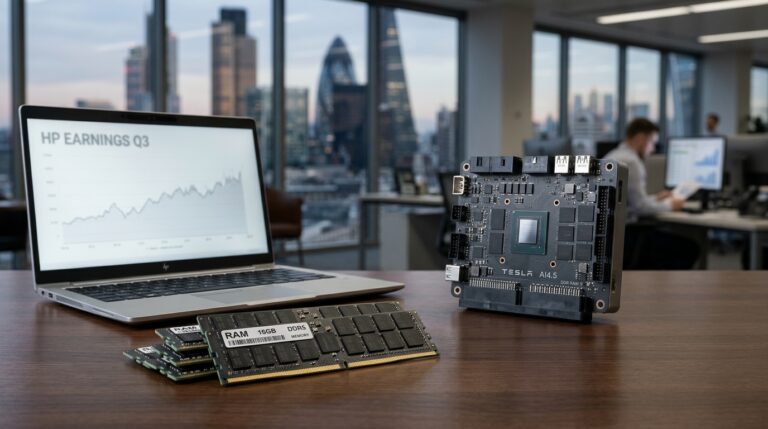
Here is the question HP Inc. investors need to answer before tonight’s earnings call: if soaring memory costs forced Tesla to quietly strip a quarter of the RAM out of its next-generation vehicle computer, what are those same costs doing to the margins of the world’s second-largest PC maker?
The Tesla detail landed Sunday. CEO Elon Musk revealed in a recent exchange on X that Tesla had cut AI4.5’s memory capacity from 32GB to 24GB due to high memory costs, while upgrading to LPDDR5X memory. That is not a footnote. Musk separately said the cost of the company’s current AI4 has doubled due to rising memory and storage prices. A car company rewriting its hardware specifications to dodge a component cost is exactly the kind of second-order signal that should sharpen attention on any business selling machines that contain DRAM.
HP sells millions of them. HP is scheduled to report fiscal fourth-quarter results today, after the market close, with expectations calling for higher revenue but lower earnings. Wall Street expects adjusted EPS of about $0.75 and revenue of about $15.4 billion.
The EPS decline tells the story better than the revenue line does. For three straight quarters, HP has demonstrated it can grow revenue even as unit volumes collapse, essentially by charging more per machine. In the Personal Systems segment, revenue climbed 18% to $11.8 billion despite a 16% drop in total unit shipments, with consumer units off 19% and commercial units off 14%. That is a remarkable feat of pricing discipline. The problem is that DRAM keeps eating the gains. The segment’s operating margin was 4.6% in the fiscal third quarter, down from 5.2% in the preceding quarter.
HP expects memory and storage costs to keep rising and has said Personal Systems margins are likely to reach a low point in the fourth quarter of fiscal 2026 before improving into fiscal 2027. Tonight is that low point. The question is whether management can credibly sketch the path out of it.
The broader DRAM market provides context for how deep this hole is. AI infrastructure demand for High-Bandwidth Memory is eating up wafer capacity at Samsung, SK Hynix, and Micron, capacity that would otherwise produce the conventional DRAM that goes into PCs and smartphones, and TrendForce reported conventional DRAM contract prices were on track to surge 90% to 95% quarter over quarter in Q1 2026 as a result. Micron expects memory and storage supply-demand conditions to be much tighter in calendar 2027 and 2028 than in 2026, and the company has said it does not have line of sight to when supply and demand will return to balance. That is not an encouraging backstop for HP’s promised margin recovery.
The bull case rests on AI PC momentum and pricing power. Personal Systems revenue surged 18% as AI PCs climbed to 46% of mix. HP has said it expects that figure to reach 60% to 70% in fiscal 2027. Higher-spec AI machines carry better average selling prices, which is the mechanism management is counting on to absorb component costs as volumes normalize.
The bear case is straightforward. Recent third-calendar-quarter industry data showed HP had the steepest shipment decline among the top PC vendors, with shipments down about 31% year over year, even as it held onto the No. 2 slot globally. A tariff refund benefit also helped recent results; that benefit is not guaranteed to repeat.
What investors should watch tonight is not whether HP clears roughly $0.75. It is what CFO Karen Parkhill says about the memory cost trajectory into the first half of fiscal 2027. If the promise of margin recovery gets pushed further out, the stock’s current valuation offers little buffer. If management can point to stabilizing DRAM contract prices and a credible AI PC mix ramp, the Q4 margin trough becomes a buying signal rather than a warning. Tesla showed this weekend that memory costs are rewriting product specs across industries. HP reports in hours.