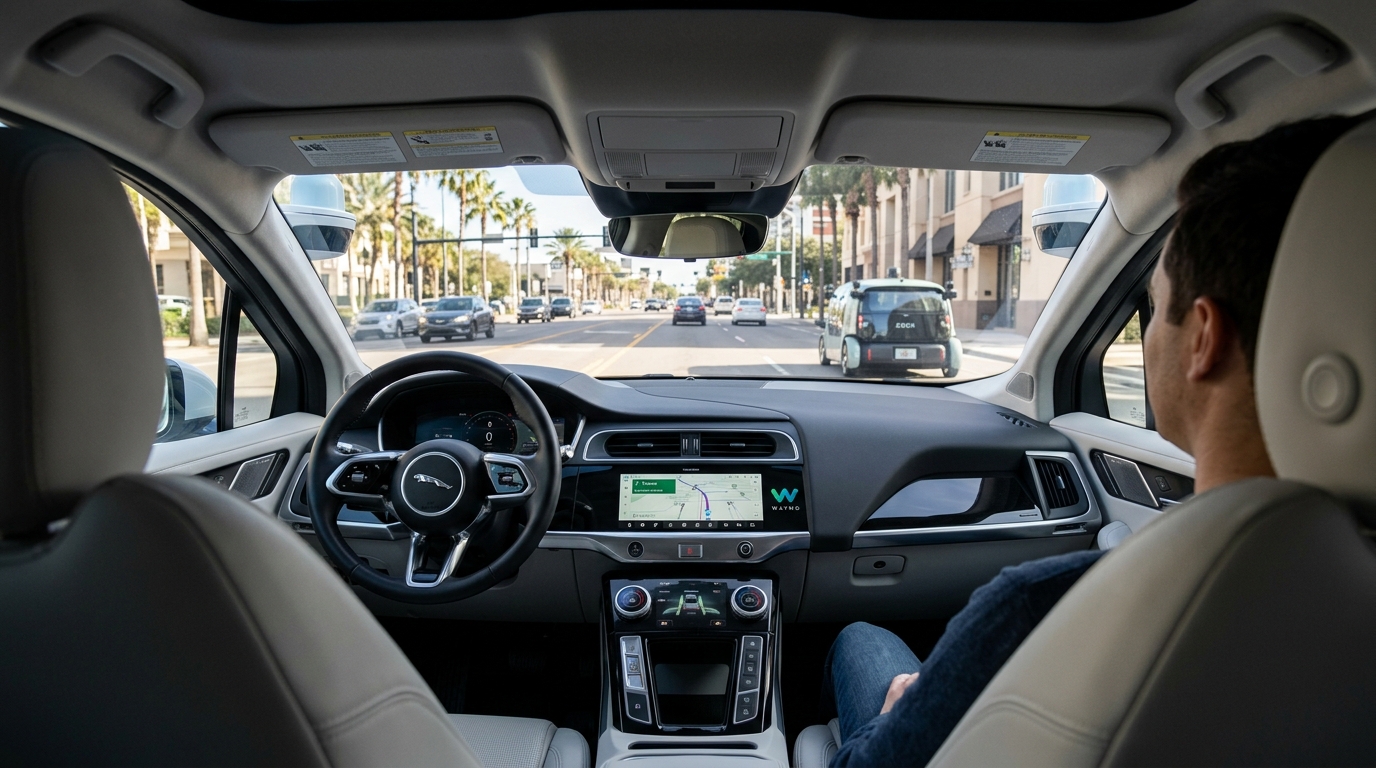
On Tuesday, September 1, Waymo launched public rides in San Diego, Tampa, and Denver, marking the first time the company will have commercial operations in Colorado. That same morning, Amazon’s Zoox separately announced its own expansion of driverless ride-hailing operations into new U.S. cities. Both companies timed their releases deliberately, ahead of a planned event from Tesla, which is expected to share details about its driverless Cybercab and its Robotaxi ride-hailing service.
The headline numbers behind Waymo’s position are hard to dismiss. The company now says it provides more than 500,000 paid rides weekly, and it now offers fully autonomous trips in 14 cities. Waymo aims to cross the 1 million weekly paid trips mark by the end of 2026. Its newest vehicle, the Ojai, is a purpose-built robotaxi manufactured by Zeekr. The Zeekrs are shipped to the U.S. for integration, with final assembly and retrofitting handled at Waymo’s Mesa, Arizona facility with supplier Magna.
The Option You Already Own
Here is what most investors overlook: if you hold GOOGL or AMZN, you already have exposure to this race. Alphabet does not merely partner with Waymo. In February 2026, Waymo announced an investment round of $16.0 billion. Waymo said Alphabet remains its majority investor, and outside investors also participated. That round values Waymo at $126 billion, more than double its value from just over two years ago. That $126 billion subsidiary sits inside a company the market still prices primarily on search and cloud revenue. Waymo is, for most GOOGL holders, essentially free.
Amazon shareholders have a parallel situation with Zoox. Zoox will begin testing in Houston and San Diego, bringing its presence to 12 U.S. locations. It will initially use retrofitted test vehicles for manual mapping and testing before deploying its purpose-built driverless robotaxis. Zoox’s commercial footprint is narrower than Waymo’s for now: Las Vegas is currently the only city where Zoox operates a paid ride-hailing service, although Zoox also says it operates in San Francisco. But the underlying logic is the same. Amazon acquired Zoox in 2020 for roughly $1.2 billion. Whatever that asset is worth today, AMZN shareholders hold it without paying separately for the ticket.
The Market Goldman Is Sizing
Goldman Sachs Research projects the U.S. robotaxi market will reach $19 billion in 2030, up sharply from a prior estimate of $7 billion, and $48 billion by 2035. The revision matters because Goldman’s earlier forecast is already dated. Waymo alone now offers fully autonomous trips in 14 cities. The pace of scaling is outrunning the models.
For a vertically integrated company that both builds and operates its own robotaxi fleet, Goldman estimates gross margins could range from 30% to 50%, implying a global gross profit pool of about $150 billion in 2035. The firm’s models show the total cost per mile dropping below $1 in the U.S. by 2035 for a vertically integrated AV rideshare operator. As that cost curve falls, the economics for Waymo and Zoox improve well before 2035.
Risks Worth Watching
Neither position is without friction. Alphabet funds Waymo’s losses through its Other Bets segment, and the capital requirements are substantial: the February 2026 round alone was $16 billion. Zoox is years behind Waymo in commercial deployment and has not disclosed a timeline for paid service outside Las Vegas. Tesla remains a threat at a different layer: the company is betting its camera-heavy approach can eventually compete at much greater scale, with cost economics that could undercut sensor-heavy fleets if its approach proves sufficient for regulators. Regulatory risk persists across all players. Labor leaders worry that autonomous vehicles will eliminate jobs in transportation, and vehicle safety advocates want companies to disclose and standardize mileage and crash data.
The Wealth Builder Takeaway
The most durable wealth-building insight here is structural: two of the deepest-pocketed competitors in a market Goldman now sizes at $48 billion by 2035 are not standalone bets. They are embedded inside companies most long-term investors already own. In some markets, Waymo offers rides through Uber, creating a distribution channel that benefits UBER shareholders too, even without a direct stake in autonomous hardware. The robotaxi race is not a future story. It is running in 14 cities today, and for GOOGL and AMZN holders, the exposure came with the shares.