Washington Is Becoming a Market Variable
Markets have always paid attention to Washington.
But during President Donald Trump’s second term, the connection between political decisions and corporate strategy has become increasingly difficult for traders to ignore.
Tariffs can alter manufacturing costs almost overnight. Defense appropriations can determine which military programs move forward. Changes to Medicare and Medicaid can reshape the economics of the healthcare industry. Energy policy can influence everything from power-plant construction to transmission infrastructure. Trade disputes can reach all the way from steel mills to American farms.
That makes the midterm election cycle particularly interesting from a market-research perspective.
The question is not simply which political party controls Congress.
The larger question is how much of the administration’s economic agenda Congress ultimately reinforces, modifies, funds, limits, or redirects.
That distinction matters.
Presidents have significant authority over areas such as trade enforcement, regulation, executive agencies, national security and foreign policy. Congress, however, retains enormous influence through appropriations, legislation, taxes, oversight and the authorization of federal programs.
The interaction between those two centers of power can create uncertainty long before an election is decided.
For traders, that uncertainty may be worth studying.
This report examines five publicly traded companies sitting near some of the most important policy debates in Washington:
Lockheed Martin (NYSE: LMT) Defense budgets and military procurement
Nucor (NYSE: NUE) Tariffs, steel and domestic manufacturing
GE Vernova (NYSE: GEV) Electricity demand, grid security and energy policy
UnitedHealth Group (NYSE: UNH) Medicare, Medicaid and healthcare funding
Deere & Company (NYSE: DE) Agriculture, tariffs and global trade
None of these companies is included because of an assumption about what its share price may do.
Instead, each provides a different window into how policy decisions in Washington can filter through the real economy.
The Political Setup
Why Congress Still Matters During a Strong Presidency
Presidential executive authority receives much of the attention in Washington, particularly on trade and regulatory policy.
But many of the policies that matter most to businesses ultimately require congressional involvement.
Defense programs need appropriations.
Healthcare programs depend heavily on federal legislation and reimbursement policy.
Farm programs are shaped through congressional legislation.
Tax policy runs through Congress.
Federal spending requires congressional authorization and appropriations.
Even areas in which presidents possess significant authority can eventually collide with lawmakers, courts or statutory limits.
That dynamic has already appeared during Trump’s second term.
Trade policy offers perhaps the clearest example. Tariffs have remained a major component of the administration’s economic strategy, but the legal foundation of some tariff actions has faced challenges. Companies exposed to imports and exports have consequently had to manage not simply tariffs themselves, but the possibility that those rules could change.
Defense presents a different version of the same problem.
The administration can propose substantially higher military spending and identify strategic priorities, but Congress ultimately plays a central role in determining how much money is appropriated and where much of that money goes.
The result is a political environment where headline policy announcements are often only the beginning of the story.
For investors researching politically sensitive companies, understanding that distinction may be more useful than trying to predict election results.
1. Lockheed Martin (NYSE: LMT)
Where Presidential Defense Priorities Meet Congressional Spending
Few companies demonstrate the relationship between Washington and corporate revenue more clearly than Lockheed Martin.
The company operates across aircraft, missiles, missile defense, space systems, helicopters and other national-security programs.
Its exposure to government spending is substantial.
Lockheed Martin’s Form 10-Q for the six months ended June 28, 2026 disclosed that 70% of its $38.1 billion in sales came from the U.S. Government, either as a prime contractor or as a subcontractor, including 61% from the U.S. Department of War (also known as the Department of Defense).
That makes federal budgeting much more than a political headline for the company.
It is a core business variable.
The Washington Connection
The Trump administration has pushed for substantially greater military investment, particularly around weapons procurement, missile defense, munitions, shipbuilding and modernization.
But administration proposals do not automatically become federal spending.
Lockheed itself notes that U.S. government funding depends on administration budget requests, procurement priorities and the congressional authorization and appropriations process. The company specifically identifies political debate, congressional compromise and competing government priorities as factors capable of influencing defense spending.
That distinction becomes particularly important during an election cycle.
Lawmakers may agree broadly that national security spending should remain elevated while disagreeing considerably over individual programs, overall spending levels, foreign military support and federal deficits.
Why Lockheed Is Worth Researching
Lockheed provides a useful way to study what might be called the translation problem in Washington.
A president can announce a defense priority.
The Pentagon can identify a capability it wants.
Congress can authorize a program.
Appropriators can fund it.
Only then does that political priority begin translating into procurement opportunities for contractors.
And even after funding is approved, large defense programs can take years to move through production.
Lockheed explicitly describes its business as operating on a long-cycle basis, meaning geopolitical events do not necessarily translate immediately into financial results.
That makes the company particularly interesting as a research subject because the political headline and the corporate impact may occur on very different timelines.
What to Research
Traders researching Lockheed may want to monitor:
- Congressional defense appropriations rather than administration proposals alone
- Funding priorities surrounding missile defense, munitions, aircraft and space
- Changes to major procurement programs
- International defense demand and foreign military sales
- Backlog conversion and production capacity
- Federal budget disputes that could delay contract awards or funding
The Counterargument
Higher proposed defense spending does not automatically mean higher profits for every contractor.
Large programs face political scrutiny, contract negotiations, production challenges and potential changes in procurement quantities.
A change in congressional priorities could also shift spending between weapons platforms, personnel, readiness, cyber capabilities and newer defense technologies.
For that reason, Lockheed may be most useful to researchers not as a simple “defense spending” trade, but as a case study in which defense priorities actually survive the congressional budgeting process.
2. Nucor Corporation (NYSE: NUE)
The Tariff Debate Comes to the Steel Mill
If Lockheed represents the congressional side of Washington’s power structure, Nucor represents an area where presidents can exert much more direct influence.
Trade.
Nucor is one of the largest steel producers in the United States, with operations spanning sheet steel, plate, bar products and downstream steel products.
That places the company near the center of the debate over tariffs and domestic manufacturing.
The Washington Connection
Steel has been one of the most important industries in Trump’s trade strategy.
The administration has relied heavily on tariffs intended to discourage certain imported metals and encourage greater domestic production.
Nucor has publicly described renewed trade enforcement as an important development for the domestic steel market.
In its Form 10-K for fiscal year 2025, Nucor stated that foreign imports’ share of the U.S. finished steel market declined as Section 232 tariffs and related trade actions took effect during the year.
But tariffs create a much broader economic debate.
Supporters argue that they may protect domestic capacity, discourage unfairly priced imports and strengthen strategic supply chains.
Critics argue that tariffs can increase input costs for manufacturers that consume steel, provoke retaliation from trading partners and add inflationary pressure throughout the economy.
Both sides of that debate matter when researching Nucor.
Why Nucor Is Worth Researching
Nucor offers traders a relatively direct way to examine one of the central questions surrounding Trump’s industrial policy:
Can protection of domestic manufacturing meaningfully change the competitive position of American producers without imposing larger costs elsewhere in the economy?
Steel sits at the beginning of many supply chains.
Automobiles use it.
Construction uses it.
Energy infrastructure uses it.
Heavy equipment uses it.
Defense manufacturing uses it.
That means trade policy affecting steel can ripple through multiple sectors.
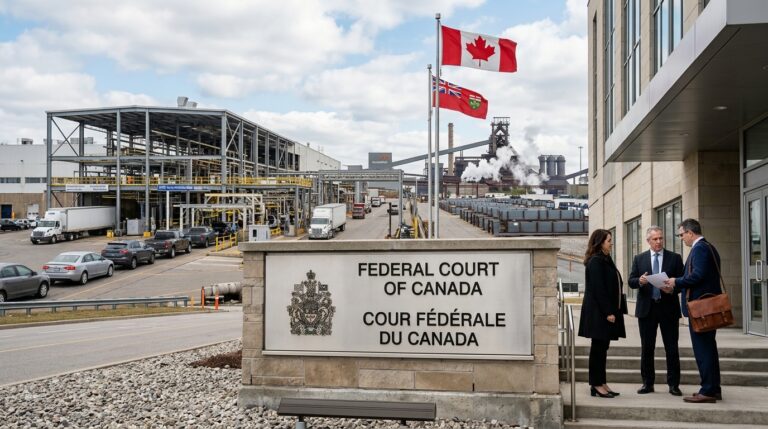
U.S.-Canada trade tensions during 2025 and 2026 illustrated how quickly the policy environment can change, and new tariff measures during that period also raised legal questions over the extent of presidential authority under different trade statutes.
That uncertainty itself is something researchers may want to monitor.
What to Research
Areas worth following include:
- Changes in steel import volumes
- U.S. manufacturing activity
- Capacity utilization across domestic steel producers
- Section 232 and other trade actions
- Congressional attempts to modify presidential tariff authority
- Retaliatory tariffs from U.S. trading partners
- Steel demand from construction, infrastructure and manufacturing
The Counterargument
Tariffs can help one part of the industrial economy while pressuring another.
Higher domestic steel prices may benefit producers while creating additional costs for companies purchasing steel.
Trade retaliation can also affect U.S. exporters.
That means the Nucor research case should not simply be framed as “tariffs are good for steel.”
The more useful question is whether the broader trade environment produces a durable improvement in domestic steel demand and competitive positioning.
3. GE Vernova (NYSE: GEV)
The Power Grid Has Become a Political Issue
One of the most important economic stories in the United States has little to do with traditional election-year politics.
Electricity demand has been rising.
Data centers, artificial intelligence infrastructure, manufacturing expansion and electrification have placed new demands on a power system that already requires substantial modernization.
GE Vernova operates directly inside that transition.
The company supplies gas turbines, grid equipment, power transmission technology, wind turbines, nuclear services and other technologies used throughout the electricity system.
The Washington Connection
Energy policy has traditionally been divided into familiar political categories:
Oil versus renewables.
Fossil fuels versus climate policy.
Republicans versus Democrats.
But the rapid growth of electricity demand has complicated that framework.
Grid reliability has increasingly become an economic and national-security issue.
On August 26, 2026, President Trump signed an executive order declaring a national emergency concerning the security of the U.S. bulk-power system, citing vulnerabilities involving critical infrastructure, national defense and the economy.
The administration has also tied energy policy more closely to domestic manufacturing, artificial intelligence infrastructure and supply-chain security.
Congress, meanwhile, remains deeply involved through tax policy, infrastructure spending, permitting rules, energy subsidies and federal regulation.
That puts companies supplying the physical electricity system in an unusual position.
They may be exposed not simply to one energy policy, but to the larger question of how the United States intends to generate and move substantially more electricity.
Why GE Vernova Is Worth Researching
GE Vernova’s results for the quarter ended June 30, 2026 illustrate the scale of activity occurring in the power sector. The company reported strong demand for grid equipment for that period, including increased activity in power transmission and grid-system technologies, and disclosed substantial growth in its equipment backlog within its Electrification business over the same period.
The company itself identifies grid modernization, rising electricity demand and the integration of new generation and storage resources as important industry drivers.
What makes GE Vernova particularly interesting politically is that several different policy paths could still require grid spending.
More gas generation requires grid connections.
More nuclear generation requires grid infrastructure.
More renewable generation requires transmission.
More data centers require electricity.
More domestic manufacturing requires electricity.
The political debate may determine which generation technologies receive the most support, while the underlying need for transmission and electrical equipment may remain an important research theme.
What to Research
Traders examining GE Vernova may want to follow:
- Utility capital spending
- Data-center electricity demand
- Orders for transformers, switchgear and transmission equipment
- Gas turbine demand
- Nuclear power policy
- Renewable-energy policy changes
- Federal permitting reform
- Domestic manufacturing and grid-security initiatives
The Counterargument
Not every part of GE Vernova’s portfolio moves in the same direction.
The company’s businesses span gas, wind, nuclear and grid infrastructure, meaning shifts in government policy may help some segments while pressuring others.
In its results for the quarter ended June 30, 2026, GE Vernova reported that wind activity experienced different demand conditions from its Power and Electrification businesses.
That makes segment-level research particularly important.
4. UnitedHealth Group (NYSE: UNH)
Healthcare Policy Is Back in the Political Crosshairs
Healthcare rarely disappears from Washington for long.
UnitedHealth Group sits near the center of several of the industry’s most important policy debates because of the scale of its insurance and healthcare-services businesses.
Through UnitedHealthcare and Optum, the company participates across commercial insurance, Medicare, Medicaid, pharmacy services and value-based healthcare.
That breadth also creates significant exposure to government reimbursement policy.
The Washington Connection
Healthcare has become increasingly important in the midterm political conversation.
The debate extends beyond the familiar argument over the Affordable Care Act.
Medicare reimbursement.
Medicaid funding.
Prescription costs.
Insurance practices.
Government healthcare spending.
Hospital economics.
Value-based care.
Each creates potential implications for insurers and healthcare-service companies.
UnitedHealth’s own regulatory filings demonstrate how directly government reimbursement decisions can affect operating conditions.
In its Form 10-Q for the quarter ended June 30, 2026, UnitedHealth reported that Medicare funding pressures contributed to pricing actions and contraction in its Medicare Advantage membership during the first half of 2026. The company also cited Medicaid reimbursement challenges in the same filing, noting that state payment rates had not fully kept pace with changes in patient health needs and medical costs.
These are not abstract political questions.
They can influence enrollment, margins, pricing and the markets in which insurers choose to participate.
Why UnitedHealth Is Worth Researching
UnitedHealth provides a useful case study in how healthcare policy travels through the economy.
Congress can alter healthcare funding.
Federal agencies can adjust reimbursement methodologies.
States can change Medicaid rates.
Healthcare utilization can change independently of either.
Those variables eventually reach insurers through medical costs, premiums and reimbursement rates.
This creates an unusually complicated research environment.
A policy intended to lower healthcare costs for consumers does not necessarily have a simple or immediate impact on insurers.
Likewise, higher government healthcare spending does not automatically translate into better economics for managed-care companies.
The details matter.
What to Research
Researchers may want to monitor:
- Medicare Advantage reimbursement
- Medicaid funding
- Medical cost trends
- Changes in insurance regulation
- Prescription-drug policy
- Optum’s value-based care operations
- Membership trends across government healthcare programs
The Counterargument
UnitedHealth is not merely a political-policy story.
Medical utilization, provider costs, pharmacy trends, competition and internal execution can all materially affect the company’s performance regardless of what happens in Washington.
That makes political headlines only one part of the research process.
For traders, the more useful exercise may be identifying where policy changes alter the underlying economics of government-sponsored healthcare rather than reacting to every healthcare headline.
5. Deere & Company (NYSE: DE)
Where Tariffs Meet the American Farm
Agriculture may be one of the most politically sensitive parts of the U.S. economy during periods of trade conflict.
Farmers sell into global commodity markets.
Equipment manufacturers operate international supply chains.
Trading partners can retaliate against U.S. agricultural exports.
Input costs can change rapidly.
Deere & Company sits directly inside that system.
The manufacturer of agricultural and construction equipment is therefore exposed to Washington policy in several directions at once.
The Washington Connection
In its Form 10-Q filings for fiscal 2026, Deere reported that incremental tariffs had increased the cost of imported products and components beginning in the third quarter of fiscal 2025 and continuing into fiscal 2026. Deere also noted in those filings that trade policies were creating uncertainty across agriculture and construction markets during that period.
Agriculture adds another complication.
Trade retaliation frequently targets politically sensitive exports.
When farm economics weaken, equipment purchasing can weaken as well.
Deere itself identifies commodity prices, crop yields, government policy and macroeconomic uncertainty as important factors affecting farmers’ income and sentiment, which in turn can influence demand for agricultural equipment.
That creates a chain worth understanding:
Washington policy → global trade → farm economics → equipment demand.
Why Deere Is Worth Researching
Among the five companies in this report, Deere may offer the clearest example of the unintended consequences that can accompany political policy.
Tariffs designed to support American industry may increase costs for some American manufacturers.
Retaliation against U.S. exports may affect farmers.
Farm aid may partially offset financial pressure.
Infrastructure spending may support Deere’s construction-equipment business even when agricultural conditions remain weaker.
Different pieces of Washington policy can therefore push the same company in opposite directions.
That makes Deere an interesting research subject heading into a politically uncertain period.
What to Research
Important areas to follow include:
- U.S. agricultural exports
- Commodity prices
- Farmer income and equipment demand
- Tariff costs on imported parts and equipment
- Retaliatory trade measures
- Federal farm programs
- Infrastructure and roadbuilding activity
- Construction demand
The Counterargument
Agricultural equipment operates in a cyclical market.
Commodity prices, interest rates, used-equipment inventories and replacement cycles can matter just as much as trade policy.
Deere described subdued conditions in portions of large agriculture in its fiscal 2026 filings, while reporting different demand patterns in other business areas over the same period.
Political analysis therefore should complement rather than replace traditional industry research.
Five Companies, Five Washington Fault Lines
The five companies in this report illustrate how differently political policy can reach corporate America.
Lockheed Martin (LMT) The key issue is federal defense spending and congressional appropriations.
Nucor (NUE) The key issue is tariffs, domestic manufacturing and presidential trade authority.
GE Vernova (GEV) The key issue is electricity demand, grid reliability and competing energy policies.
UnitedHealth Group (UNH) The key issue is government healthcare reimbursement and regulation.
Deere & Company (DE) The key issue is the interaction between tariffs, agriculture, farm economics and global trade.
There is no single “midterm trade” connecting all five.
That is precisely the point.
What Traders Should Really Be Watching
Election coverage tends to focus on polling.
Markets often have to focus on policy.
The more useful questions may therefore be:
Does Congress expand, reduce or redirect federal spending?
Does presidential tariff authority face additional legislative or legal constraints?
Which defense programs receive actual appropriations?
How does Washington respond to rising electricity demand?
Do healthcare reimbursement rules become more or less favorable for insurers and providers?
Does trade policy improve conditions for domestic manufacturers while creating pressure elsewhere?
Those questions are likely to matter considerably more to the companies in this report than any single political headline.
There is also another reason to keep the analysis balanced.
Markets frequently begin forming expectations before policy changes occur.
By the time a political outcome becomes obvious, some assumptions may already be reflected in company valuations.
That is why research should focus not simply on predicting who wins an election, but on identifying which expectations appear embedded in the market and what could cause those expectations to change.
The Bigger Picture
Washington Creates Winners, Losers and Unexpected Consequences
One of the easiest mistakes investors can make is assuming political policy produces a simple market outcome.
Tariffs can help steelmakers while raising costs for manufacturers.
Defense spending can increase while individual weapons programs are reduced.
Policies encouraging electricity production can benefit some energy technologies while hurting others.
Healthcare spending can rise while reimbursement economics deteriorate.
Farm support can improve liquidity while weak commodity economics continue to pressure equipment demand.
Policy rarely moves through the economy in a straight line.
That complexity is exactly why these five companies may deserve closer research during the midterm cycle.
They sit at places where government policy intersects directly with industrial activity, national security, healthcare, energy and global trade.
The objective is not to predict which company will perform best.
It is to understand where political decisions could change the assumptions investors are using to evaluate them.
Research Checklist
Before forming a view on any politically exposed company, consider five questions:
1. Is the policy already law, or is it only a proposal?
Administration announcements and congressional proposals can generate headlines long before implementation.
2. Who actually has authority?
Some decisions can be made through executive action. Others require congressional approval, agency rulemaking or both.
3. What part of the company is actually exposed?
A diversified company may benefit in one division while experiencing pressure in another.
4. Is the market reacting to politics or fundamentals?
Political headlines can create short-term volatility even when the underlying business changes very little.
5. What could invalidate the thesis?
Every research case should include reasons the expected outcome may not occur.
That last question may be the most important.
Final Perspective
The midterms are not simply a political event.
They represent another potential turning point in the balance of power between the White House and Congress.
That balance can influence federal spending, trade policy, healthcare, energy, agriculture and national security.
For traders, the opportunity is not necessarily predicting an election correctly.
It is understanding which companies sit closest to the policies being debated, which assumptions depend on Washington and which developments could materially alter the investment narrative.
Lockheed Martin, Nucor, GE Vernova, UnitedHealth Group and Deere each offer a different place to begin that research.
None should be viewed as a predetermined winner or loser from the political environment.
But all five provide useful windows into how decisions made in Washington can eventually reach corporate America.
And during a period when political policy is increasingly becoming an economic variable, that relationship may be worth watching carefully.
Disclaimer
This report is for informational and educational purposes only and does not constitute financial, investment, legal or trading advice. The companies discussed are presented solely as examples for further independent research and should not be interpreted as recommendations to buy, sell or hold any security.
Investing and trading involve risk, including the possible loss of principal. Political, regulatory and economic conditions can change rapidly, and policy proposals may be modified, delayed, challenged or never implemented.
Readers should conduct their own research, review company filings and other primary-source information, and consult with a qualified financial professional before making investment decisions.