Boeing’s problem is not demand. Airlines around the world want its planes badly enough that the company has accumulated the largest commercial backlog in its history. The problem is turning that backlog into deliveries, cash, and eventually a stock that reflects what the orders are worth.
Right now, the market is focused on execution, not the order book. CEO Kelly Ortberg made that tension explicit on September 16, 2026.
The Business
Boeing builds commercial jets, military aircraft, and satellite systems across three segments. Its commercial franchise, built around the 737 MAX and 787 Dreamliner, generates the bulk of revenue and nearly all of the long-term cash-flow potential. Total backlog at June 30, 2026 reached $715.3 billion.
Q2 2026 revenue rose about 8% year over year to $24.6 billion, a steady improvement, but earnings and cash flow remain constrained by the production ramp.
Why Wall Street Is Paying Attention
The 737 MAX is Boeing’s financial engine. Each delivery generates cash and chips away at years of accumulated debt. Increasing output of the popular single-aisle jetliner is critical to the company’s financial recovery after years of crises that have left it with roughly $26 billion in net debt and a bruised reputation.
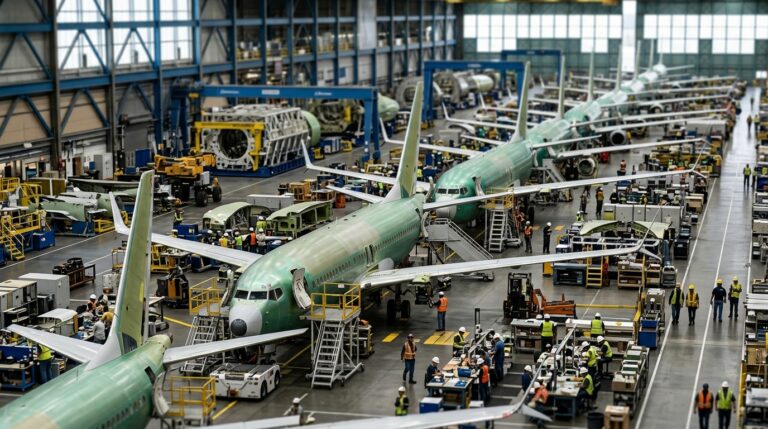
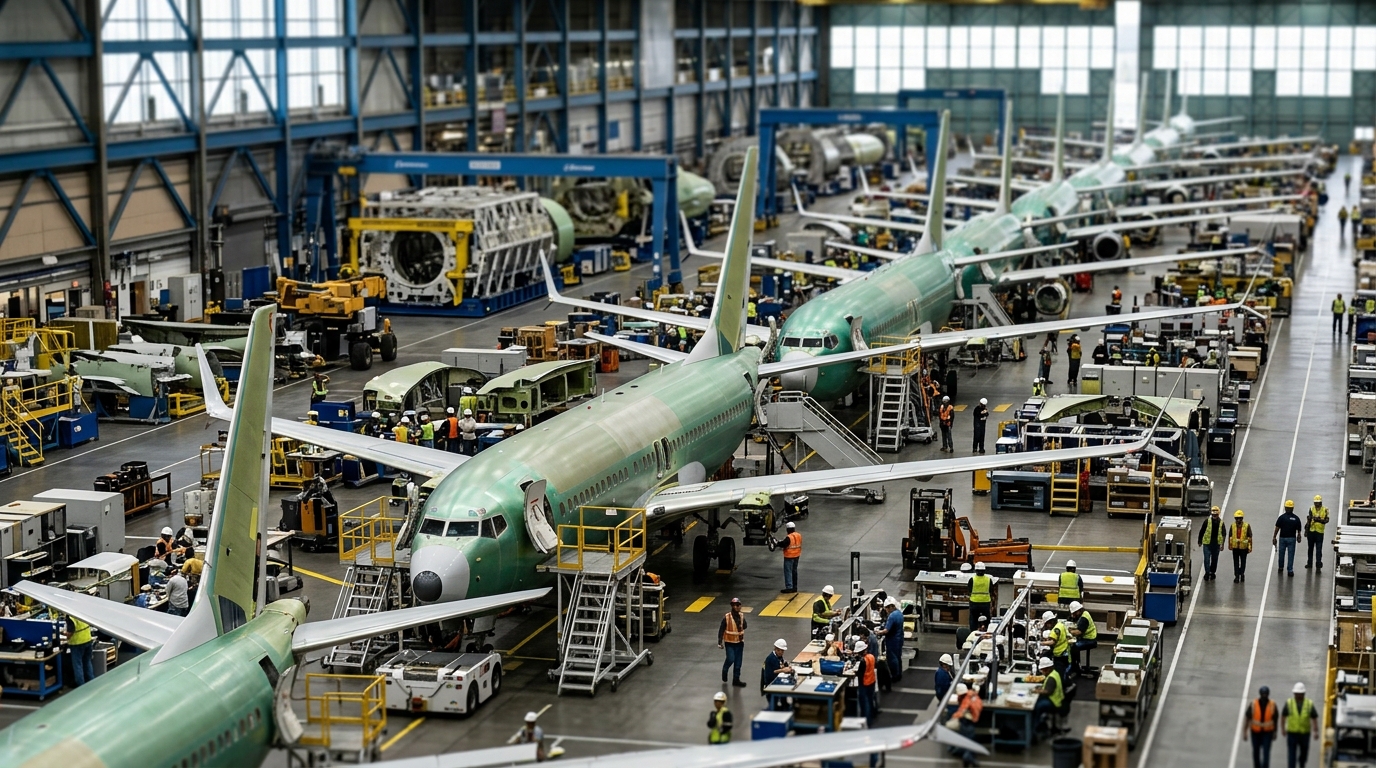
Ortberg told investors at the Morgan Stanley Laguna Conference on September 16, 2026 that stabilizing the 737 MAX at 47 jets per month is taking longer than expected. The stock fell about 4% that day. The company has not been able to make 737 wings fast enough to consistently feed the higher production rate.
The slower 737 and 787 rate increases mean Boeing is now talking to investors about landing closer to $2 billion in free cash flow for the year, the midpoint of its guidance, rather than an upside outcome nearer $3 billion.
Fresh demand is still arriving. Boeing finalized a Turkish Airlines deal for up to 150 737 MAX jets. Boeing also announced a Biman Bangladesh order for 14 jets. China also committed to buy 200 Boeing jets at the May summit, though expectations for a quick follow-on have cooled ahead of the Trump-Xi meeting this week.
What’s Driving the Opportunity
Boeing still expects certification of the long-delayed 737 MAX 10 very soon, with deliveries starting in 2027. Clearing the remaining certification backlog matters because it represents commercial aircraft orders that cannot be delivered until the FAA acts.
Boeing generated $1.4 billion in operating cash flow and $631 million in non-GAAP free cash flow in Q2 2026, a sharp improvement versus expectations earlier this year for cash burn. The trajectory is positive, even if the pace has disappointed.
Jefferies carries a $265 price target on the stock, roughly 30% above where BA has been trading. The bull case is straightforward: once wing production normalizes and 737 MAX 10 certification closes, the free cash flow machine turns on with a $715 billion backlog behind it.
What Could Go Wrong
There is significant uncertainty regarding when backlog will convert into revenue, and Boeing may experience reductions to backlog or order cancellations due to delivery delays, production disruptions, or further delays to entry into service of the 777X, 737-7, and 737-10.
The wing constraint is solvable, but Ortberg did not put a timeline on it. Ortberg said wing production at the Renton, Washington factory is the current constraint, adding the company has plans in place to address it, without specifying a date. Every quarter that the ramp stalls is a quarter of cash generation deferred. And with roughly $26 billion in net debt, deferral has a real cost.
The Bottom Line
Boeing’s case rests on one thing: can management close the gap between what the backlog promises and what the factory delivers? Ortberg has stabilized the culture and restored some airline confidence. The wing problem is a production engineering challenge, not a demand collapse. Q3 results are due in late October, and that report will show whether the production rate held after September’s stumble. If it did, the free cash flow guide may look conservative by year end. If it did not, the $715 billion backlog will keep looking like a number that belongs to a different company.