The debate inside every AI infrastructure investment committee right now is not about demand. Demand is not in question. The question is who captures the economics of that demand: the hyperscaler that writes the check, or the neocloud that leases the floor space and GPU racks underneath it.
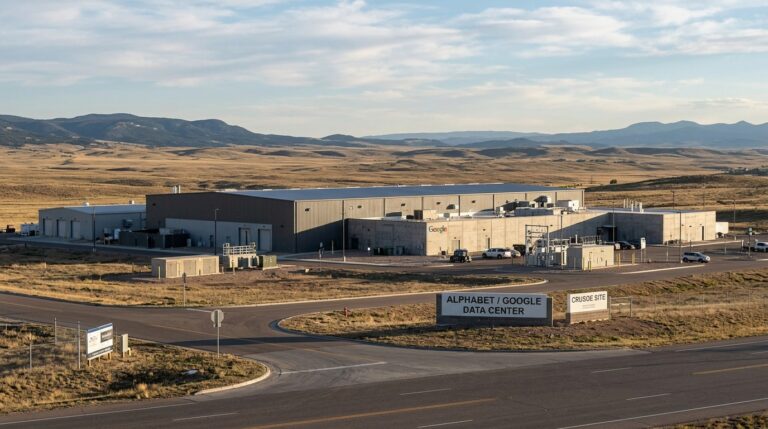
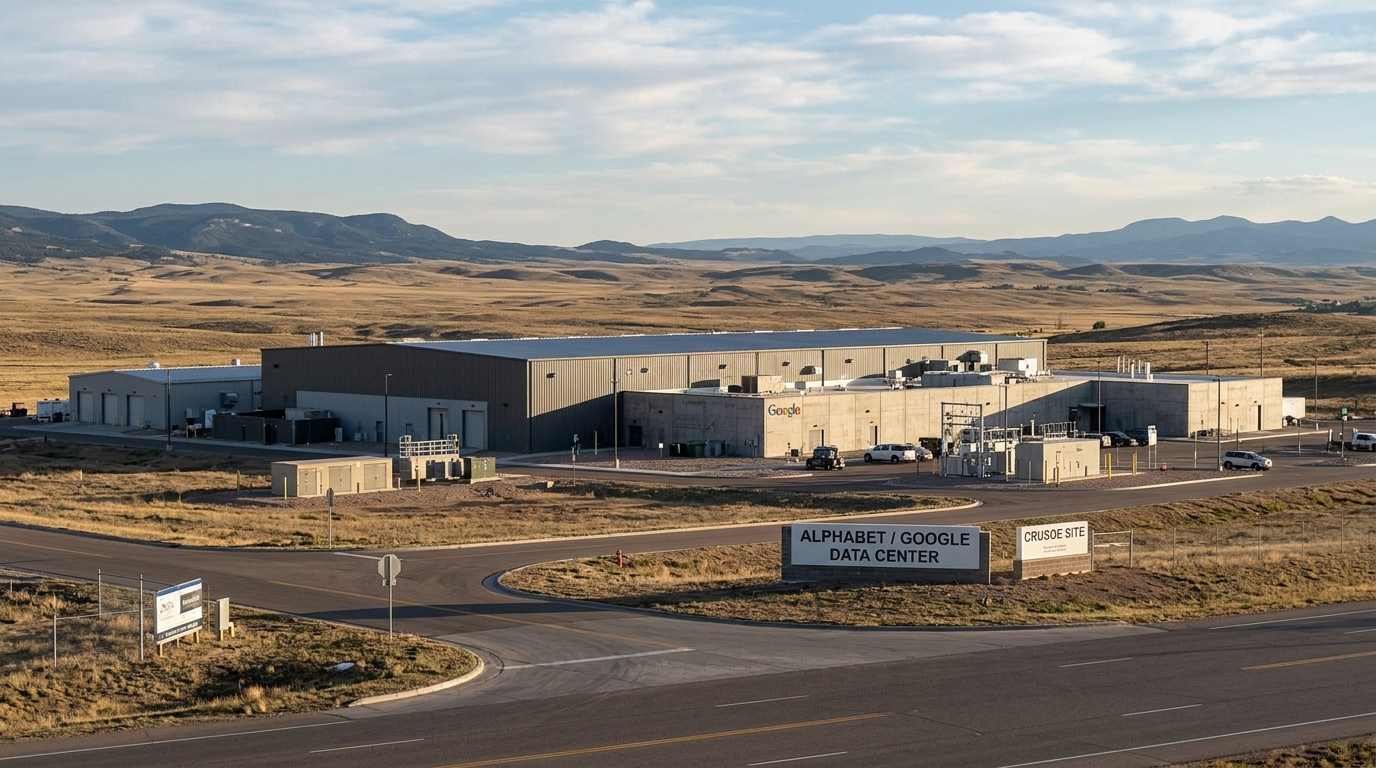
Google just answered that question loudly, in Laramie County, Wyoming.
What Actually Happened
Alphabet’s Google bought out Crusoe’s data center site in southeast Wyoming, opting to take on the project itself after the AI computing upstart failed to lock in customers. Google said it would be investing $17 billion on the site. That $17 billion is Google’s planned development spend, not the price paid to Crusoe.
Crusoe framed the transaction as the completion of its pre-development work on the Wyoming project, which included data center site selection, governmental approvals, and power strategy. The tidier version: Bloomberg reported Crusoe was pushed aside after failing to sign customers for the site.
Why Wall Street Cares
The timing matters. CoreWeave reports after the close on Tuesday, November 10, with its conference call at 5:00 PM ET. The consensus estimate for CoreWeave’s total revenues is about $3.5 billion, implying roughly 160% year-over-year growth. Explosive growth, but the structural argument underneath it just got more complicated.
CoreWeave’s value proposition rests on the assumption that hyperscalers will keep renting rather than owning. CoreWeave reported a revenue backlog of $99.4 billion as of March 31, 2026, to be delivered from 49 active data centers, and the company says it leases its data center spaces. The bear case has always been the same: the business model appears to be an extremely capital-intensive leasing operation, with NVIDIA maintaining a dominant position requiring upfront cash, so larger tech firms may use these providers to keep massive capex off their own balance sheets, shifting the depreciation and technical obsolescence risks entirely onto the neocloud.
Google just removed one Crusoe site from that equation. It could remove its own CoreWeave capacity next, or it could double down on rented compute for years. That is precisely the argument that makes Tuesday’s earnings call consequential beyond the revenue line.
The Bull Case
Crusoe, for its part, is not panicking. In September it raised $3.9 billion at a $30.9 billion valuation, and said the Wyoming setback did not stop it from pursuing other projects.
The bull case for CoreWeave is similar in structure. The company said its revenue backlog was approximately $104 billion as of June 30, 2026. And management told investors in August that returns from its spending were starting to show up in results, which was the first credible margin signal since the IPO.
What Investors Are Missing
The Wyoming deal exposes a distinction that rarely surfaces in earnings previews: a hyperscaler that rents compute is not the same counterparty as a hyperscaler that owns competing infrastructure. The same companies renting capacity are building their own, designing their own silicon to fill it, and are the neoclouds’ most creditworthy counterparties. That structural tension does not appear in CoreWeave’s backlog number. It appears in what a hyperscaler does the moment it decides Wyoming is cheaper to own than to rent.
CoreWeave’s comeback hinges on hitting a narrow profit window while interest expense climbs into the high hundreds of millions per quarter. At those leverage levels, any customer that internalizes demand rather than extends a lease does real damage to the model.
Stocks to Watch
CoreWeave (CRWV). The report tonight will be read differently than it would have been without Wyoming. Customer concentration and lease duration will matter more than revenue growth in the analyst questions.
Nebius (NBIS). Nebius confirms earnings on November 12, before the market opens. Nebius owns a growing share of its infrastructure, which is precisely the characteristic the Wyoming deal rewards. That differentiation is not yet fully priced.
Alphabet (GOOGL). Google is now a direct AI infrastructure owner in Wyoming, not just a cloud provider. That is a balance sheet commitment, but it is also a signal that the company has decided owning compute at scale beats the alternative.