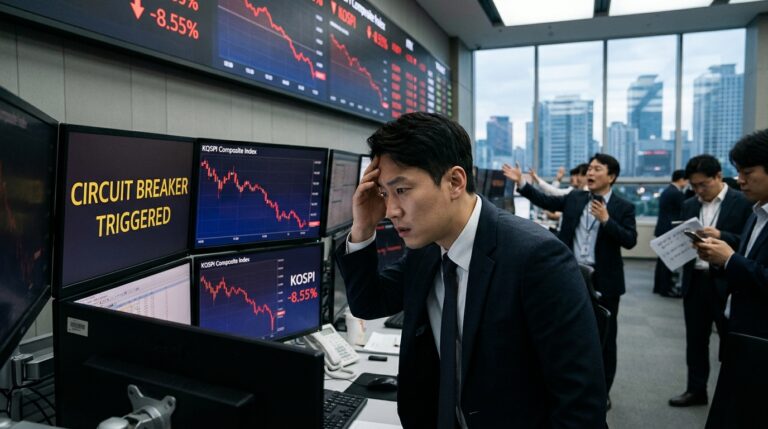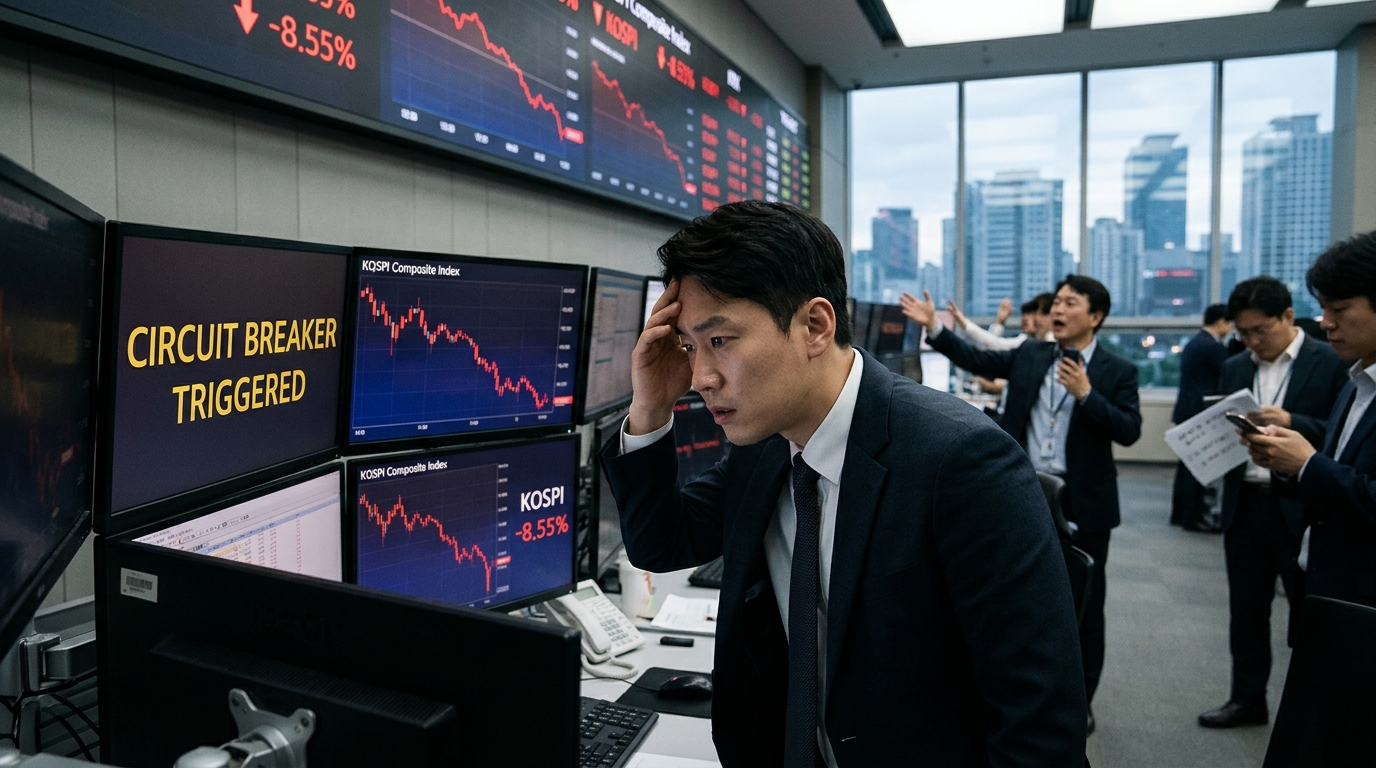
South Korea’s Kospi fell 8.55% in the first three minutes of Friday trading, broke below 5,000 for the first time since February, and forced the Korea Exchange to trigger a circuit breaker at 9:03 a.m. Seoul time. It was the 11th circuit breaker of 2026 and the 17th on record. The government called an emergency meeting before the session was an hour old.
The proximate cause was Wall Street. Global stocks extended a selloff on concerns that the Democrats’ decisive U.S. midterm election victory could lead to tighter AI industry regulations. The S&P 500 fell 4.4% Thursday, while the Philadelphia Semiconductor Index fell 3.13%. Those are American numbers. The Kospi absorbed them like a leveraged bet.
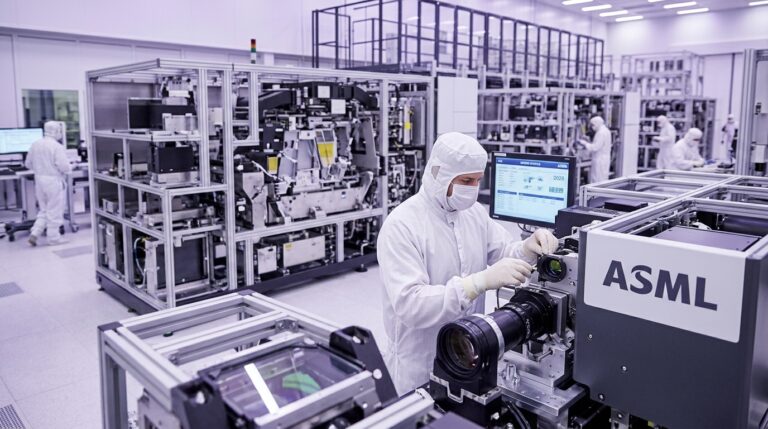
That is not a metaphor. Samsung Electronics and SK Hynix, the world’s two largest memory chip makers, account for more than half of the Kospi’s market value, and both supply high-bandwidth memory used in Nvidia’s AI processors. When fears about AI data-center spending spread across Wall Street, the two stocks did not fall alongside the index. They effectively dragged it. Samsung fell about 10% and SK Hynix about 11% in the first minutes of trading.
By the close, some ground had been recovered. The benchmark narrowed its decline to about 6.0%, finishing around 5,059.7 points. The partial recovery reflected afternoon intervention as authorities signaled support for orderly markets.
What Seoul Reached For
Finance and Economy Minister Lee Hyoung-il vowed to defend Korean stocks against excessive volatility, citing the country’s economic fundamentals as a line of defense. The initial emergency response was concrete. The government waived for three months a rule requiring securities firms to maintain collateral levels on margin loans, aiming to prevent a wave of forced stock sales. The exemption lets brokerages lower that threshold or delay forced sales, reducing the risk of compulsory selling into a falling market.
Market participants are watching whether authorities will roll out stronger measures, including activating the stock market stabilization fund and imposing a temporary ban on short selling, to curb short-term volatility. The stabilization fund is a mechanism in which financial companies and securities-related institutions pool capital to buy shares when prices plunge. But some market observers note that the immediate supply-demand effect may be limited, since the fund can only be activated after a stock decline persists beyond a certain level.
Short-selling restrictions have their own complications. A ban would satisfy retail investors who have long viewed foreign short sellers as the enemy, but it carries a cost Seoul has already paid before: MSCI has flagged South Korea’s short-selling accessibility as deteriorating, and developed-market index inclusion remains a standing ambition for the exchange.
Whether the Tools Work
The honest read is that official support buys time, not conviction. When the Kospi fell sharply in prior episodes, government intervention stabilized prices temporarily but did not change the underlying dynamic: an index whose behavior is determined by two balance sheets, not by broad economic diversification. The Kospi, with two stocks commanding over half its value, behaves more like a concentrated bet on two balance sheets than a diversified national benchmark.
On chip stocks, analysts note that valuations have fallen from recent peaks, but that a sustained rally would be difficult without buying support from foreign and institutional investors. Foreign investors were net sellers again on Friday.
The question Seoul cannot answer with a margin-collateral waiver is whether the AI regulation fears that drove Thursday’s Wall Street rout reflect a durable policy shift or a post-election overreaction. If Democrats move to constrain data-center construction or chip exports, the memory cycle thesis that underpins both Samsung and SK Hynix weakens materially. If the scare passes, the Kospi’s concentration becomes its recovery engine just as it was its vulnerability.
What to watch: any concrete signal from Washington on AI regulation scope, the weekly foreign investor flow data from the Korea Exchange, and whether Lee Hyoung-il announces a formal stabilization fund deployment or a short-selling restriction in the coming days. Those moves, more than the circuit breaker itself, will indicate how seriously Seoul reads this as structural rather than seasonal.