By Jonathan Landay
WASHINGTON (Reuters) – Two U.S. researchers say they have identified the probable deployment site in Russia of the 9M370 Burevestnik, a new nuclear-powered, nuclear-armed cruise missile touted by President Vladimir Putin as “invincible.”
Putin has said the weapon – dubbed the SSC-X-9 Skyfall by NATO – has an almost unlimited range and can evade U.S. missile defenses. But some Western experts dispute his claims and the Burevestnik’s strategic value, saying it will not add capabilities that Moscow does not already have and risks a radiation-spewing mishap.
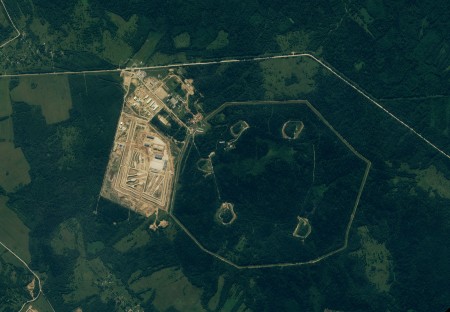
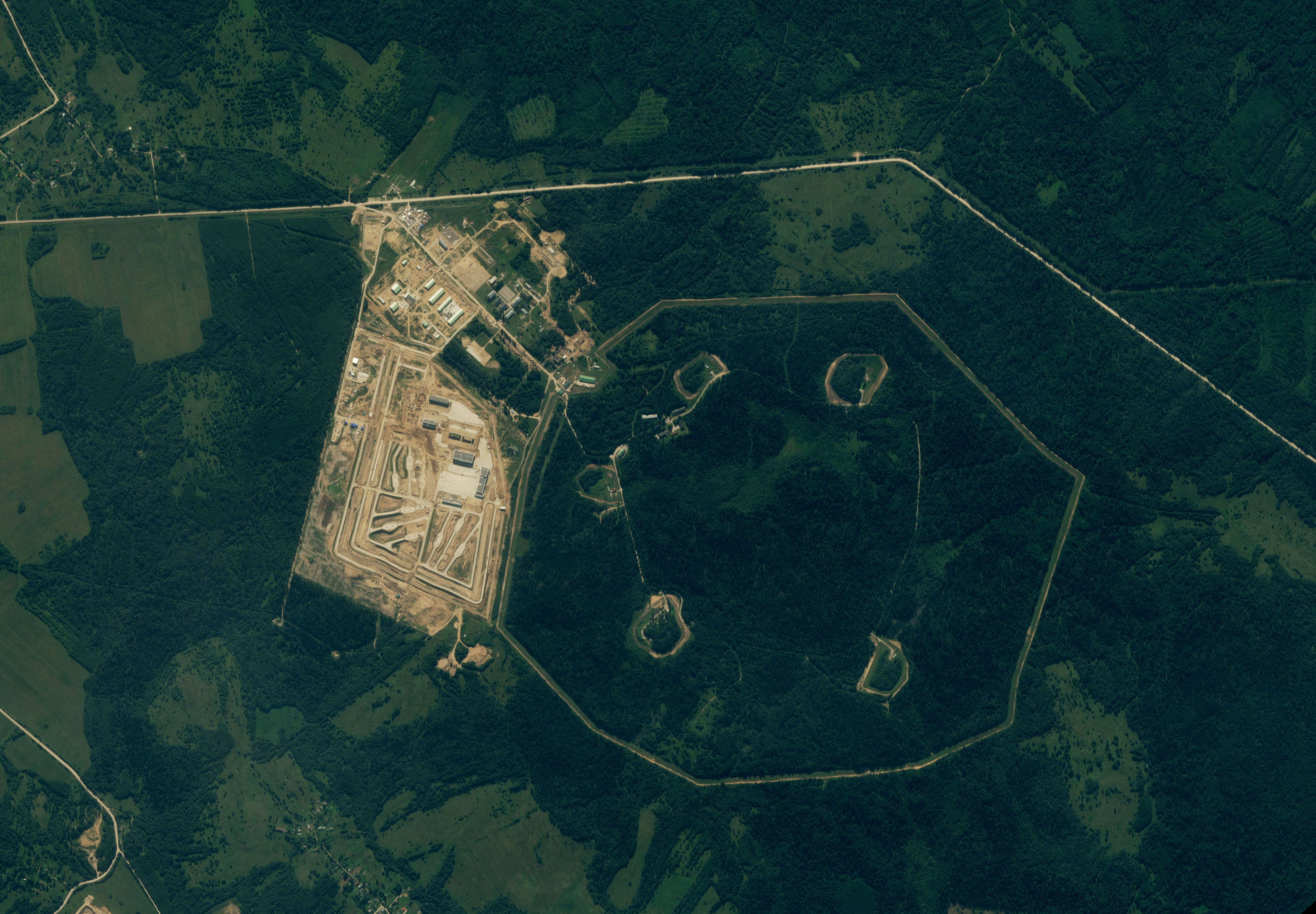
Using images taken on July 26 by Planet Labs, a commercial satellite firm, the two researchers identified a construction project abutting a nuclear warhead storage facility known by two names – Vologda-20 and Chebsara – as the new missile’s potential deployment site. The facility is 295 miles (475 km) north of Moscow.
Reuters is the first to report this development.
Decker Eveleth, an analyst with the CNA research and analysis organization, found the satellite imagery and identified what he assessed are nine horizontal launch pads under construction. They are located in three groups inside high berms to shield them from attack or to prevent an accidental blast in one from detonating missiles in the others, he said.
The berms are linked by roads to what Eveleth concluded are likely buildings where the missiles and their components would be serviced, and to the existing complex of five nuclear warhead storage bunkers.
The site is “for a large, fixed missile system and the only large, fixed missile system that they’re (Russia) currently developing is the Skyfall,” said Eveleth.
Russia’s defense ministry and Washington embassy did not respond to a request to comment on his assessment, Burevestnik’s strategic value, its test record and the risks it poses.
A Kremlin spokesman said these were questions for the defence ministry and declined further comment.
The U.S. State Department, the CIA, the Office of the Director of National Intelligence and the U.S. Air Force National Air and Space Intelligence Center declined to comment.
The identification of the missile’s probable launch site suggests that Russia is proceeding with its deployment after a series of tests in recent years marred by problems, said Eveleth and the second researcher, Jeffery Lewis, of the Middlebury Institute of International Studies at Monterey.
Lewis agreed with Eveleth’s assessment after reviewing the imagery at his request. The imagery “suggests something very unique, very different. And obviously, we know that Russia is developing this nuclear-powered missile,” he said.
Hans Kristensen of the Federation of American Scientists, who also studied the Vologda imagery at Eveleth’s request, said that it appears to show launch pads and other features “possibly” related to Burevestnik. But he said he could not make a definitive assessment because Moscow does not typically place missile launchers next to nuclear warhead storage.
Eveleth, Lewis, Kristensen and three other experts said Moscow’s normal practice has been stockpiling nuclear payloads for land-based missiles far from launch sites – except for those on its deployed Intercontinental Ballistic Missile (ICBM) force.
But deploying the Burevestnik at Vologda would allow the Russian military to stockpile the nuclear-armed missiles in its bunkers, making them available to launch quickly, said Lewis and Eveleth.
Deputy Foreign Minister Sergei Ryabkov said Russia will make changes to its guidelines on the use of nuclear weapons in response to what it regards as Western escalation in the war in Ukraine, state news agency TASS reported on Sunday.
POOR TEST RECORD
A 2020 report by the United States Air Force’s National Air and Space Intelligence Center said that if Russia successfully brought the Burevestnik into service, it would give Moscow a “unique weapon with intercontinental-range capability”.
But the weapon’s checkered past and design limitations raised doubts among eight experts interviewed by Reuters about whether its deployment would change the nuclear stakes for the West and other Russian foes.
The Burevestnik has a poor test record of at least 13 known tests, with only two partial successes, since 2016, according to the Nuclear Threat Initiative (NTI), an advocacy group focused on reducing nuclear, biological and emergent technology risks.
The setbacks include a 2019 blast during the botched recovery of an unshielded nuclear reactor allowed to “smolder” on the White Sea floor for a year following a prototype crash, according to State Department reports.
Russia’s state nuclear agency Rosatom said five staff members died during the testing of a rocket on Aug. 8. Putin presented their widows with top state awards, saying the weapon they were developing was without equal in the world, without naming the Burevestnik.
Pavel Podvig, a Geneva-based expert on Russia’s nuclear forces, Lewis, Eveleth, and other experts said it will not add capabilities that Moscow’s nuclear forces already do not have, including the ability to overwhelm U.S. missile defenses.
Moreover, its nuclear-powered engine threatens to disgorge radiation along its flight path and its deployment risks an accident that could contaminate the surrounding region, said Cheryl Rofer, a former U.S. nuclear weapons scientist and other experts.
“The Skyfall is a uniquely stupid weapon system, a flying Chernobyl that poses more threat to Russia than it does to other countries,” agreed Thomas Countryman, a former top State Department official with the Arms Control Association, referring to the 1986 nuclear plant disaster.
NATO did not respond to questions about how the alliance would respond to the weapon’s deployment.
Little publicly is known about the Burevestnik’s technical details.
Experts assess that it would be sent aloft by a small solid-fuel rocket to drive air into an engine containing a miniature nuclear reactor. Superheated and possibly radioactive air would be blasted out, providing forward thrust.
Putin unveiled it in March 2018, saying the missile would be “low flying,” with nearly unlimited range, an unpredictable flight path and “invincible” to current and future defenses.
Many experts are skeptical of Putin’s claims.
The Burevestnik, they say, could have a range of some 15,000 miles (23,000 km) – compared to more than 11,000 miles (17,700 km) for the Sarmat, Russia’s newest ICBM – while its subsonic speed would make it detectable.
“It’s going to be as vulnerable as any cruise missile,” said Kristensen. “The longer it flies, the more vulnerable it becomes because there is more time to track it. I don’t understand Putin’s motive here.”
The Burevestnik’s deployment is not banned by New START, the last U.S.-Russian accord limiting strategic nuclear weapon deployments, which expires in February 2026.
A provision allows Washington to request negotiations with Moscow on bringing the Burevestnik under the caps but a State Department spokesperson said no such talks had been sought.
Citing the war in Ukraine, Russia has spurned U.S. calls for unconditional talks on replacing New START, stoking fears of an all-out nuclear arms race when it expires.
Podvig said Moscow might use the missile as a bargaining chip if talks ever resume.
He called the Burevestnik a “political weapon” that Putin used to bolster his strongman image before his 2018 re-election and to telegraph to Washington that it cannot dismiss his concerns over U.S. missile defenses and other issues.
(Reporting by Jonathan Landay; Editing by Daniel Flynn)
About the Author