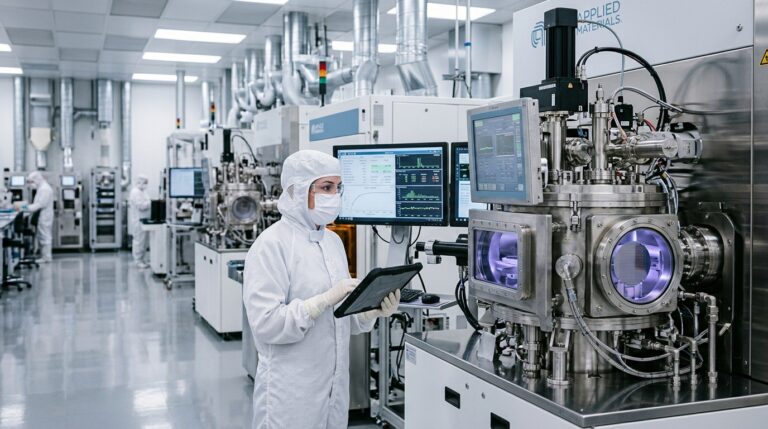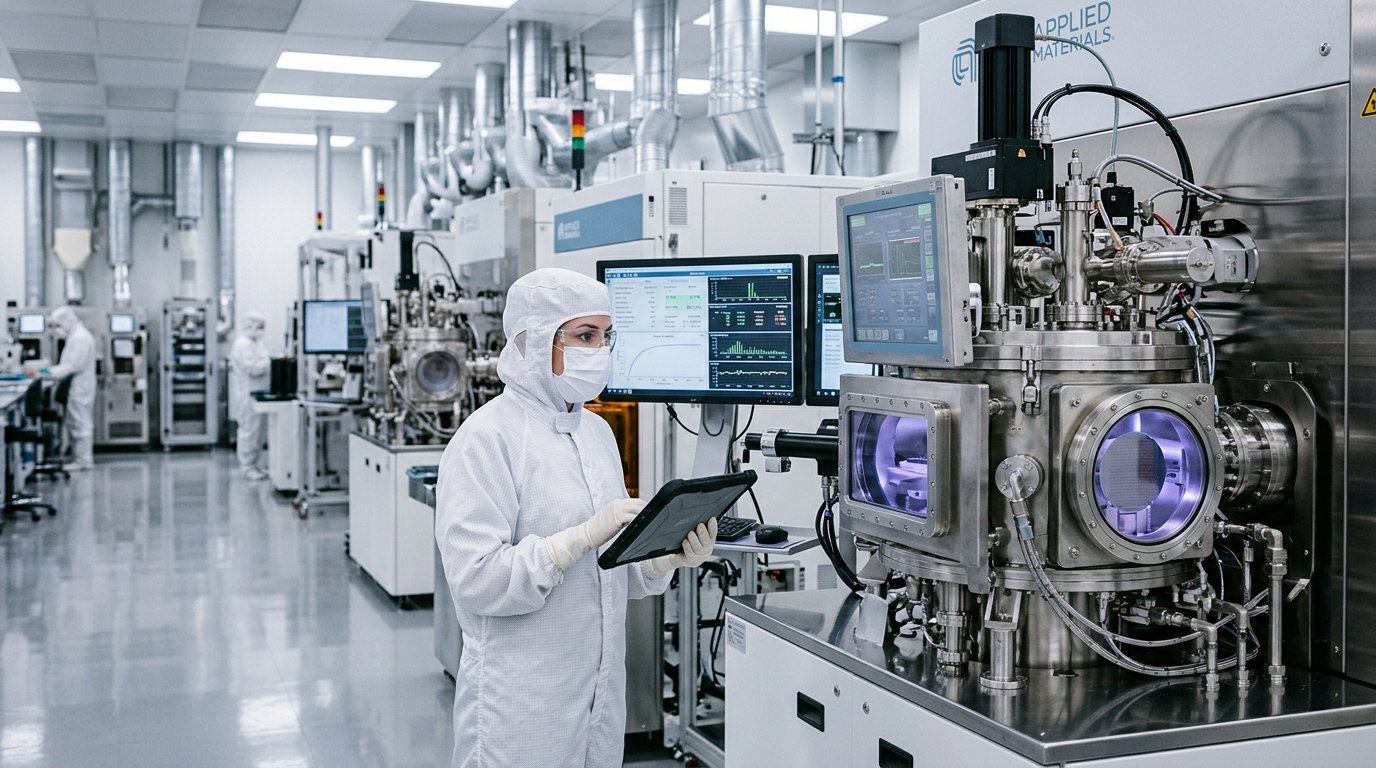
Here is what Applied Materials reported Thursday after the close: non-GAAP earnings of $4.16 a share on revenue of $10.41 billion, compared with forecasts for $4.06 a share and $10.30 billion. Revenue was up 53% year over year and 14% sequentially. The company generated record operating cash flow of $3.3 billion in the quarter. Management guided Q1 2027 to adjusted EPS of $4.35, plus or minus $0.20, on revenue of $11.10 billion, plus or minus $500 million. Analysts had expected $4.24 and $10.85 billion, respectively.
The stock closed down 3.58% at $380.95. Part of the pressure came from outside the company: Nvidia’s CEO exit weighed on chip stocks broadly that session, with Nvidia itself falling 4.3%. The numbers, though, were not ambiguous. This was Applied Materials at its best.
Why This Stock Matters Now
In the last year, Applied Materials shares hit a 52-week high of $739.67 and a 52-week low of $203.40. At Thursday’s close of $380.95, the stock is trading at roughly half its peak. Applied Materials has slumped into a bear market after falling more than 50% from its 52-week high, as concerns about the artificial intelligence industry have persisted. Those concerns look increasingly disconnected from what the company is actually delivering.
Analysts hold a Strong Buy consensus rating on AMAT, but published price targets vary widely depending on the source and timing. The point is not the exact number. It is that the Street still sees meaningful upside from here. That is not a rounding error. It is a gap worth understanding.
The Investment Thesis
Applied Materials is the dominant supplier of equipment used to fabricate semiconductors. When chipmakers spend on new capacity, the company collects. It is growing faster than the wafer fab equipment market because of leadership in leading-edge foundry logic, DRAM, and advanced packaging, the most enabling areas for AI computing and among the fastest-growing parts of wafer fab equipment in 2027.
The 2027 outlook is what separates Thursday’s report from a standard beat-and-raise. Management expects another record year with wafer fab equipment demand up more than 30% year over year, and Applied positioned to outperform the market again. CEO Gary Dickerson put the demand case plainly on the call: “Demand for advanced semiconductors remains much higher than supply, and multiyear investments in new fab capacity are needed for the industry to close this supply-demand gap,” he said, adding that customers are pressing the company to deliver equipment sooner.
The company is investing to double its systems output by 2028 and more than double manufacturing and lab capacity by 2030, supporting multi-year growth and customer demand. That is a capital commitment that signals management believes the demand cycle is structural, not cyclical.
The Risks
The bull case is not without friction. Supply chain constraints, including component shortages, are limiting Applied’s ability to fully meet demand, with Q1 revenue slightly impacted and inventory levels lower than desired. Clean room capacity remains a gating factor for industry growth, potentially constraining wafer fab equipment demand expansion beyond 2027.
China exposure is a persistent variable. CEO Gary Dickerson noted that ICAPS growth in 2027 will be much faster in non-China markets than in China, which signals the company is managing around export restrictions rather than depending on them easing. Any tightening of controls would pressure near-term numbers. Summit Insights downgraded AMAT to Hold from Buy following Thursday’s earnings report, a reminder that not every analyst is convinced the stock reflects the results.
What Investors Should Watch Next
Applied Materials is tracking more than 20 fab ramps and line expansions in 2027. The cadence of those ramps, combined with whether supply chain bottlenecks ease, will determine whether Q1 guidance of $11.1 billion becomes a floor or a ceiling. Watch semiconductor systems revenue specifically: Q4 semiconductor systems hit a record $8.0 billion. Sustaining those geographic and segment gains into 2027 is the clearest signal the thesis is tracking.
Bottom Line
Applied Materials just delivered the highest-dollar revenue growth in its history, beat on every metric that mattered, and guided above consensus for the next quarter, all while calling for a 30%-plus expansion in its addressable market in 2027. The stock is about half its high and trading at a discount to peers. The disconnect between the operating results and the share price is the story. At some point, one of those has to give.