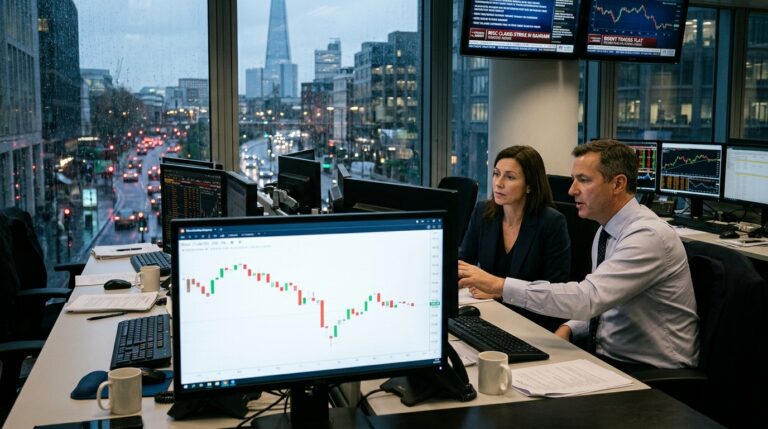
Wednesday was not the collapse it looked like at 9:45 a.m. The S&P 500 touched 6,970.11, the Nasdaq Composite bottomed at 22,632.40, and the Nasdaq 100 briefly sat about 20% below its record, brushing the technical definition of a bear market. By the close, the S&P had recovered to finish at 7,182.78, down about 0.3%. The Dow erased a 1,100-point deficit to close green at 50,182.95. The Nasdaq Composite ended at 23,585.80, off 0.6%.
That round trip is the whole story. Not because the dip-buying was definitive, but because of who bought the dip.
What the Breadth Reading Actually Says
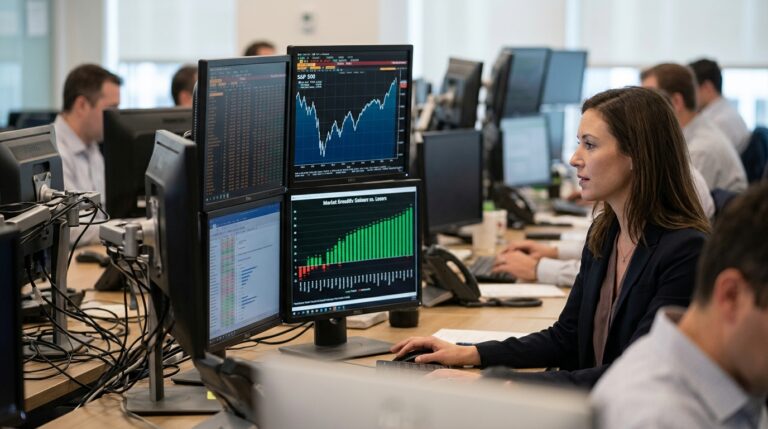
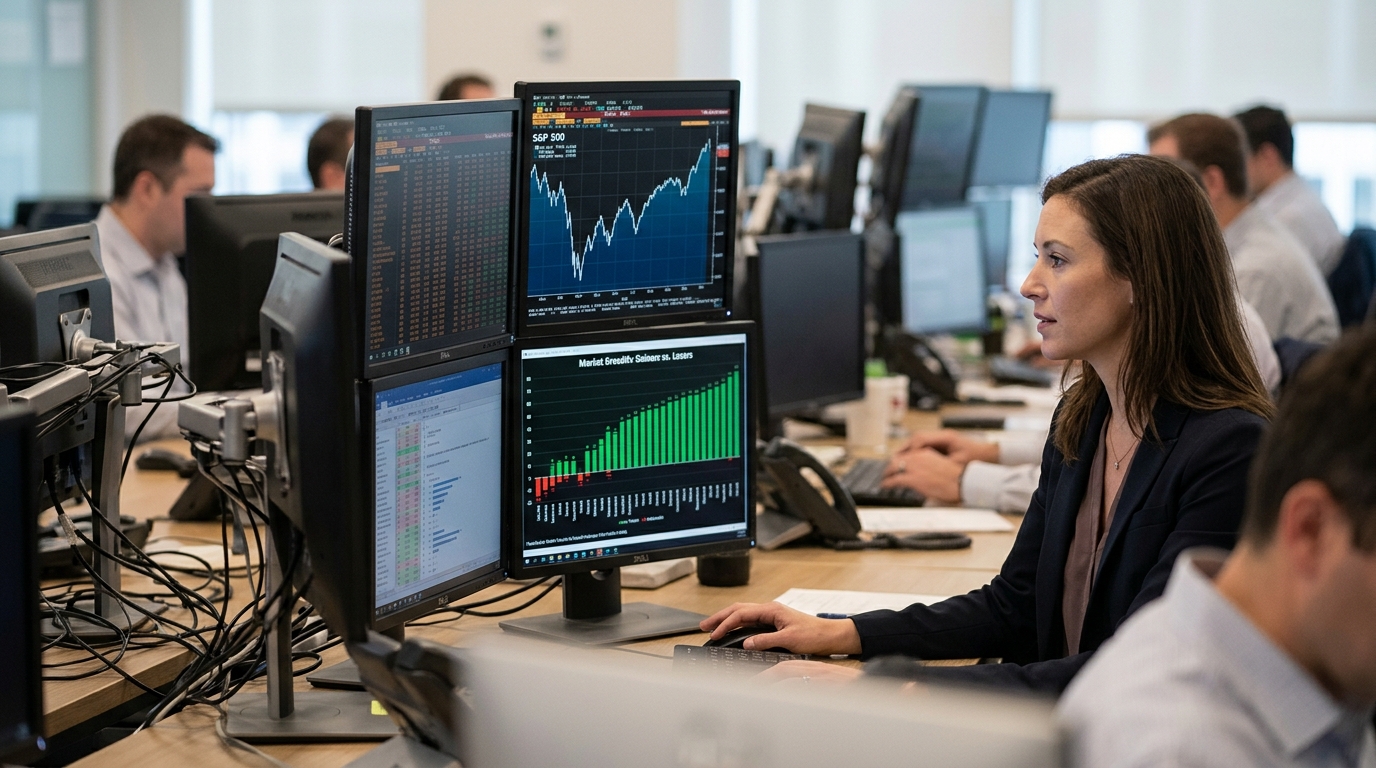
Advancers beat decliners 370 to 128 in the S&P 500 at the close. The index finished lower. That split matters. When a headline loss masks a majority of members closing green, the selling is concentrated, not broad. Wednesday’s concentrated seller was the AI and semiconductor complex. Eight AI-linked heavyweights cost the S&P 500 about 67 basis points, more than twice the index’s roughly 30-basis-point decline; gains across other sectors added back roughly 42 basis points.
Seven of the eleven S&P 500 sectors rose on Wednesday, but the specific sector leaderboard was not as clean as the early tape suggested. Materials and real estate were leaders, while technology was the main drag.
While consumer staples and utilities attracted buying, the relative strength developing in materials, industrials, and homebuilders suggests this rotation is not exclusively defensive. That is the more important signal. Defensive hiding is a risk-off posture. Homebuilders and materials in the green, alongside a Russell 2000 that closed up 0.71%, points to something else entirely.
The Catalyst and the Chip Problem
The sell-off deepened as investor anxiety about the sustainability of the AI boom collided with fresh concerns about new tariffs from President Donald Trump and interest-rate risks. The Trump administration proposed fresh tariffs on imports from 14 trading partners, including India, China, and the European Union, following investigations into excess manufacturing capacity. Nvidia closed down 3.91% after being down more than 9% earlier in the session. The Philadelphia Semiconductor Index fell sharply intraday before recovering to finish modestly lower.
The Nasdaq 100 fell as much as 4.7% early and closed down about 0.6%, with no single headline explaining the turn. With the VIX near 28, a 2% daily move is normal, and systematic buyers will not return until volatility settles.
VIX at 28: The Honest Risk Assessment
The VIX peaked at 34.95 early and closed at 28.29, still above recent averages. That spread between spot VIX and the back end of the curve matters. VIX futures remain in backwardation, a condition in which near-term contracts trade above later-dated ones, signaling much greater concern about risk in the coming weeks than further out.
VIX at 28 is not a green light. But context matters: a VIX near 30 is often closer to a stock-market bottom than the start of a bigger decline, but the consequences of being wrong are pretty severe here. That tension is the actual trading environment entering Friday’s half session.
The Plan Into a Thin Friday
The recovery was real but not a reversal: over the three sessions since Friday the indexes are still up, with the S&P 500 gaining 3.94%, the Nasdaq Composite 4.28%, and the Dow 4.23%. The selling started in tariff headlines and never left the AI complex.
The highest-conviction read from Wednesday is that capital rotated into cyclicals and small caps rather than hiding in bonds and staples. Homebuilders jumped as Treasury yields fell and new-home sales topped expectations. The S&P 500 equal-weighted index ended higher.
Going into Friday’s shortened session, the levels that matter are straightforward. A break in the S&P 500 below Wednesday’s 6,970.11 low would signal that dip-buying has failed. A VIX rally back above 34.95 would signal stress returning. Both need to hold for the rotation trade to remain valid.
Add risk selectively where breadth already confirmed it: materials, industrials, homebuilders, and small caps. Keep position sizes tight until the VIX drops sustainably below 25. The AI complex is not the place to build new longs yet, it is where discipline gets tested.