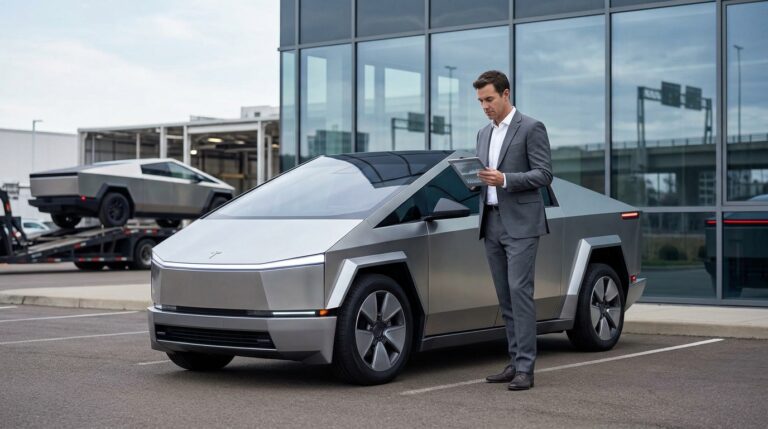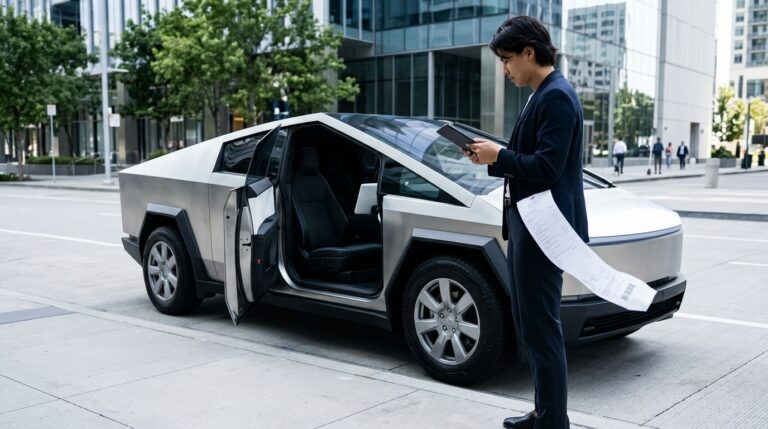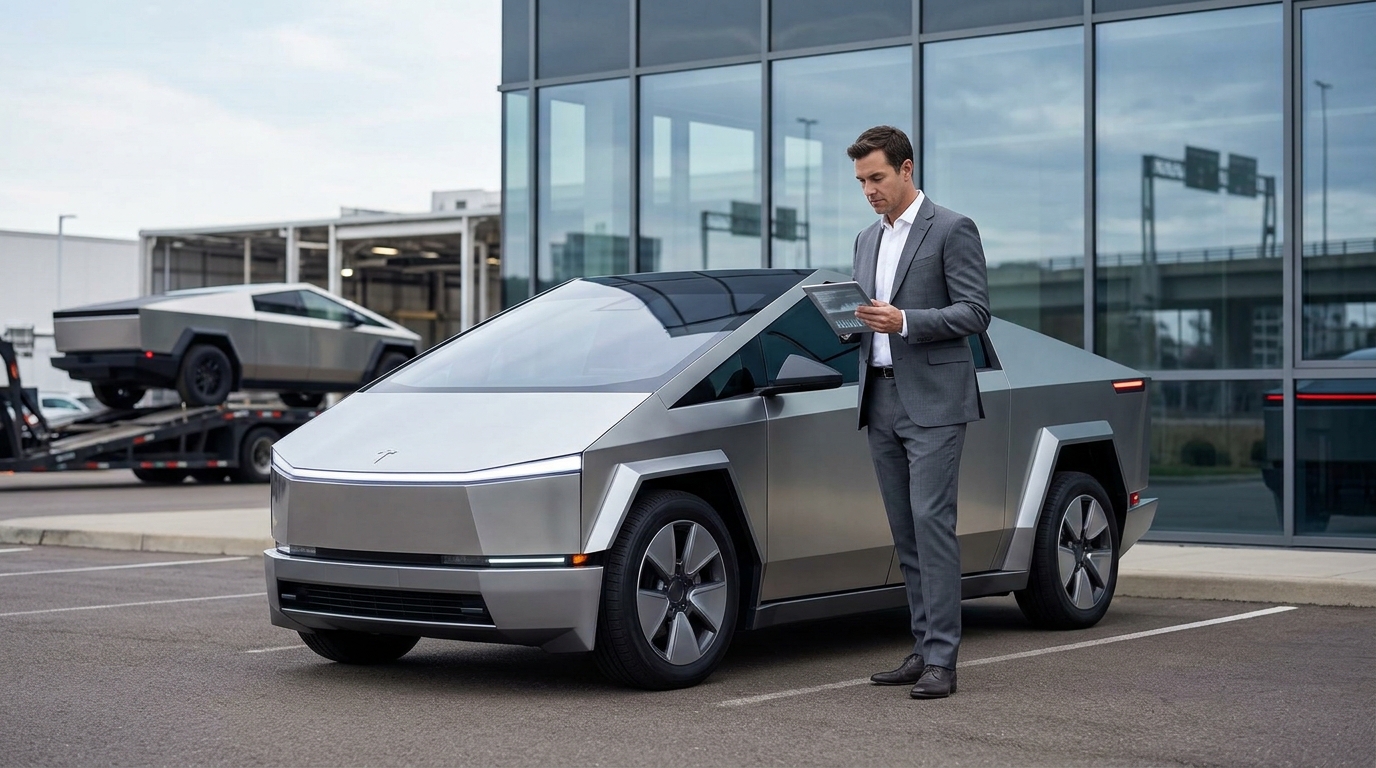
Tesla opened Cybercab orders to select individual customers on November 13, priced at $29,990 before taxes. The number sounds reasonable until you read the fine print. At $299 per month, the subscription adds $3,588 a year to the cost of ownership after the introductory period, on top of the vehicle’s purchase price. And unlike a software upgrade you can decline, the vehicle’s usability depends entirely on an active Autonomy Subscription because it has no steering wheel. Cancelling won’t downgrade it to a normal car; it means it can’t operate as a road vehicle.
That is the investment thesis in one sentence: Tesla is not selling a car. It is selling a hardware key to a software service it controls indefinitely. For bulls, that is recurring revenue at scale. For skeptics, it is a $30,000 subscription trap with wheels.
What You Actually Get
The Cybercab only works inside Tesla’s Robotaxi service areas in Texas and Florida, and Tesla’s own Robotaxi Support page currently lists service in limited areas of four Texas metros (Austin, Dallas, Fort Worth, and Houston) and three Florida metros (Miami, Orlando, and Tampa). Live anywhere else and the car is a very expensive paperweight. Even inside those cities, independent tracker Koby Pierce tested thousands of addresses in the Robotaxi app and found that the areas where Tesla actually accepts pickups and drop-offs are only 59% to 78% of the advertised geofences in the cities he checked.
Musk acknowledged on X that the $299 fee is too high almost immediately after launch. He said the monthly fee should match the cost of FSD and Premium Connectivity on other Teslas, which he pegged at about $115 per month. That is a CEO publicly undercutting his own product pricing within 24 hours of opening orders. It is either a signal that the subscription will come down, or evidence that the launch price was set without the CEO’s sign-off.
The Cybertruck Problem
Simultaneous with Cybercab orders opening, Musk confirmed the Cybertruck’s end. He announced on X that Tesla plans to start winding down Cybertruck production at Gigafactory Texas around mid-2027 to make room for increased Cybercab production. The truck will have been on sale for only about three and a half years when production winds down, a remarkably short run for a vehicle that required years of delays and significant capital to bring to market.
The sales history is worth confronting directly. Tesla sold 20,237 Cybertrucks in the US in 2025, down 48% from 38,965 in 2024, according to Kelley Blue Book estimates cited by outlets including CBS News. Around the start of production, Musk had predicted annual sales of roughly 250,000. That gap between promise and delivery is not a minor footnote. It is the core question any investor in TSLA must answer: how much weight should a $1.54 trillion valuation place on Musk’s forward projections when the most recent major product missed its volume target by roughly 92%?
Why the Bull Case Still Has Legs
The bear case above is real, but incomplete. Tesla has said its next-generation manufacturing approach is designed to dramatically increase output, and Musk has suggested Cybercab could eventually become Tesla’s highest-volume vehicle. If the autonomy subscription falls closer to $115 and geographic coverage expands with regulatory approval, the unit economics improve sharply.
At $299 per month, the subscription is significantly higher than the $99 per month Tesla owners currently pay for the Full Self-Driving subscription, and could offer a clue to how Tesla might price a higher-autonomy tier for existing vehicle owners if and when that arrives. That optionality across the existing Tesla fleet is the larger prize, and it doesn’t depend on Cybercab volumes alone.
The Bottom Line
TSLA trades around $390, carrying a trailing price-to-earnings ratio above 420. The stock has already priced in a future where autonomous vehicles generate software-margin revenue at scale. The Cybercab launch is the first real-world test of that model, and it arrives with meaningful constraints: current Robotaxi service listed across seven metros, geofences smaller than advertised, a subscription the CEO himself says is priced too high, and a $1,000 non-refundable deposit required to participate.
Tesla deserves a place on every autonomy-focused investor’s list. It does not yet deserve uncritical confidence in every figure attached to its roadmap. The Cybertruck’s trajectory from roughly 250,000 annual units in Musk’s projections to a wind-down plan in under four years is a useful calibration. Own the thesis, but price in the execution risk.